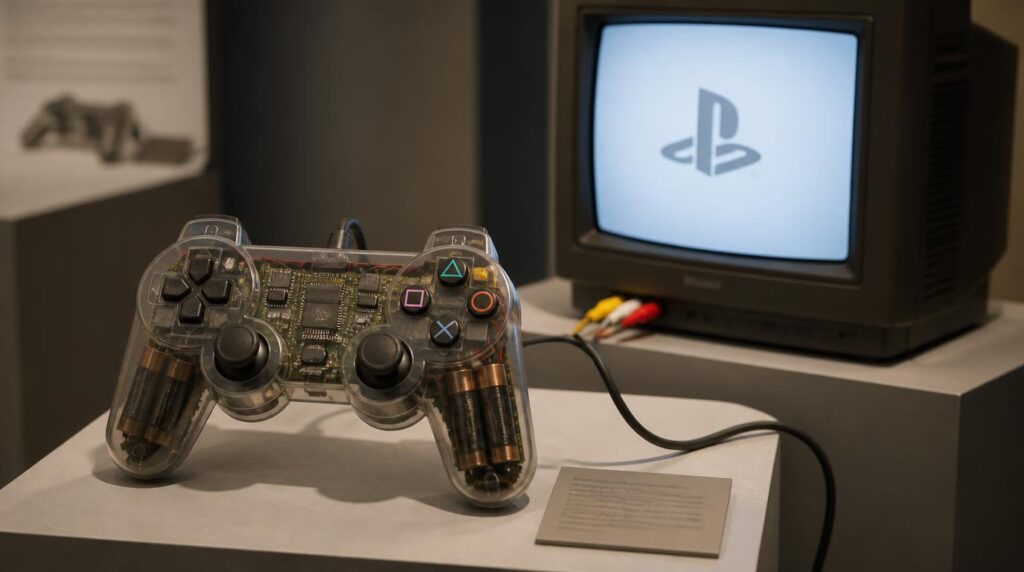
No screen, no disc drive, no separate console box. Just a controller, a memory card slot, and a composite jack aimed straight at the back of a television. Watson worked on PS1 and PS2 emulation during his time at Sony, and the PUGA was one of the projects that never made it past his workbench — until a museum talk decades later pulled it back into daylight.
01 Built for a Market Sony Couldn’t Reach Normally
The PUGA wasn’t designed for a global launch. It was designed for one country: Brazil, where import tariffs on consoles were steep enough that official PlayStation hardware struggled against a thriving grey market. Consoles that did arrive often moved through unofficial channels rather than retail shelves, and Sony was watching a huge audience of players access its own catalog through routes the company saw none of the revenue from.
The fix wasn’t a cheaper import — it was a device that never needed importing in the first place. Manufacture the PUGA locally in Brazil, and the same tariff walls that were shutting out standard consoles simply stopped applying. It’s the same playbook Sega used decades earlier when it partnered with Samsung to build Mega Drive and Master System units inside South Korea to dodge Japanese import restrictions — a company whose later hardware bets, including the underappreciated run of Dreamcast titles, still get revisited by collectors today. Sony wasn’t inventing a new strategy; it was applying an old one to a controller-shaped PlayStation.
Keeping the unit cheap to build was the whole point, and that single constraint quietly shaped every decision that followed — from the chip Sony picked to the games it planned to preload, the kind of trade-off that shows up constantly in console hardware built around a specific region’s economics rather than a worldwide spec sheet. It’s also the same economic pressure that keeps a whole secondary market alive around retro game resellers and collectors today.
02 What Was Actually Inside the Controller
This wasn’t a re-housed PS1 motherboard. The PUGA ran the original console’s game library through software emulation on mobile-class hardware — a genuinely different engineering problem from just shrinking the original chipset.
A molded composite cable was the only display option on the table — no HDMI, no digital signal chain, just a direct analog feed to whatever TV was in the room. It’s a world away from the display considerations that matter for modern gaming monitor shopping, but for a plug-and-play device meant to reach households that might not have a modern set at all, composite was the pragmatic, universal choice.
The OMAP 3530 was a chip built for phones and early tablets, not consoles — which is exactly why it worked here. Running PS1 titles through emulation on that silicon, inside a controller shell, on battery power, for up to 20 hours, meant Sony’s engineers had to hit a level of power efficiency that native PS1 hardware from 1994 was never designed for. The DualShock form factor added its own constraint: there was no room for a bulky heatsink or a large battery bay, so the whole software stack had to run lean enough not to cook itself in someone’s hands.
It’s the same category of problem that shows up any time a studio tries to push more performance out of a small, fixed power budget — the kind of optimization work covered in guides on trimming draw calls for mobile and VR hardware, just applied to an emulator instead of a modern game engine.
According to Watson, the engineering side of the PUGA actually worked. The prototype he brought to the museum booted, ran its library, and functioned as intended — right up until Sony pulled the plug on the business side instead.
03 The Ten-Cent Number That Killed It
Hardware wasn’t the problem. Money was.
-
01
The price point came first To stay competitive against the grey market, the PUGA had to sell cheap — and that ceiling was set before a single licensing conversation started.
-
02
Royalties got squeezed to fit Sony’s offer to third-party publishers for each preloaded game landed around 10 cents per unit sold — a figure the low retail price left little room to raise.
-
03
Publishers said no Ten cents a copy didn’t come close to what studios expected for licensing their PS1-era catalog, and negotiations stalled game by game.
-
04
Sony’s own divisions couldn’t agree either Watson described friction not just with outside publishers but between internal Sony groups over how licensing revenue would even be split.
-
05
No confirmed library, no product Without a locked-in list of ten playable games, there was nothing to preload onto the memory card — and the project had nowhere left to go. It’s the flip side of arguments made in favor of why physical PlayStation games still matter: a license, once secured, tends to stay usable far longer than the deal that got it there.
“Yes, it’s a PlayStation controller, but it’s a PlayStation controller with PS1 inside of it.”
— Brian “Biscuit” Watson, on stage at The Retro Collective
Watson has said the cancellation hit hard enough that he nearly left Sony over it — the first major project of his career to get shelved after the hard engineering problems were already solved. It’s a familiar shape for anyone who’s watched a console’s fate get decided by a spreadsheet rather than a lab bench, a tension that runs through pieces on how licensing terms can quietly control what PlayStation owners actually get to keep.
Today, the surviving PUGA prototype doesn’t even boot into its game library anymore. It’s stuck on a debug screen, and the software needed to get it out of that mode is long gone.
04 The Emulator Outlived the Console
Cancelled projects don’t always disappear completely, and the PUGA’s most interesting afterlife has nothing to do with Brazil at all. The emulation software Sony’s engineers built to run PS1 games on ARM hardware inside a controller didn’t get thrown away — it got reused.
PUGA (2000s, unreleased)
PS1 emulator built for a TI OMAP ARM chip, running on batteries inside a controller shell, targeting a Brazil-only retail launch that never happened.
Xperia Play (2011, shipped)
Sony’s PlayStation-branded Android phone leaned on the same PS1-on-ARM emulation lineage to bring classic titles to a mainstream mobile device.
That’s the quieter story underneath the headline: the licensing fight killed a product, not the code behind it. The same ARM-based emulation groundwork that couldn’t clear Sony’s business hurdles for a $20 Brazilian plug-and-play device found a second life once it was attached to a phone with a broader commercial case behind it. It’s a pattern that shows up across gaming hardware more than people assume — official and community emulation projects both tend to survive the platforms they were originally built for, and today’s retro consoles with built-in game libraries essentially ship the PUGA’s original pitch as a mainstream product category.
It also lines up with a broader shift in how PS1-era games get preserved and replayed today. Between official re-releases, ARM-powered handhelds, and community emulation scenes, the appetite for that library hasn’t gone anywhere — you can see the same demand reflected in retrospectives on the PS2 library that followed the PS1 generation, in guides to genre-specific PS2 favorites like its racing catalog and its shooters and stealth games, and in roundups of underrated PS2 games still worth tracking down. That secondary market exists precisely because devices like the PUGA never got to fill this demand officially in the first place.
05 What the PUGA Says About Building Retro Hardware Today
The PUGA sits in a lineage that stretches well past Sony. Plug-and-play micro-consoles, official mini-console reissues, and DIY emulation handhelds are all chasing a version of the same idea: package an old library into cheap, self-contained hardware. What the PUGA proves is that the engineering side of that idea has been solvable for a long time — it was the business side, not the silicon, that decided whether it ever reached a store shelf.
- Efficient emulation beats native reproduction. Running PS1 games well on a phone-grade ARM chip on battery power was a harder, more transferable achievement than physically shrinking original hardware would have been — the same principle that keeps Raspberry Pi retro-gaming builds popular today.
- Regional constraints are a legitimate design input. Import tariffs and grey-market pricing shaped the PUGA’s chip choice, battery target, and game count just as much as any spec sheet did.
- Licensing has to be scoped before engineering locks in. A confirmed, cleared library at a workable royalty rate needed to exist before the hardware price point was finalized — not after.
- R&D that gets shelved isn’t necessarily wasted. Code, tooling, and hard-won efficiency work can resurface years later on a completely different product, the way the PUGA’s emulator did on the Xperia Play.
None of this is unique to Sony or to the PS1 era. The same tension between what’s technically buildable and what’s commercially clearable runs through the history of console emulation generally, from cartridge-based hardware clones of the SNES generation onward.
For anyone who grew up importing a console the hard way, or who’s spent time inside the modern retro-handheld and preservation scene, the PUGA is a reminder that some of the most interesting PlayStation hardware never had a launch date at all — it’s still sitting in a drawer, or on a museum stage, running a debug screen with nowhere left to go.
FAQ Common Questions About the PlayStation PUGA
What was the PlayStation PUGA?
The PlayStation PUGA was an unreleased Sony prototype that packed a full, self-contained PS1 emulator inside a DualShock-style controller. It connected directly to a TV over composite video and required no separate console box, running off four AA batteries.
Why was the PUGA made specifically for Brazil?
Brazil’s import tariffs made official PlayStation consoles expensive and pushed a lot of demand toward the grey market. Manufacturing the PUGA locally inside Brazil would have sidestepped those import restrictions entirely, similar to how other manufacturers localized production to dodge tariffs in the past.
What hardware powered the PlayStation PUGA?
A TI OMAP 3530 system-on-chip with an ARM CPU running around 650 MHz, paired with roughly 4 GB of flash storage for about ten preloaded PS1 games, running on four AA batteries for up to 20 hours.
Why was the PlayStation PUGA cancelled?
Not because of the hardware — because of licensing. Sony’s planned royalty offer to third-party publishers worked out to around 10 cents per unit sold, which publishers wouldn’t accept, and internal Sony divisions couldn’t agree on revenue splits either. Without a confirmed, cleared game library, the project stalled out.
Does the PlayStation PUGA still work today?
According to Brian “Biscuit” Watson, the surviving prototype no longer boots into its game library. It’s stuck on a debug screen, and the software required to exit debug mode has been lost.
Did any of the PUGA’s technology make it into a real product?
Yes. The PS1 emulator originally developed for the PUGA later formed the basis of PS1 emulation on the Sony Xperia Play, the PlayStation-branded Android phone released in 2011.