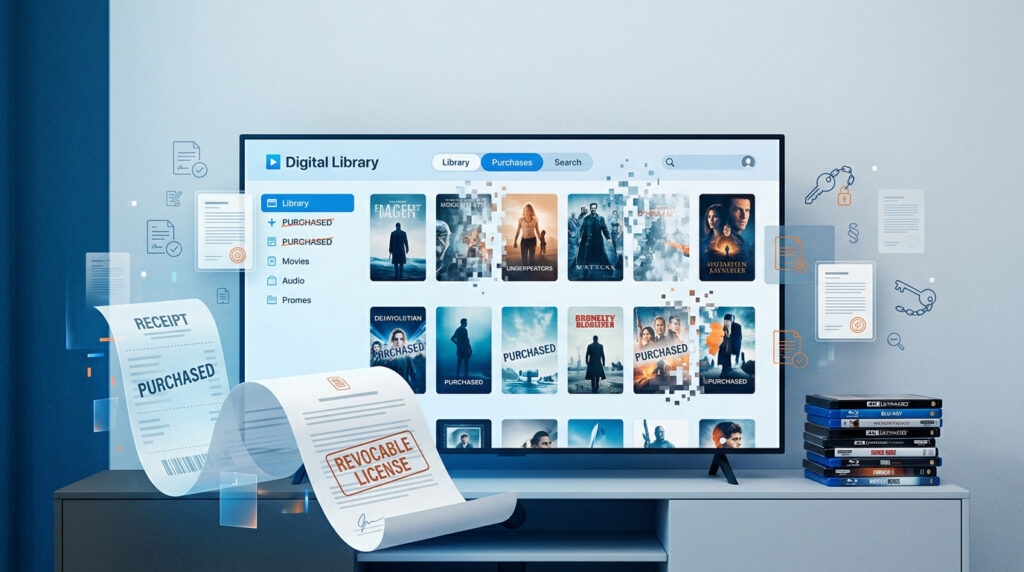
When you click “buy” on a movie in the PlayStation Store, the receipt says purchase. The fine print says something else entirely. What you’re actually acquiring is a revocable license — a conditional right to stream or download a file, granted for as long as Sony’s own deal with the studio that owns it stays in force. When that underlying deal lapses, so does your access, refund or no refund.
This isn’t a hypothetical. Sony has already pulled purchased content from PlayStation libraries twice in recent years — once quietly, once loudly enough that it had to reverse course. Both cases expose the same uncomfortable truth about PlayStation Video library licensing agreements: the button that says “buy” was never selling you a copy of the film. It was selling you access, on Sony’s terms, for as long as Sony’s licensors allow it.
High-Profile Cases: When PlayStation Video Libraries Disappeared
Two incidents, three years apart, illustrate exactly how fragile a digital movie “purchase” can be — and how much depends on licensing arrangements the customer never sees.
The StudioCanal Incident (2022)
In mid-2022, Sony quietly posted a notice on the German and Austrian PlayStation Store pages: due to “evolving licensing agreements,” previously purchased StudioCanal titles would be stripped from customers’ libraries at the end of August. No replacement content was offered, and no refund process was detailed for buyers who had paid full price for films they could no longer watch.
The affected catalog included major titles distributed through StudioCanal and Lionsgate, from the John Wick and Saw franchises to Paddington and The Hunger Games. The likely trigger was StudioCanal pulling its library back in-house to feed its own European video-on-demand service — a reminder that a removal doesn’t require any wrongdoing on the buyer’s part. A distributor simply deciding to redirect its content elsewhere is enough to erase a purchase.
The Discovery / Warner Bros. Controversy (2023)
A far bigger scare followed in December 2023. Sony informed PlayStation Store customers that, effective December 31, all previously purchased Discovery content deleted from PlayStation libraries would become permanent — regardless of what customers had paid. The scope was enormous: more than 100 individual Discovery series, adding up to over 1,300 seasons of television, were on the chopping block.
Public backlash was immediate and loud enough that Sony reversed the decision within roughly three weeks. On December 21, 2023, PlayStation announced it had renegotiated with Warner Bros. Discovery, guaranteeing access to purchased content for “at least the next 30 months.” That phrasing matters: it’s a reprieve, not a permanent guarantee. The same titles could legally disappear again once that window closes, likely around 2027.
Unpacking the Fine Print: What the PlayStation Terms of Service Say
Content Licenses vs. Ownership
Physical media — a 4K UHD disc or Blu-ray — transfers a tangible copy to the buyer under long-established first-sale doctrine principles. Once you own the disc, no distributor can reach into your living room and take it back. Digital storefronts operate on an entirely different legal model. What Sony sells through PlayStation Video is a content license: permission to access a file hosted and controlled by Sony, itself licensed from a studio or distributor, for a duration tied to that upstream deal.
The “Revocable License” Clause
Sony has stated plainly that it does not own the licensing rights to the TV and movie content sold through its own store — it’s simply the middleman passing along a temporary right of access. That single sentence is the entire legal foundation for both the StudioCanal and Discovery removals, and it’s why the question “do you own digital movies on PlayStation” has a clear, if unwelcome, answer: no, not in any sense that survives a licensing dispute.
It’s also worth separating two different events that get conflated. Sony shut down new movie and TV purchases and rentals on PlayStation Store back in August 2021 — that storefront is closed for good. What’s happening now is different: it’s the ongoing renewal (or non-renewal) of licenses covering content people bought before that shutdown, which is why libraries built years ago can still lose titles today.
The Future of Digital Ownership vs. Physical Media
Laid side by side, the trade-offs between formats become hard to ignore.
| Feature | PlayStation Digital Purchases | Physical Media (4K UHD / Blu-ray) | Subscription Streaming (Netflix / PS Plus) |
|---|---|---|---|
| Ownership permanent? | No — license-based, revocable | Yes — physical copy owned outright | No — access only while subscribed |
| Internet required? | Yes, for activation and streaming/download | No — plays offline on any compatible device | Yes, for streaming; most titles can’t be downloaded permanently |
| Revocation risk | High — tied to third-party licensing deals | None — no distributor can retrieve the disc | High — titles rotate in and out constantly |
| Resale value | None — licenses are non-transferable | Yes — discs can be resold or lent | Not applicable — no purchase to resell |
None of this makes digital purchases worthless — for convenience, cross-device access, and instant playback, they’re hard to beat. But framing them as “ownership” misleads buyers about what they’re actually paying for, and that gap between marketing language and legal reality is exactly what fuels renewed interest in physical media on PlayStation hardware, even in an era of digital-first storefronts.
How Consumers Can Protect Their Media Libraries
- Back up what’s legally accessible. Where downloads are permitted rather than stream-only, keep local copies on a drive you control — don’t rely solely on a cloud library that can be edited without your input.
- Prioritize physical media for titles you actually care about. A 4K disc collection can’t be revised by a licensing dispute three years after purchase, unlike a digital library.
- Read the content licensing notices, not just the purchase confirmation. Sony posts removal warnings on its legal and store pages well before deadlines — StudioCanal and Discovery buyers who caught those notices early had more time to react.
- Compare before buying. If a title is also available through a subscription library or games-and-media bundle, weigh whether a one-time “purchase” price is actually buying you anything more durable than a subscription would.
- Support digital consumer protection legislation. Laws requiring platforms to clearly disclose that a “buy” button sells a license, not permanent ownership, are gaining traction and directly respond to cases like these.
The Bottom Line
Sony isn’t unique here — every major digital storefront operates on licensed access rather than transferred ownership. But the StudioCanal and Discovery incidents make the stakes concrete: hundreds of purchased titles vanished overnight in one case, and well over a thousand seasons of television nearly vanished in the other, saved only by public pressure rather than any built-in consumer guarantee. Until digital ownership rights are clearly labeled at the point of sale, the safest assumption for any buyer is that a digital “purchase” is a lease with an undefined end date.