The Nintendo GameCube’s IBM Gekko CPU ran at 485 MHz with a 162 MHz GPU — modest numbers that somehow produced a library still worth playing today, often without any modification. While PlayStation 2’s texture-heavy photorealism now looks like digital archaeology, many GameCube titles hold up not despite their technical constraints but because of them.
This isn’t a nostalgia piece. It’s a technical reckoning. The question isn’t whether you remember these games fondly — it’s whether the underlying art direction and engine architecture can survive being pushed through a 4K display in 2026. Spoiler: the ones built on geometry and stylised shading pass the test with flying colours.
Below you’ll find the best GameCube games to play in 2026, analysed for their visual longevity, performance characteristics, and how each one behaves under modern retro gaming upscaling and 4K treatment — whether via original hardware and component cables, or through GameCube emulation on modern setups. If you’re building a broader retro station, our guides to the best Sega Dreamcast games and best SNES games of all time make excellent companion reads.
📋 What You’ll Find in This Guide
The Top GameCube Games: Technical Breakdown
Metroid Prime
Retro Studios built Metroid Prime on a lighting model that was, frankly, embarrassing for its competition. Per-pixel lighting calculations, real-time reflections on Samus’s visor, and geometry that used curved surfaces rather than flat polygonal shortcuts — the engine treated every room as a showcase. Two decades on, the architectural silhouettes and environmental storytelling read as sharply as ever. Fans of atmospheric exploration should also see our breakdown of the best atmospheric horror games by price and performance.
The decision to render the game world through Samus’s helmet visor was also a masterstroke of geometric efficiency. The game never needed to render wide exterior vistas; tight corridors and enclosed biomes kept draw calls manageable while creating a claustrophobic intensity that still works. If you’re drawn to isolation-driven sci-fi, the best 3DS Metroidvania-style experiences offer a similarly focused design philosophy on a handheld scale.
⚡ Modern Performance
In Dolphin Emulator at 4× internal resolution (roughly 1440p native), Metroid Prime transforms into something approaching a current-gen remaster. The geometry holds because it was never polygon-cheap to begin with. Visor reflections scale beautifully. The main caveat: widescreen hacks expose some geometry pop-in at screen edges that the original framing was designed to hide.
- Original: 480p / 60fps
- Dolphin 4K: Stable 60fps
- Widescreen: Hack available
- Visual style: Geometry lighting
The Legend of Zelda: The Wind Waker
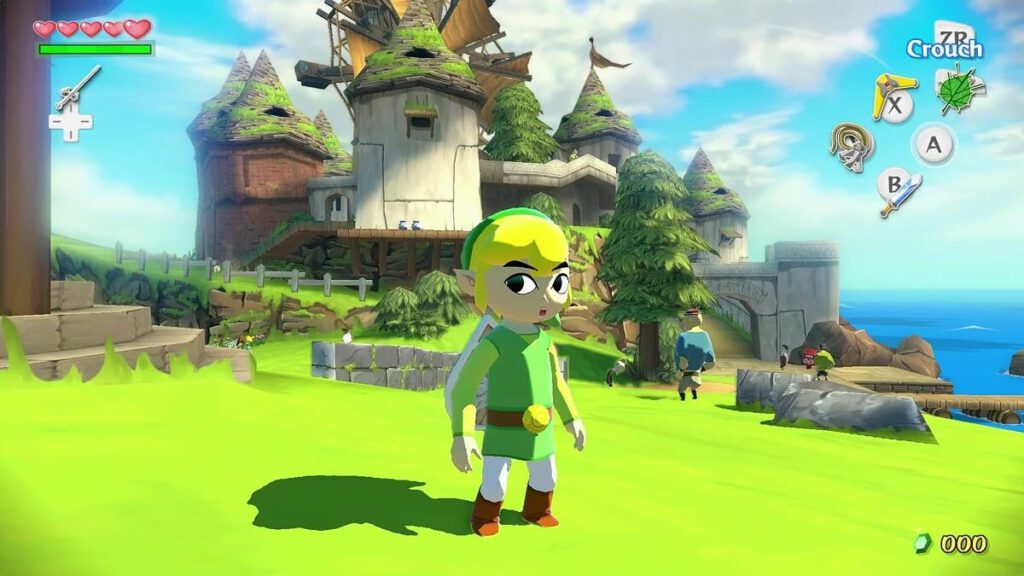
The most prescient artistic decision in GameCube history. When Nintendo shipped Wind Waker in 2002, the backlash over its visual style was immediate. In 2026, that decision looks like genius. Cel-shading combined with outline rendering essentially created a game that cannot age — because it was never chasing photorealism, it was never betrayed by its absence. For Zelda fans expanding their Nintendo library, our guide to the best Wii games with motion controls includes several essential entries in the series.
The ocean rendering deserves specific mention: real-time water with scrolling bump maps and specular highlights that still reads as intentional and beautiful, not as “2002’s best attempt at water.” The timeless Nintendo art direction of this title is the case study every game studio should study before committing to hyper-realistic pipelines. The same philosophy of stylised longevity appears in our roundup of the best single-player PC games that prioritise art direction over raw fidelity.
⚡ Modern Performance
Wind Waker at 4K via Dolphin is arguably the best-looking pre-HD Zelda experience available. The flat colour fields in cel-shading scale infinitely — there are no texture seams to expose at higher resolution. Enhanced texture filtering barely needs touching; the original art is resolution-independent by design.
- Original: 480p / 30fps
- Dolphin 4K: Stable 60fps (unlocked)
- Texture filter: Minimal needed
- Visual style: Cel-shaded / outline
F-Zero GX
Here’s the performance argument in its purest form: F-Zero GX runs at a locked 60fps at all times. On original hardware. In 2003. Sega’s AmusementVision team achieved this by prioritising framerate above everything else — geometry budget, texture complexity, shadow fidelity all bent to the altar of 60. The result is a racing game that still feels fast in a way that many modern 30fps racers simply don’t. Racing fans should also check our coverage of retro arcade builds on Raspberry Pi for a complete racing-cabinet setup.
The track design benefits from this constraint: courses are enormous, dramatic roller-coasters of geometry that read instantly at high speed. There’s no muddy detail that requires slowing down to appreciate — F-Zero GX is designed to be comprehended at 1,500km/h. The same clarity-of-design principle shows up in our list of the best SNES games, where 16-bit racers achieved similar immediacy through bold visual language.
⚡ Modern Performance
F-Zero GX remains one of the cleanest retro gaming upscaling 4K candidates in the entire GameCube library. The bold track geometry scales without artefact. Anisotropic filtering applied in Dolphin eliminates the only visible age-related flaw: oblique track surface shimmer.
- Original: 480p / 60fps locked
- Dolphin 4K: 60fps locked
- AF benefit: High
- Visual style: Speed geometry
Resident Evil 4
The original GameCube version of Resident Evil 4 remains the leanest, most optimised build of one of the greatest action games ever made. Shinji Mikami’s team pushed asset detail remarkably far: Leon’s jacket features tangent-space normal mapping, enemy models use a surprising polygon budget, and dynamic lighting creates genuine tension in torchlit church interiors and foggy village squares alike. Our dedicated horror game price comparison tracks the best deals on RE4 across every platform.
RE4 also demonstrates how environmental density beats environmental size. Every room is small, every texture carefully authored. Compared to the sprawling environments of its successors, RE4’s handcrafted spaces hold together remarkably well. The best horror games are often defined by their use of space, and RE4 still sets the standard. For a completely different flavour of horror, see our picks for the best Roblox horror games that channel the same tension through low-fi aesthetics.
⚡ Modern Performance
At 4× resolution in Dolphin, RE4 reveals just how detailed its assets were. The 2023 remake has obviously raised the bar, but the GameCube original retains a directorial focus and gameplay rhythm its successor partially lost. Widescreen patches are stable and the cinematic framing benefits from the wider FOV.
- Original: 480p / 30fps
- Dolphin 4K: 60fps (unlocked)
- Asset quality: Surprisingly high
- Visual style: Realistic w/ baked lighting
Super Smash Bros. Melee
This entry isn’t about graphics — Melee was pushing technical limits in a different dimension. Input latency as low as 1–2 frames, a physics system that produces emergent movement options that HAL Laboratory may not have intentionally designed, and a 60fps framerate that the competitive community has protected with hardware-level devotion for over 20 years. For players who value tight controls above all else, our guide to the best precision-driven PC games covers titles that share Melee’s obsession with responsive feel.
The character models are charming if dated, but Melee’s visual language — shockwaves, hitbox-flash effects, stage variety — communicates gameplay information with surgical clarity. At a competitive level, the readability of visual feedback is arguably better than some modern platform fighters with busier particle budgets. The broader context of competitive retro gaming is explored in our Raspberry Pi 4 retro gaming guide, where Melee remains a centrepiece title.
⚡ Modern Performance
The competitive scene runs Melee predominantly on CRT displays via original hardware — a deliberate choice to preserve sub-2-frame input latency. For casual play, Dolphin emulation in 2026 with a GameCube adapter is a viable substitute. Slippi netcode has made rollback-based online play a practical reality.
- Original: 480p / 60fps
- Input latency: ~1–2 frames
- Competitive scene: Still active 2026
- Online: Slippi rollback netcode
Pikmin 2
Nintendo’s strangest technical achievement on the platform. Pikmin 2 renders hundreds of individual agents simultaneously with pathfinding, animation blending, and collision — on a 485 MHz CPU with no second thread. The organic surface shaders on underground environments, translucent water surfaces in cave pools, and the way overworld lighting shifts during the day cycle all demonstrate a team that knew how to spend a polygon budget. Strategy-minded players might also enjoy our look at the best 3DS strategy and puzzle games.
The microscale aesthetic also plays a neat visual trick: by populating the world with oversized everyday objects, Nintendo sidestepped the need for complex geometry. A tin can is a cylinder. A bottle cap is a disc. Elegant engine work dressed up as art direction. This same economy of design appears in our best SNES games list, where 16-bit hardware constraints produced similarly clever visual solutions.
⚡ Modern Performance
Pikmin 2 scales into HD with minimal artefact. The organic colour palette and diffuse lighting model read cleanly at higher resolutions. Widescreen patches are stable and genuinely improve the strategic overview of underground cave layouts — a strong candidate for anyone exploring GameCube graphics on modern displays for the first time.
- Original: 480p / 30fps
- Dolphin 4K: 60fps capable
- Agent count: 100+ simultaneous
- Visual style: Organic / naturalist
Luigi’s Mansion
A launch title demonstrating what the GameCube GPU could do when a team focused entirely on one effect: real-time volumetric lighting and dynamic shadows. Every light source in the mansion casts soft shadows in real time. The flashlight cone renders dust particles. Ghost transparency relied on hardware blending modes that were novel for a console launch in 2001. The atmospheric DNA here connects directly to the best atmospheric horror games on Roblox and beyond.
Nintendo designed a single large building rather than an open world, keeping all lighting calculations within one architectural envelope. It’s a short game, but a technically coherent one — and a strong ancestor to the kind of lighting-first design philosophy seen in modern horror titles like atmospheric horror experiences today. Our broader horror game price comparison places Luigi’s Mansion among the most affordable classics still worth owning physically.
⚡ Modern Performance
The real-time shadow and volumetric light systems benefit enormously from higher internal resolution. Shadow edge softness that was blurry on a 480p CRT becomes precise and atmospheric at 4K. This is one of the clearest cases where retro gaming upscaling doesn’t just sharpen an image — it reveals artistry the original hardware couldn’t fully express.
- Original: 480p / 60fps
- Key tech: Real-time shadow volume
- Dolphin 4K: Excellent scaling
- Visual style: Lighting-driven
Paper Mario: The Thousand-Year Door
Another entry in the “stylised art direction as longevity insurance” category, and one of the richest examples on the platform. The 2D-character-in-3D-world aesthetic was a deliberate artistic choice that produced a visual identity instantly recognisable in screenshots today. The animation quality on paper-character rigs is exceptional — characters fold, curl, and squash with tactile weight. For more Nintendo RPG excellence, our guide to the best 3DS RPGs covers the handheld lineage that followed.
The 2024 Nintendo Switch remaster confirmed what GameCube players knew: this visual language ages so well that HD treatment barely needed to change the fundamentals. For anyone comparing the best Nintendo handheld and console design philosophies, this title is a fascinating case study in art direction that transcends hardware. Our best Wii games guide shows how Nintendo carried this philosophy forward into the motion-control era.
⚡ Modern Performance
Both the original GameCube version via Dolphin and the Switch remaster are worth playing in 2026. The Dolphin build at 4× resolution pre-dates the official remaster’s aesthetic decisions and arguably has a rawer, more atmospheric quality. The flat character models at high resolution have an almost graphic-novel quality that the remaster’s softer lighting slightly diluted.
- Original: 480p / 30fps
- Dolphin 4K: 60fps, excellent
- Remaster: Switch 2024
- Visual style: Paper / 2D-in-3D
At-a-Glance: All 8 Games Compared
Use this table to quickly identify which GameCube games best match your priorities — whether that’s competitive latency, 4K scaling potential, or artistic longevity.
| Game | Original FPS | 4K Scaling | Art Direction | Best For |
|---|---|---|---|---|
| Metroid Prime | 60fps | Excellent | Geometry lighting | Atmosphere, exploration |
| Wind Waker | 30fps | Excellent | Cel-shaded | Timeless visuals, open world |
| F-Zero GX | 60fps | Excellent | Speed geometry | Competitive racing |
| Resident Evil 4 | 30fps | Very Good | Realistic / baked | Action, horror |
| Melee | 60fps | Good | Functional / readable | Competitive fighting |
| Pikmin 2 | 30fps | Very Good | Organic / naturalist | Strategy, co-op |
| Luigi’s Mansion | 60fps | Excellent | Lighting-driven | Atmosphere, short sessions |
| TTYD | 30fps | Excellent | Paper / 2D-in-3D | RPG storytelling |
The “Secret Sauce”: Why Stylised Art Direction Beats Realism
There’s a pattern across the best entries in this list, and it’s not hardware power. It’s a deliberate rejection of photorealism in favour of systems that age independently of polygon count.
Realism vs. Abstraction: The 2026 Test
When a game chases photorealism, it enters a race it can never win. The technology defining “realistic” shifts every hardware generation. A 2005-era realistic face is an uncanny-valley horror by 2026 standards. But a 2002 cel-shaded character remains a cel-shaded character — stylised, intentional, and free from the indignity of comparison.
- Baked lightmaps on flat textures
- Low-poly “realistic” faces
- Compressed normal maps
- Pre-rendered FMV cutscenes
- Specular aliasing on curved surfaces
- Cel-shading with outline rendering
- High-contrast flat colour fields
- Clean geometry with bold silhouettes
- Minimalist texture, strong shape language
- Real-time lighting over pre-baked shadows
The Texture Efficiency Argument
GameCube games were constrained to 4MB of texture memory. This forced artists into a discipline that accidentally produced timeless work: use as little texture as possible, and make every pixel count. Wind Waker’s ocean isn’t impressive because it’s detailed — it’s impressive because three carefully designed tiling textures and a convincing bump-map create a convincing ocean at any scale. That’s timeless Nintendo art direction in its most practical form.
Contrast that with 2005–2008 games that filled their texture budgets with high-resolution photographs of bark and concrete. Those textures reveal their photographic origins immediately at modern resolutions. Clean, authorially-designed textures do not. This principle extends directly to why modern single-player games with stylised aesthetics tend to age better than their photorealistic contemporaries even within a single hardware generation.
GameCube Emulation vs Original Hardware in 2026
The honest answer: both are valid, and the choice depends on what you’re optimising for.
Original hardware via component cables into a capture card or upscaler (RetroTINK 4K being the current gold standard) preserves the exact rendering behaviour developers tested against. Some games — particularly Melee — are categorically better on native hardware due to display latency characteristics that emulation cannot fully replicate without specialised setup.
Dolphin Emulator in 2026 is extraordinarily mature software. At 4× internal resolution with anisotropic filtering, enhanced anti-aliasing, and widescreen patches applied, it offers a visual experience that frequently surpasses official remasters in geometric fidelity. For most players exploring GameCube graphics on modern displays for the first time, Dolphin is the recommended entry point. The broader retro gaming context — including the Sega Dreamcast’s equally interesting catalogue and SNES longevity — rewards the same approach.
Quick-Reference: Emulation vs Hardware
- Best visual quality: Dolphin at 4K internal resolution with post-processing
- Best input latency (competitive): Original hardware → CRT or RetroTINK 4K
- Best convenience: Dolphin — saves states, widescreen, controller mapping
- Most accurate rendering: Original hardware for edge-case behaviour
- Recommended for newcomers: Dolphin, no question
Recommended Dolphin Configuration by Game
Not all GameCube games respond to the same emulator settings. Here’s how to get the best results for the titles in this list without trial and error.
🐬 Per-Game Dolphin Presets
Metroid Prime
Set Internal Resolution to 4× (1440p). Enable Per-Pixel Lighting in Graphics > Enhancements. Use the widescreen gecko code but expect minor pop-in at edges. Force 16x Anisotropic Filtering for crisp surface detail.
Wind Waker
4× or 6× IR both work beautifully — cel-shading has no texture ceiling. Enable Force Texture Filtering off; the original art doesn’t need it. The HD texture pack community project is optional but impressive if you want crisper UI elements.
F-Zero GX
4× IR + 16x AF is the sweet spot. Anisotropic filtering is essential here — track surfaces at oblique angles shimmer without it. Keep EFB Copies to Texture enabled for speedometer clarity. Ubershaders prevent rare shader compile stutter.
Resident Evil 4
4× IR reveals texture work you won’t see at 2×. Enable Widescreen Hack — it’s one of the most stable in the library. Consider the HD UI mod for menus; the original font scales poorly. Disable Force Filtering to preserve the gritty texture intent.
Melee (Casual)
2× or 4× IR is sufficient — the game isn’t texture-heavy. Enable Netplay-optimised settings if using Slippi. For local play, Original hardware + CRT remains the gold standard for competitive players.
Luigi’s Mansion
4× IR minimum — this is where you’ll see the biggest visual payoff. Shadow volumes and flashlight volumetrics resolve with a precision the original hardware couldn’t manage. Keep EFB to RAM for accurate shadow behaviour.
Honourable Mentions: Four More Worth Your Time
These four didn’t make the top eight only because of space, not quality. Each one demonstrates a different facet of GameCube technical excellence and scales beautifully into 2026.
Star Wars Rogue Leader II
Factor 5’s “Factor 5 engine” pushed more polygons per frame than almost anything else on the system. Space combat with dense fleet battles and volumetric nebula effects that still impress. A showcase for what the GameCube GPU could do when unconstrained by ground-based environments.
Beyond Good & Evil
A cult classic whose soft, painterly art direction and stealth-photography mechanics create a mood no HD remaster has fully replicated. The GameCube original has a colour grading warmth that later ports slightly cooled. A must-play for fans of narrative-driven adventure.
Skies of Arcadia Legends
The expanded GameCube port of the Dreamcast RPG classic adds new content and faster encounter rates. Its bright, sky-pirate aesthetic and world-map exploration scale cleanly in Dolphin. A strong bridge title for anyone exploring both Dreamcast and GameCube libraries.
Eternal Darkness: Sanity’s Requiem
Silicon Knights’ psychological horror experiment remains genuinely unsettling. The sanity-effect system — fake volume changes, simulated controller disconnects, false save-file deletions — was innovative in 2002 and still lands today. For horror completists, it pairs naturally with our horror game price comparison.
GameCube Buying Guide for New Collectors (2026)
If you’re assembling a physical GameCube collection rather than relying on emulation, here’s what to know before you start hunting.
🎮 Hardware: What to Look For
- DOL-001 vs DOL-101: The DOL-001 model has the Digital AV Out port, which is essential for component cables or the RetroTINK 4K. The DOL-101 removed this port to cut costs. For modern display play, the DOL-001 is worth the small premium.
- Controller condition: GameCube controllers use a proprietary mechanism. Stickboxes wear out. Buy from sellers who show close-up photos of the stick and C-stick. First-party Nintendo controllers are still the best option in 2026.
- Memory Cards: Official Nintendo 1019-block cards are reliable. Third-party cards from the era are notoriously failure-prone. Don’t store long RPG saves on unbranded hardware.
- Component Cables vs HDMI Solutions: Original Nintendo component cables now sell for $200+. The Carby HDMI adapter or GCHD Mk-II offer digital output from the DOL-001 port at a fraction of the price. For most users, these are the smarter buy.
💿 Software: Pricing & Rarity in 2026
- Budget-friendly essentials: Luigi’s Mansion, Pikmin 2, and Wind Waker (Player’s Choice editions) are still reasonably priced. These are excellent entry points for new collectors.
- Mid-tier investments: Metroid Prime, Melee, and RE4 command $40–$80 depending on completeness and condition. All three are worth owning physically if you play them regularly.
- High-tier rarities: Beyond Good & Evil, Skies of Arcadia Legends, and Eternal Darkness have all climbed past $100 for complete-in-box copies. Buy these for love, not speculation — reissues or remasters could shift pricing quickly.
- Player’s Choice vs Original: Player’s Choice reprints play identically but trade at a discount. If you’re not a sealed collector, these are the pragmatic choice for actually playing the games.
Build a Complete Retro Library: Related Guides
The GameCube doesn’t exist in isolation. These companion guides from Pink Crow help you build a retro collection that covers every major Nintendo and Sega generation with the same technical rigour.
🕹️ Nintendo Ecosystem Guides
- Best SNES Games of All Time — The 16-bit foundation that shaped Nintendo’s design DNA, from Super Metroid to Yoshi’s Island.
- Best Wii Games That Made Motion Controls Actually Fun — How Nintendo iterated on the GameCube hardware to create a new control paradigm.
- Best 3DS Games You Need to Play — Nintendo’s handheld masterpiece library, with surprising technical parallels to the GameCube.
- GameCube Games That Still Shine Today — Our original deep-dive into why this catalogue refuses to age.
🌐 Multi-Platform & Emulation Guides
- Best Sega Dreamcast Games — The GameCube’s most interesting contemporary competitor, with a similarly forward-looking design philosophy.
- Best PS2 Games: The Greatest PlayStation 2 Games Ever Made — The best-selling console of the generation, and a fascinating contrast to the GameCube’s focused library.
- Raspberry Pi 4 Retro Gaming Guide — Build a compact emulation station that handles GameCube, Dreamcast, and SNES in one box.
- Best Single-Player PC Games — For when you want modern titles that share the GameCube’s emphasis on tight design and strong art direction.
👻 Horror & Genre-Specific Guides
- Horror Game Price Comparison — Track the best deals on Resident Evil 4, Eternal Darkness, and modern horror classics.
- Best Roblox Horror Games — Surprisingly atmospheric experiences that prove low-fidelity horror can still deliver genuine tension.
Final Verdict: The GameCube’s Legacy in the High-Res Era
The GameCube’s library holds up in 2026 for reasons that have nothing to do with nostalgia. The platform’s hardware constraints forced developer decisions — stylised art direction, clean geometry, locked framerates — that accidentally constituted a masterclass in visual longevity.
The titles that age best are the ones that rejected photorealism and committed to a visual language strong enough to survive resolution increases, widescreen ratios, and two decades of comparative context. Metroid Prime’s geometry-first lighting, Wind Waker’s cel-shading, F-Zero GX’s framerate discipline — these weren’t compromises. They were, as it turned out, the correct creative decisions.
Whether you approach these games through original hardware with a high-quality upscaler or through a mature emulation stack, the experience remains substantive. For the broader context of which platforms have aged with similar grace, the deep-dives into PlayStation 2’s greatest games and Wii’s best titles offer useful comparisons. The GameCube sits, in retrospect, as Nintendo’s most technically rigorous platform — and its catalogue rewards exactly the kind of close attention this moment in retro gaming is finally affording it.
The GameCube didn’t age well by accident. It aged well because its best developers chose art direction that cannot be obsoleted by time — only appreciated more clearly as the gap between stylisation and photorealism grows wider every year.