Seven years. That’s how long Middle-earth: Shadow of War fans have been waiting for something worthy of the license. The wait — and the excuse — just ran out.
When Monolith Productions wrapped Shadow of War in 2017, they handed the gaming world something genuinely special: a Middle-earth open world that felt alive, morally complicated, and technically ambitious. Then the franchise went quiet. Warner Bros. shelved the IP. Embracer Group gaming made headlines for all the wrong reasons. Amazon’s much-hyped MMO burned money at a rate that would make Smaug blush. For LOTR fans who actually play games, it felt like the whole industry had turned its back on the most beloved fictional universe in literary history.
That era is ending. 2026 shapes up as the year Middle-earth gaming finally stops being a cautionary tale and starts becoming a conversation about what’s possible — and two very different studios are making that argument simultaneously.
⚔Crystal Dynamics Bets $100M on a New Age
Crystal Dynamics — Unnamed LOTR RPG
The leaks have been building since late 2025, and at this point the shape of the project is too consistent to dismiss. Crystal Dynamics Tolkien — the studio behind Marvel’s Avengers and several Tomb Raider entries — is developing what sources describe as a Hogwarts Legacy-scale LOTR RPG 2026 built entirely on Unreal Engine 5. Budget estimates have landed consistently at the $100M mark, placing this firmly among the largest fantasy RPG investments since Elden Ring.
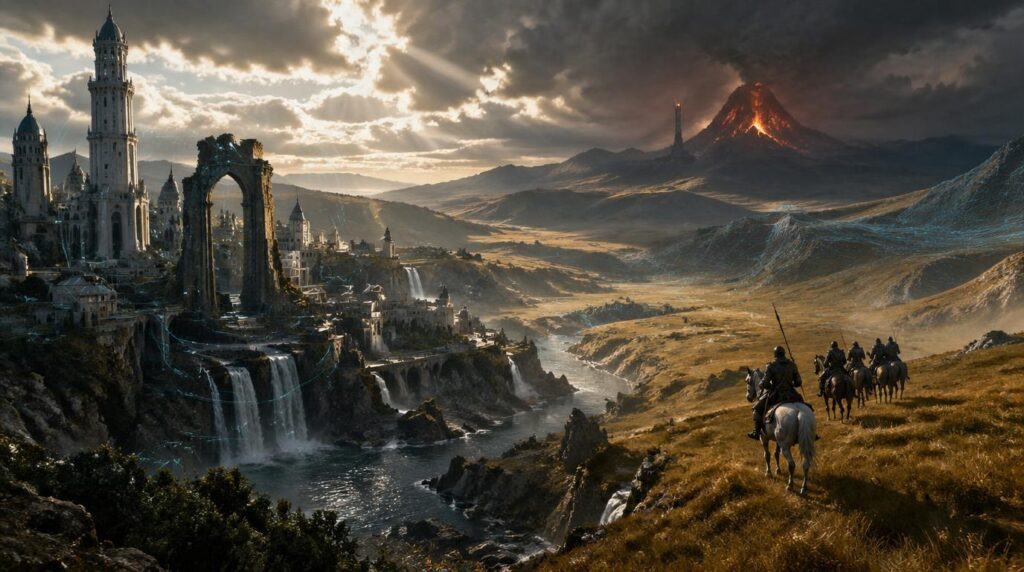
The Unreal Engine 5 choice matters more than it might seem. Nanite and Lumen — Epic’s geometry and global illumination systems — mean a studio can render Númenórean architecture at a fidelity that was simply not achievable on previous hardware generations. We’re talking about the soaring white towers described in Tolkien’s Unfinished Tales built in real-time, without the polygon-budget compromises that flattened every previous attempt. Ray-tracing on the reflective obsidian walls of Barad-dûr. Lumen bouncing torchlight through the mines of Moria the way Peter Jackson’s crew could only achieve in post.
The scope, per the leaks, covers the Third Age — familiar enough to sell — but with significant Second Age flashback sequences. That means the Rings of Power forging, Annatar’s deception, and the drowning of Númenor as cinematic set pieces rather than loading screens. For lore heads, that’s enormous. For AAA game buyers who just want something spectacular to experience, it’s exactly the kind of spectacle that justifies a 2026 launch price.
The Hogwarts Legacy comparison being thrown around in leak circles isn’t flattery — it’s a target spec. That game proved an open-world RPG built on an established literary IP could sell 22 million copies without satisfying the hardest-core fans of the source material. Crystal Dynamics doesn’t need to write The Silmarillion: The Game. They need to make the world feel enormous, navigable, and inhabited by something other than quest markers.
That last point connects to the most intriguing technical rumor: a Nemesis-adjacent NPC faction system. Not the Nemesis system itself — that’s Warner Bros. IP locked away indefinitely following the patent saga — but something philosophically similar. Orcs that remember you. Faction dynamics in Mordor that shift based on how aggressively you’ve played. A studio with systemic design credentials applying that logic to Tolkien’s enemy armies is a genuinely exciting prospect.
🏇Warhorse Studios and the Road to Rohan
Warhorse Studios — Unconfirmed Tolkien Project
The Warhorse rumors are less confirmed but arguably more interesting. The Prague studio built its reputation on Kingdom Come: Deliverance — a medieval survival RPG that dropped you into 15th-century Bohemia with no magic, no quest markers, and an NPC ecosystem that ran entirely on schedules and routines. The pitch was brutal realism inside a beloved historical setting. The execution was remarkable.
Now whispers suggest they’re bringing that same design philosophy to Tolkien — specifically to Rohan and Gondor during the later Third Age. If accurate, picture a game where you’re not the destined hero. You’re a Rohirrim scout navigating the political tension between Théodred’s household and Wormtongue’s growing influence. Survival mechanics. Horse culture modeled on steppe nomads. Actual hunger. Weather that kills you on the Pelennor Fields before the armies even arrive.
That’s a completely different proposition from Crystal Dynamics’ apparent blockbuster approach — and the market almost certainly has room for both. Single-player RPG fans have been starved for a hardcore alternative to the power-fantasy model, and Warhorse has the pedigree to deliver it.
The lore angle here is particularly rich. Rohan’s geography — those plains, the Edoras plateau, the White Mountains as a constant looming presence — is almost perfectly designed for Warhorse’s style of environmental storytelling. You don’t need a waypoint. You need to ride until you find the gap in the Ered Nimrais that the old Dunlendings told you about. That’s Kingdom Come design applied to Tolkien, and it works on paper in a way that’s genuinely exciting.
The Blue Wizards angle is a wilder theory circulating in fan forums: that Morinehtar and Rómestámo — the pair Tolkien left almost entirely undeveloped — could appear as mysterious quest-givers operating in the East, outside Gondor’s knowledge. It’s exactly the kind of obscure lore corner that satisfies deep Tolkien readers without derailing the narrative for anyone who only knows the films.
💀Amazon’s MMO: What Went Wrong
Amazon Games MMO — Post-Mortem
The collapse of Amazon Games’ Lord of the Rings MMO was one of the least surprising cancellations in recent memory, and also one of the most expensive. The project burned through development cycles at a rate the company was never equipped to sustain, and the IP holder — the Tolkien Estate, operating through Embracer Group gaming‘s licensing structure — reportedly grew frustrated with the creative direction well before the formal cancellation.
The fundamental problem was cultural fit. Amazon Game Studios built New World and learned hard lessons about what live-service MMO players expect. Applying that framework to Tolkien — a property whose fans are constitutionally allergic to invented lore — was always a structural risk. When concept art suggesting significant canonical deviations leaked in 2024, the community response was severe enough to trigger internal restructuring. The project never recovered momentum.
The licensing fallout may be more significant than the cancellation itself. The estate now has leverage to demand tighter creative controls on future deals. That’s actually good news for both Crystal Dynamics and Warhorse — it suggests whoever currently holds those licenses has met a higher bar of approval before a single line of code was written.
🏛The Lore Beneath the Pixels
Both projects, if they land, will face the same fundamental test: does the game feel like Tolkien, or does it feel like a game using Tolkien as wallpaper?
That distinction shows up in details. Númenórean architecture isn’t just “stone fantasy buildings” — it’s a specific aesthetic vocabulary of sea-imagery, circular forms, and inscriptions in Adûnaic that the island kingdom’s exiles carried west to Gondor. The cultural divergence between Gondor — proud, declining, backward-looking toward drowned Númenor — and Rohan — vital, oral, present-tense — is embedded in every piece of architecture, every naming convention, every social hierarchy. Games that get those textures right earn a permanent place in the fandom. Games that get them wrong become talking points in a very different kind of online discussion.
The Second Age framing in Crystal Dynamics’ project is either a masterstroke or a minefield. On one hand, it gives writers enormous freedom — the First Age of Númenor is barely sketched even in Unfinished Tales. On the other hand, every invented detail will be scrutinized by people who have read The Notion Club Papers. The safest play is exactly what Hogwarts Legacy did: set the story between canonical events, using original characters, so no beloved figure can be mishandled.
⚙Technical Ambitions: What These Games Need to Deliver
The next generation of immersive game experiences demands something beyond better graphics. For a Middle-earth open world to land in 2026-2027, three technical pillars need to function simultaneously.
Procedural scale. The Misty Mountains stretch hundreds of miles in Tolkien’s geography. No hand-crafted approach fills that space meaningfully. UE5’s procedural generation tools — seeded with art-directed biome rules — can produce mountain passes that feel traversed rather than designed, snowfields with realistic accumulation, and cave systems deep enough to hide an entire Goblin kingdom without a single repeated chamber.
Ray-traced atmosphere. Middle-earth lives or dies by its light. The difference between Lothlórien and Fangorn isn’t primarily geometry — it’s how light moves through the canopy, what it illuminates, what it leaves in shadow. Ray-tracing isn’t a checkbox feature here; it’s load-bearing architecture for the emotional register of every biome.
Living faction systems. Whether it’s a Nemesis-adjacent system or something entirely new, the enemy AI needs memory. An orc lieutenant who remembers killing you, who has climbed through your failures, who now commands the gate you’re trying to breach — that’s not a feature. That’s the game. For anyone serious about game design at this scale, these aren’t separate systems. They’re one system: a world that reacts, remembers, and rewards attention.
The intersection of all three — procedural geography + lighting fidelity + reactive factions — is what separates a good open-world game from a transformative one. The Witcher 3 achieved it without any of those tools. Imagine what it looks like with all of them.
Will Middle-earth finally get its Witcher 3 moment? Almost certainly — but not the way people expect. The Witcher 3‘s genius wasn’t its scope or its graphics; it was that every NPC had a life the player was temporarily interrupting. That requires writing, and writing requires someone at the top of the project who is constitutionally incapable of treating Tolkien as a brand asset rather than literature. Crystal Dynamics’ project is large enough to have that person. Whether they have the authority to actually use the source material as a moral compass rather than a mood board — that’s the only question that matters heading into 2027.