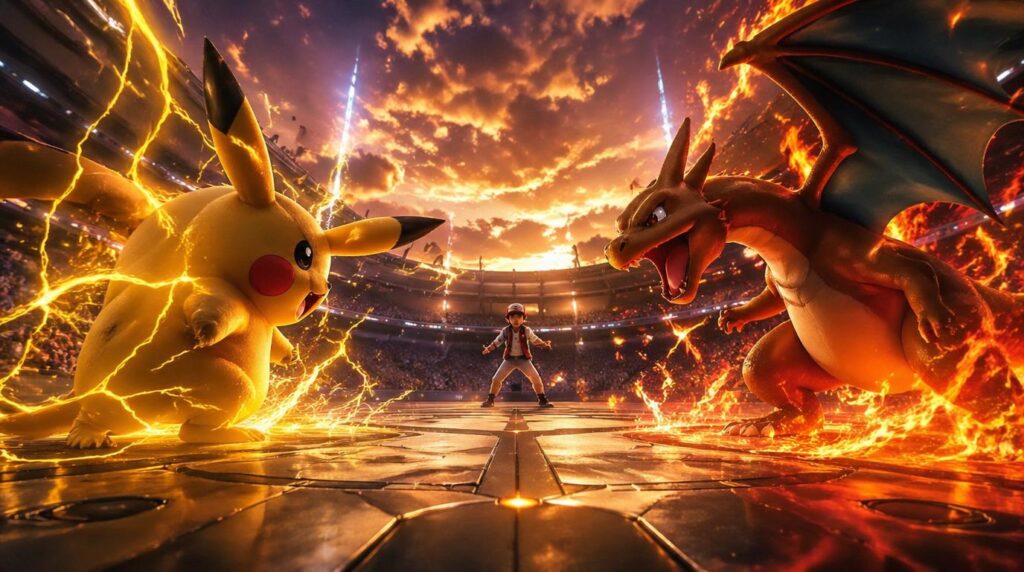
After thirty years of shoving competitive Pokémon into mainline RPG cartridges, The Pokémon Company finally built the arena. Pokémon Champions launched on April 8, 2026 — and the VGC community hasn’t stopped arguing about it since.
Let’s be clear about what happened on April 8. The Pokémon Company didn’t release another spin-off. They didn’t push out another Stadium clone for nostalgia points. They rewired the entire infrastructure of official competitive Pokémon and handed it a new home — purpose-built, free-to-start, and coming to your phone before Christmas. The Pokémon Champions release date is going to be a watershed moment people reference for years.
Think about the old model: championship-level players had to breed Pokémon in Scarlet and Violet, EV train across hundreds of battles, manage IVs, pray that the new mainline release hadn’t broken the meta you spent months building. It was brilliant game design buried under layers of friction that had nothing to do with battle strategy. Champions strips all of that away. Game design philosophy has been shifting toward purpose-built competitive experiences for years — and Pokémon just caught up.
The reception has been loud, messy, and exactly what you’d expect from a community this passionate. Some veterans are thrilled. Others are furious about the restricted roster. And a surprising number of lapsed players — folks who dropped off after Pokémon X and Y — are logging in again, charmed by the streamlined entry point. All of them agree on one thing: nothing about competitive Pokémon will look the same by the time the 2027 season starts.
Switch Now, Mobile Soon: Understanding the Rollout
The phased launch strategy is calculated, not rushed. Live-service games increasingly lean on multi-platform launches to build audience momentum — and Champions is doing exactly that. The Switch version (including Switch 2) dropped first because that’s where the VGC competitive scene already lives. Getting the tournament infrastructure right before opening the mobile floodgates is the smart call.
On Nintendo Switch, Champions plays like a modern version of Pokémon Stadium with a much sharper competitive eye. Docked mode gives you a clean 60fps battle experience. Handheld mode is fluid enough for casual ranked grinding. The Switch 2 version provides a free visual upgrade — better textures, crisper animations — without any gameplay splits. The competitive scene stays level regardless of hardware tier, which matters enormously for fairness at Premier Events.
The mobile version is the bigger long-term play. Scheduled for iOS and Android in late 2026 — most analysts are guessing Q3 or Q4 — it will carry full cross-play and cross-progression with the Switch version. You’ll be able to start a ranked match on your Switch, grab a VP quest reward on your phone during lunch, and jump back into a serious ladder session in the evening. That kind of seamless continuity has historically been reserved for massive live-service titles. For Pokémon, it’s unprecedented.
-
APRApril 1, 2026Regulation I returns for Scarlet/Violet — final mainline format
-
APRApril 8, 2026Pokémon Champions launches on Switch. Regulation M-A goes live.
-
MAYMay 1–4, 2026Global Challenge I — first official online VGC event in Champions
-
MAYMay 29–31, 2026Indianapolis Regionals — first live Premier Event exclusively on Champions
-
AUGAugust 28–30, 2026Pokémon World Championships in San Francisco — all-in on Champions
-
SEPSeptember 1, 2026Champions mandatory for all CP events. The old era officially ends.
One key detail for competitors: the format transition isn’t instant. Some regional events still allowed Scarlet and Violet during April and early May. That buffer is deliberate — regional organizers needed time to onboard, and players needed time to build legal rosters in a system where your old S&V teams don’t transfer automatically as battle-ready sets. Champions uses an in-game recruitment system called Roster Ranch, where a new lineup refreshes every 22 hours. Trial Recruitments are free. Permanent ones cost Victory Points, earned through ranked play — not real money. It’s a monetization system that’s genuinely pro-player.
Technical Excellence: Building the Infrastructure for Competitive Play
Here’s where things get interesting if you care about what’s under the hood. Pokémon Champions isn’t just a new game — it’s a new kind of Pokémon game architecturally. Developed by The Pokémon Works, a joint venture between The Pokémon Company and ILCA, it’s built from the ground up with online-first, cross-platform competitive play as the load-bearing requirement. That’s a fundamentally different design constraint than any previous entry in the franchise.
The cross-platform multiplayer layer — Switch to mobile to Switch 2, all in the same ranked pool — demands the kind of backend engineering that mainline Pokémon games have never needed. Battle state synchronization across hardware architectures, latency compensation for competitive-critical timing windows, anti-cheat systems that account for Pokémon HOME transfers from multiple source games — none of this is trivial. Studios specializing in this space, like ejaw.net, who focus on Unity-based game development and cross-platform engineering, have written extensively about just how complex maintaining consistent competitive rulesets across heterogeneous device ecosystems can be. Champions is solving that problem at franchise scale.
Victory Points (VP) — the in-game currency for roster building — are not purchasable with real money. They’re earned through ranked play, daily challenges, and in-game events. The Battle Pass has both free and paid tiers, but the core competitive loop remains pay-to-enter, not pay-to-win. That’s a meaningful architectural commitment to competitive integrity.
The IV system — Individual Values, the hidden stat variables that competitive players have spent decades manipulating through breeding — is completely removed. Victory Points replace them with a slider-based customization system that achieves the same competitive granularity without hundreds of hours of RNG breeding sessions. No 0 IV manipulation for Trick Room speed control. No Hyper Training grind. You build your team’s stats directly. Veteran players are still adjusting to the mental model shift, but nobody who’s tried both systems denies that Champions’ approach is cleaner.
The launch wasn’t spotless. Early players flagged framerate drops during certain matchups and a text rendering bug that mangled Leech Seed’s tactical description — embarrassing for a flagship competitive title, but the dev team was transparent about the issues and patched quickly. More meaningfully, Champions commits to ongoing balance patches post-launch. Mainline Pokémon games have essentially never done mid-season mechanical adjustments. That’s a franchise-level paradigm shift. The metagame will now be a managed environment, not just a solved equation.
The Meta Shift: Mega Evolutions Return and Rewrite the Rulebook
If you haven’t followed VGC since Scarlet and Violet, here’s the quick orientation: the dominant mechanics of the past few years were Terastallization (type-changing crystals, introduced in Gen IX) and before that, Dynamax (frame-swelling power moves from Gen VIII). Champions launches with neither in the standard ruleset. Instead, it reaches back to 2013 and recrowns Mega Evolution as the primary competitive mechanic — and the community has opinions.
At launch, the format features 59 legal Mega forms, with each team allowed one Mega Evolution per battle via the game’s “Omni Ring” slot. The roster isn’t complete — Mega Salamence, Mega Metagross, and Mega Mawile are explicitly absent from Regulation M-A, which is notable because all three have historically been among the most ban-worthy threats in any Mega-legal format. Their absence isn’t an accident. It reads like a deliberate meta-shaping decision: let the early format breathe before introducing the apex predators.
“Mega Meganium is effectively a free Sunny Day every turn. In doubles, where a single move advantage compounds across four turns, that’s not a niche pick — that’s a framework.”
— Community analysis, Champions Lab (April 2026)The genuinely new additions are three Mega Evolutions that debuted in Pokémon Legends: Z-A:
Acts as a permanent harsh sunlight setter. Frees an entire moveslot normally used for Sunny Day. Chlorophyll + Fire-type synergy teams are already dominating early ladder.
A Fire/Fighting wallbreaker that bypasses Sturdy and Levitate — two of the most common defensive tools in the format. Defensive strategies built around those abilities need new answers.
Normal moves become Dragon-type with a 20% boost. Effectively gives Feraligatr a third STAB. Unpredictable coverage makes this the wildcard of the trio — difficult to switch into safely.
Early ladder data from the first weeks post-launch is revealing. According to usage tracking from Pikalytics, the VGC 2026 meta’s early power tier is anchored by familiar faces: Incineroar (Intimidate + Fake Out, as reliable as ever), Sneasler, Garchomp, Sinistcha, and Kingambit. The absence of Mega Salamence and Metagross means Dragon-type and Steel-type threats aren’t dominating the same way they did in older Mega formats — which opens up space for creative team building.
Without 0 IV manipulation, underspeed control in Trick Room requires genuinely slow Pokémon plus Iron Ball or Room Service items. The archetype is still viable, but the execution path changed. Returning players should expect to relearn the setup conditions from scratch.
What does this mean for the tournament scene? The VGC 2026 meta is wide open in a way it hasn’t been for years. Without Terastallization’s type-scrambling chaos, team-building is more legible. Matchup reads are cleaner. That’s good for spectators, good for production value, and potentially very good for the World Championships broadcast in August. The Indianapolis Regionals at the end of May will be the real data point — that’s where the paper theory hits the reality of 2,000+ competitors all trying to counter each other’s counters.
Pokémon HOME, the 2026–2027 Season, and What Comes Next
The Pokémon HOME integration is the bridge between Champions and everything that came before it. Players can transfer Pokémon from Scarlet, Violet, and other compatible Switch titles into Champions via HOME — but there’s a catch that has caused genuine community frustration: only final evolutions are currently supported in battle. Pre-evolved forms, including Eviolite strategies that were a legitimate competitive niche in previous formats, simply can’t be used right now.
Game Freak producer Masaaki Hoshino acknowledged this directly in press coverage, saying earlier evolutions might be considered for future updates. That’s not a promise, but the door is open. Given that Champions is explicitly designed as a live-service title with regular seasonal updates, the roster will expand — the question is pace and priority.
The HOME connection also shapes how the broader Pokémon ecosystem functions going forward. Champions isn’t just a game — it’s the competitive infrastructure that will underpin a likely decade of official tournament play. When Pokémon Winds and Waves (the Gen X mainline titles for Switch 2) arrive in 2027, their Pokémon will slot into Champions via HOME updates rather than forcing another platform migration. That’s the theory, at least — and it’s a much more sustainable model than requiring competitive players to buy a new mainline game every two years just to stay eligible for tournaments.
The mandatory switch for all Championship Points events arrives September 1, 2026. From that point, the 2027 season is entirely Champions-native. New players entering VGC next year won’t need to know what IVs are. They won’t need to breed. They won’t need to own any mainline game. Download Champions (free), earn VP through ranked play, build your team. The barrier to entry has never been lower. Whether that democratization dilutes the depth of high-level play or expands the talent pool is the question the community will be debating well into next year.
Pokémon Champions isn’t a perfect game. The roster is smaller than long-time fans deserve, the launch bugs were embarrassing for a title this important, and the removal of pre-evolutions stings specific playstyles. But the vision is correct, the execution is improving fast, and the decision to build competitive Pokémon its own house — free, cross-platform, and balance-patched like a real esport — is overdue by about a decade. The VGC 2026 meta with Mega Evolutions returning is already more interesting than Terastallization’s final, bloated year. Come Indianapolis, come San Francisco in August, this is going to be something worth watching. The Pokémon Champions release date marks a new era — and for once, that’s not marketing copy. It’s just true.