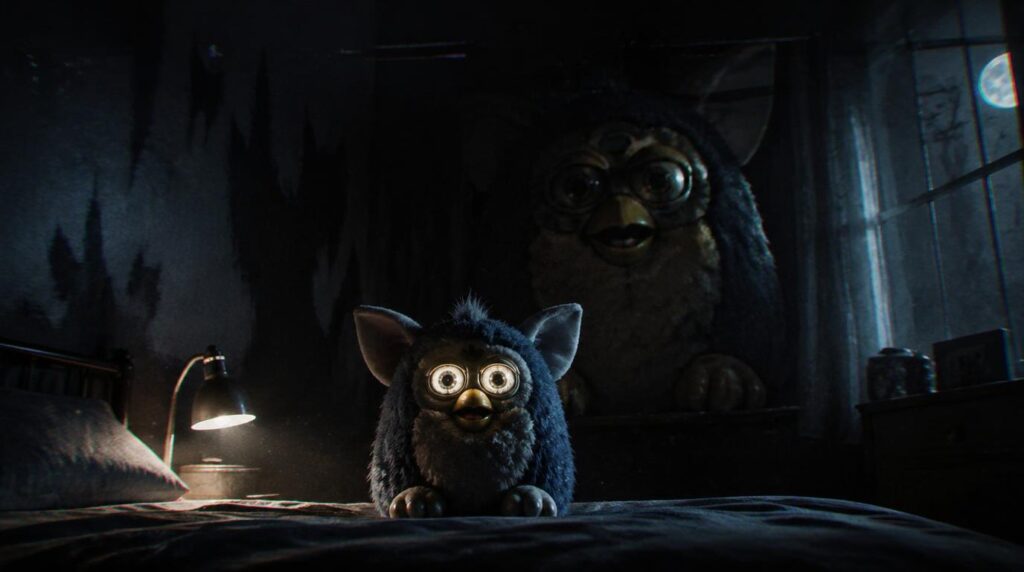
“It’s 3 AM. The closet door is shut. Something inside just said ‘Me love you.'”
If you grew up in the late 90s, that sentence just rearranged your organs a little. The original Furby, released in 1998 by Tiger Electronics, sold 27 million units in its first year alone — and haunted roughly the same number of childhoods. Parents shoved them in closets to stop the batteries draining overnight. The toys kept talking anyway. Nobody ever fully explained that. Nobody could.
Fast-forward to 2026, and the little gremlin is back. Not in toy stores — in browser tabs, Discord servers, TikTok edits, and the best horror games of the decade. The “Long Furby” aesthetic — those stretched, cursed, grotesquely elongated plush variants that exploded on Tumblr and never really left — has mutated into something genuinely lore-heavy on social media. And the Furby horror game microgenre? Quietly, stubbornly, it has become one of the most-discussed categories in indie horror circles. Welcome to the renaissance nobody saw coming.
The Collective Trauma We Never Processed
Here’s the thing about 90s nostalgia: it rarely arrives clean. It comes wrapped in the specific dread of objects that were meant to be comforting but weren’t. Furby was peak Electronic Pet culture — a breed of toy-companion that demanded attention, simulated emotion, and occasionally malfunctioned in ways that felt less like a glitch and more like a choice. You couldn’t turn it off properly. It “learned” your voice. It stared.
That stare is doing a lot of cultural work right now. The internet’s long memory means nobody has forgotten the creepypasta threads, the Reddit nostalgia dumps, the YouTube compilations of Furbies saying deeply wrong things in the dark. What was once ambient childhood unease has crystallized into a recognizable aesthetic language — and that language is fluent in horror. The Furby horror game trend didn’t come from nowhere. It came from twenty-five years of unresolved feelings about a toy that looked almost alive.
Compare it to the trajectory of Art the Clown, another figure who crossed from campy to genuinely sinister through sheer persistence in pop culture. The mechanism is the same: repeated exposure doesn’t kill the fear. It ferments it.
The 2024 re-release of the interactive Furby (with app connectivity and mood lighting) introduced the creature to Gen Z with zero irony. Gen Z, being Gen Z, immediately made it horrifying on purpose. That collision between sincere product marketing and terminally-online horror sensibility is exactly the kind of cultural short-circuit that generates trends.
The Psychology of the Uncanny Valley — Furby as Perfect Horror DNA
The Uncanny Valley is the theoretical dip in human comfort that occurs when something looks almost human but not quite. Robotics researchers mapped it first, but game designers weaponized it. Furby doesn’t sit in the uncanny valley by accident — it camps there, pitches a tent, and starts babbling in Furbish.
Let’s be clinical about this for a second. The original Furby had:
- Mechanical eyes that blinked asymmetrically — mimicking organic movement without achieving it
- A vocabulary that grew over time, simulating language acquisition without true comprehension
- An IR sensor that made it “react” to nearby Furbies, as if communicating
- A persistent off-switch problem — many owners reported continued vocalizations after battery removal
Each of those features is, individually, a horror trope. Together, they form something that iconic horror characters have exploited for decades: the familiar made threatening. A doll that wants something. An object with agency. The design was never meant to be scary — but it activated the exact same cognitive alarm systems that make horror work.
Non-sequitur speech is scarier than silence. When something speaks and you can’t parse its intent, your brain fills the gap with threat. Furby spoke. Constantly. In two languages. And it wouldn’t stop.
This is why the Furby horror game concept translates so naturally to interactive media. You can’t look away from a screen the way you could shove a toy in a box. The mechanical eye follows your cursor. The babble responds to your inputs. The horror moves with you.
Gaming Spotlight: Tattletail and the Toy-Horror Formula
Tattletail, released in 2016 by Waffle Iron Entertainment, is the defining text of this subgenre. You play as a child who unwraps their Christmas gift — a Tattletail, a barely-disguised Furby parody — before they’re supposed to. What follows is a Christmas-themed survival horror experience built almost entirely around caregiving mechanics. Feed it. Groom it. Charge it. Don’t let it make noise. Don’t let it see you fail.
Why Caretaking Creates Better Horror Than Jump-Scares
Traditional horror games give you a gun, a flashlight, and a monster to avoid. Tattletail gives you a needy, noisy, adorable little creature and tells you to keep it quiet or die. The tension is completely different — and dramatically more sustained. Here’s why the caretaking loop is such clutch horror design:
- Obligation creates vulnerability. You can’t just run. You have to stay and manage the creature. Every feeding or grooming session is a moment of exposure.
- Noise-making mechanics punish attachment. The toy you’re caring for is also the thing that will get you caught. That’s a genuinely elegant double-bind.
- Mama is always watching. The antagonist — a massive, menacing adult Tattletail — functions as the consequence of failure, not as a constant threat. You dread her precisely because the dread is deferred.
- Low-poly aesthetics amplify unease. The game’s deliberately crude visuals echo early PlayStation-era graphics, which triggers 90s nostalgia while simultaneously making everything feel slightly wrong and cheap in a way that expensive AAA horror rarely achieves.
The success of Tattletail opened the door for a wave of similar experiments. You can trace the design DNA through titles in the best Roblox horror games category, through yandere-adjacent horror games, and into the increasingly popular love-horror hybrid space. The “caring for something dangerous” mechanic is Indie Horror‘s most underrated toolkit. It works because it exploits empathy rather than threat aversion.
Consider parallel experiments: how to survive as a maid in a horror game similarly weaponizes domestic service as a horror frame — you’re not a warrior, you’re a caregiver in a hostile space, and that inversion of power is where the dread lives. Even Zoochosis operates on this principle: zookeeping as existential horror. The genre is cohering around a single thesis — caregiving is a power dynamic, and power dynamics make excellent horror.
Internet Culture: Long Furbies, Biblically Accurate Furbies, and Folk Horror
If the games are the formal canon, the internet is the apocrypha — and it’s far stranger. The “Long Furby” phenomenon deserves its own academic paper. Beginning as a Tumblr craft project (someone elongated a Furby body to absurd, serpentine proportions) and accelerating through Pinterest, TikTok, and Reddit, Long Furbies have become one of the most durable pieces of internet folk art of the 2020s. They are clearly crafted with love. They are deeply, viscerally wrong to look at. That tension is the whole point.
Then there are the “Biblically Accurate Furbies” — fan art and 3D renders depicting Furbies as they might appear in Ezekiel-style angelology: covered in eyes, ringed in fire, wheels within wheels. It’s a meme format, sure. But it’s also a sophisticated piece of Analog Horror visual culture that understands exactly why Furby’s design is theologically disturbing. Something that watches. Something that speaks in a language you almost understand. Something that knows your name.
The crossover with horror gaming culture is direct and well-documented. Players who grew up on collectible creature culture — Pokémon, Tamagotchi, Neopets — bring an existing emotional framework for attached-to-a-creature gameplay. The Furby horror game taps into that framework and quietly corrupts it. You know how to feed and care for a creature. You do not know what happens if you stop.
This is the mechanism of modern folk horror online: take something familiar, stretch it past comfort, give it eyes that track. You don’t need a mythology. You need a vibe. And Furby has had that vibe for twenty-seven years, waiting.
The current Analog Horror movement — which includes landmark works like Local58, Mandela Catalogue, and the broader “found footage” web horror space — is built on the same principle: technology that behaves wrong is scarier than monsters. Furby is, at its core, a piece of technology that has always behaved slightly wrong. It belongs here. It was always going to end up here.
The Verdict: Analog Horror’s Perfect 90s Host
Here’s what the data, the culture, and the discourse are all pointing at: the Analog Horror genre didn’t just find a home for Furby. It found its ideal vessel. Analog horror thrives on objects. It thrives on the gap between cheerful exterior and threatening interior. It thrives on 90s nostalgia as a delivery mechanism for dread — the VHS aesthetic, the CRT static, the lo-fi audio artifacts that your brain associates with safety and warmth right up until they don’t.
Furby is all of those things simultaneously. It is a physical object. It has a cheerful exterior and a deeply ambiguous interior. It is irreversibly anchored to the 90s. It makes sounds that should be comforting and frequently aren’t. It is, in the language of the genre, perfect lore.
The best horror games of 2026 understand that the uncanny lives in intimacy, not spectacle. A grotesque monster behind a door is frightening for a moment. A beloved object that might be aware of you is frightening forever. That’s why Indie Horror keeps returning to the same well — toys, children’s media, domestic spaces — and why the Furby horror game category is going to keep growing. Developers are finally building the games that the 3 AM closet deserved.
There’s something genuinely moving about it, underneath the jump-scares and the creepypasta. A generation that wasn’t allowed to admit it was scared of its own toys has found a genre that takes that fear completely seriously. The Corpse Party lineage, the Doki Doki Literature Club tradition of subverted innocence, Mad Father’s domestic horror — they’re all circling the same drain. Childhood wasn’t as safe as the packaging said. Someone should have warned us. Instead, we made games about it.
The Furby was always watching. We just finally built the right game to watch back.
- The Furby horror game genre is a direct product of unresolved 90s childhood anxiety combined with the Analog Horror aesthetic movement’s focus on corrupted familiarity.
- Tattletail proved that caretaking mechanics — not jump-scares — are the most psychologically effective tool in toy-horror game design.
- The “Long Furby” and “Biblically Accurate Furby” internet phenomena are genuine folk horror artifacts, extending the creature’s uncanny mythology organically.
- Analog Horror is the perfect genre home for 90s nostalgia: it uses the aesthetic warmth of that decade as an ironic delivery vehicle for sustained dread.
- The Uncanny Valley isn’t a flaw in Furby’s design — it was always the feature. Game designers are finally exploiting it correctly.
- Expect more Indie Horror entries in the toy-horror space through 2026–2027, as the Tattletail template proves consistently commercially and critically viable.