Corpse Party redefined what 16-bit horror could carry in its bones. Here, the Corpse Party story and its shattered Corpse Party characters forge a masterpiece built entirely from despair — one that still refuses to let go. We go deep into the mechanics, lore, and the darkness that made it legendary.
What Is Corpse Party, Really?
It starts quietly. A classroom. Friends performing a ritual. Then everything collapses.
The Sachiko Ever After charm splits a group of high school students across dimensional fragments of Heavenly Host Elementary — a demolished school with a history soaked in unexplained child deaths. From that premise, the game never once loosens its grip.
But what makes this survival horror game transcend its humble technical origins isn’t shock value. It’s architecture. Specifically, the architecture of inevitability — the creeping sense that no matter what you do, the walls are already closing.
The PC-98 Origin and What It Unlocked
Expert Insight
In most genres, low resolution is a liability. Here, it’s the weapon. RPG Maker horror — at its best — weaponizes the player’s imagination by leaving things half-visible.
The PC-98 original was a one-person project. Kedouin coded it as a personal horror experiment. The corridors were sparse. The sound design, primitive by any 1996 standard, still managed to cultivate unease through repetition and absence.
The 2008 PSP reimagining, Blood Covered, and its further upgrade Repeated Fear, expanded the cast and the chapter structure. But they kept the soul: a cramped, top-down perspective where darkness starts two steps ahead of you. If you’re drawn to rediscovering games that punched above their hardware, the best 3DS games covers a similar era of handheld titles that made constraints work in their favor.
Binaural Audio: Where the Real Horror Lives
Expert Insight
Put on headphones. That instruction alone is half the game’s design document.
Binaural 3D audio changed everything about how Blood Covered was experienced. A child’s whimper doesn’t just play from the left speaker — it seems to originate from behind your left shoulder. A distant scraping sound moves. It tracks. It closes in.
This compensates for what the visual layer cannot show. RPG Maker sprites are limited. But sound has no polygon budget. When the graphics show an empty hallway and the audio tells your nervous system someone is standing right behind you — your nervous system wins every time.
The franchise understood something fundamental: psychological dread is auditory before it’s visual. Every sequel has reinforced this with increasingly sophisticated soundscapes. It’s a philosophy that bleeds into newer atmospheric horror too — games like Dark Season build dread the same way: sound first, sight second.
The Corpse Party Story — A Cartography of Loss
The narrative isn’t linear. It never was meant to be. Each character exists in a separate “wrong space” — a pocket dimension that mirrors the original school’s layout but operates on corrupted logic. Time bleeds. Memories overlap. And the dead don’t know they’re dead.
This structure isn’t arbitrary. It mirrors the fragmentation of grief itself — the way trauma splinters chronology and isolates people who were once together in the same moment.
The school’s history, excavated chapter by chapter, reveals a series of ritualistic child murders connected to Sachiko Shinozaki, a young girl whose fate became the dark engine driving the entire pocket dimension. Understanding her story is essential. But understanding doesn’t save you.
Corpse Party Characters — Archetypes in the Dark
Horror has always used archetypes as shorthand — the final girl, the skeptic, the reluctant hero. You can trace the same roles through iconic horror movie characters, where archetype often predicts fate. Corpse Party knows you know this. And it uses that knowledge against you.
| Character | Archetype | Narrative Role | Fate Pattern |
|---|---|---|---|
| Satoshi Mochida | The Reluctant Hero | Emotional anchor; player surrogate | Survives through guilt, not triumph |
| Naomi Nakashima | The Loyal Friend | Grief as narrative engine | Most psychologically fractured arc |
| Seiko Shinohara | The Comic Relief | Emotional dissonance; tonal bait-and-switch | Used to break player trust in safety |
| Yoshiki Kishinuma | The Protector | Physical courage vs. supernatural helplessness | Forced passivity; horror of uselessness |
| Sachiko Shinozaki | The Vengeful Spirit | Antagonist with sympathetic origin | Tragic recursion — victim becomes perpetuator |
| Ayumi Shinozaki | The Obsessive Researcher | Exposition and dangerous knowledge | Knowledge as curse, not salvation |
Notice the pattern. Every archetype that traditionally signals safety — the protector, the researcher, the hero — is methodically stripped of its protective function. That’s intentional. The game studies your genre expectations and turns them against you.
Wrong Ends — The Subversion of Player Agency
Expert Insight
Most games treat death as a rejection. Try again. You failed.
Corpse Party does the opposite. Its Wrong Ends feel complete. Deliberate. Sometimes they feel more honest than the canonical routes. A Wrong End isn’t a punishment — it’s a parallel truth.
This has profound psychological consequences for the player. In a traditional horror game, death teaches you what not to do next. Here, death teaches you that your attempts to prevent suffering may have directly caused it. The feedback loop isn’t mechanical — it’s existential.
By Wrong End 4 or 5, most players enter a dissociative cautious state. Every choice feels weighted. Every kindness toward a character feels like loading a gun. That psychological transfer — from gamer logic to something more anxious and human — is the masterwork. The Mad Father series walks similar ground, but even there the Wrong End logic is more corrective than complicit.
Heavenly Host Elementary — A School as Psychological Architecture
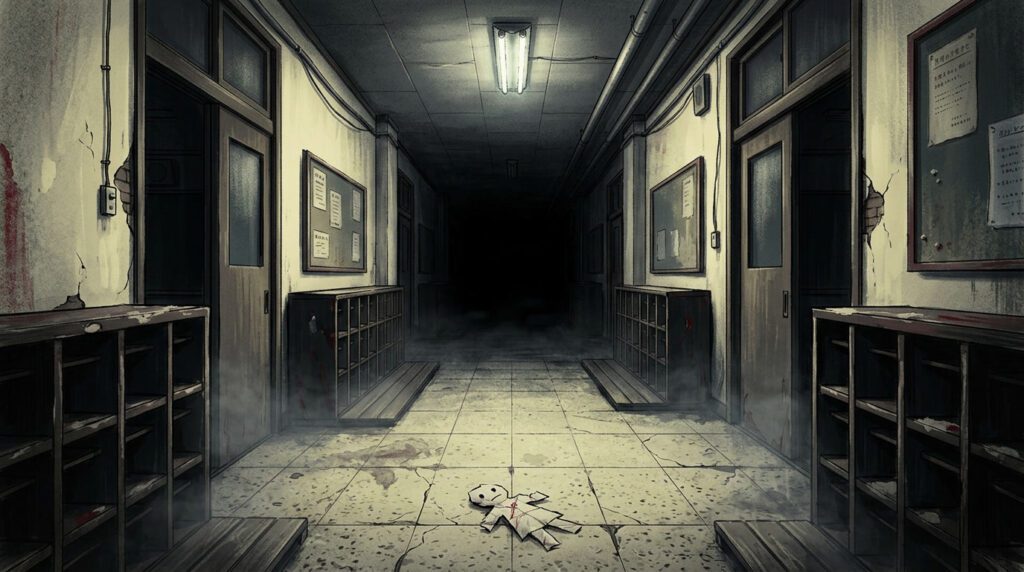
Schools carry specific emotional residue. Uniformity. Rules. The memory of being small and afraid in institutional corridors. Corpse Party chose Heavenly Host deliberately — because no architecture triggers collective childhood anxiety more reliably than a school gone wrong.
The building fragments across dimensions. You might find a door that was open an hour ago now sealed. A room that shouldn’t exist appears between two rooms you’ve already mapped. The school learns your movements. It adapts its cruelty.
Structurally, this creates a survival horror environment where memorization — usually a player’s greatest advantage — becomes unreliable. You can’t map what shifts. You can’t plan against a building that rewrites itself overnight.
The Sachiko Ever After Ritual — Urban Legend Meets J-Horror
Expert Insight
Japanese horror aesthetics derive enormous power from the corruption of innocent cultural rituals. The Sachiko Ever After charm is modeled on real school-yard superstitions — the kind that spread through elementary schools in whispers and lunch breaks.
By grounding the supernatural trigger in something recognizable — something that feels like a real rumor a real student might really try — the game collapses the distance between fiction and lived experience. It asks: what if that game you played in fourth grade had actually worked?
This is essential to Japanese horror aesthetic at its most effective. The supernatural must be adjacent to the ordinary. It must contaminate familiar things — classrooms, friends, paper dolls — before it can fully terrify. Doki Doki Literature Club would later apply the exact same logic: disguise the horror in something achingly familiar until the floor drops out.
Sachiko Shinozaki herself echoes Sadako, Kayako — the lineage of vengeful female spirits whose pain has calcified into something inhuman. But the game does something those predecessors rarely attempted: it asks you to understand how she got there. Not to forgive. Just to understand.
Corpse Party Walkthrough — Mechanics That Serve the Dread
Core Gameplay Systems
- No combat: Players cannot attack. Survival depends entirely on avoidance, timing, and environmental knowledge.
- Name Tags: Collecting the name tags of the dead is both a gameplay objective and a moral act — giving them the dignity of being acknowledged.
- Sanity-adjacent states: Prolonged exposure to certain areas causes characters to behave erratically, making player control feel less reliable.
- Multi-character chapters: Switching between isolated characters reinforces emotional fragmentation — you know something terrible is about to happen to the character you just left.
- Visual novel elements: Dialogue trees and narrative choices blur the line between game and story, making player agency feel more personal and therefore more costly.
- Wrong End triggers: Many Wrong Ends are triggered by choices that feel correct — acts of compassion or logical investigation that backfire catastrophically.
For players seeking a Corpse Party walkthrough, understanding this is critical: the game isn’t testing your reflexes. It’s testing your assumptions. The most dangerous moments arrive dressed as safe ones. If the choice-driven horror format appeals to you, Homicipher is worth exploring next — it shares the same philosophy of narrative consequence over combat.
Team GrisGris, XSEED, and the Franchise’s Global Life
The localization question matters more here than in most cases. Blood Covered carries deeply Japanese cultural content — school rituals, Shinto-adjacent spiritual concepts, specific urban legend traditions. XSEED Games handled this with unusual care, maintaining the ritual language and its untranslated emotional weight.
The result was a horror game that felt genuinely foreign to Western players — not alienating, but instructively different. The horror worked precisely because the cultural context was preserved rather than sanitized.
Team GrisGris continued expanding the franchise with Book of Shadows (2012) and subsequent entries. Each maintained the core philosophy: no combat, no safety, no guaranteed endings. The franchise’s refusal to offer comfort as a default is its most consistent artistic choice.
What Corpse Party Left Behind — And What It Still Teaches
The industry kept trying to replicate what Corpse Party understood instinctively. Many of the best horror games that followed — both indie and major-studio — borrowed its logic without always crediting it: strip the player of power, make death mean something, ensure that knowledge doesn’t guarantee survival.
The franchise also demonstrated that existential fatalism — the sense that tragedy was always inevitable, that survival is not reward but continuation of grief — could sustain a narrative across multiple installments without losing emotional force. Its fingerprints are visible in Signalis, in the love-horror genre broadly, and in every horror game that has since chosen grief over gore as its primary instrument.
Players who find Heavenly Host still argue about whether any ending is truly good. That ambiguity is the point. The school doesn’t let go. Not of its dead. Not of its visitors. Not of the people who played it once in 2011 on a PSP and still haven’t fully left.
Corpse Party built a haunted house inside a PSP cartridge and inside your memory simultaneously. The cartridge you can shelve. The memory doesn’t cooperate.
That’s the Corpse Party story in full — not what happens to the characters in Heavenly Host, but what happens to you after you’ve been there with them. And the answer, consistently, across every version and every platform since 1996, is the same:
You don’t entirely come back.