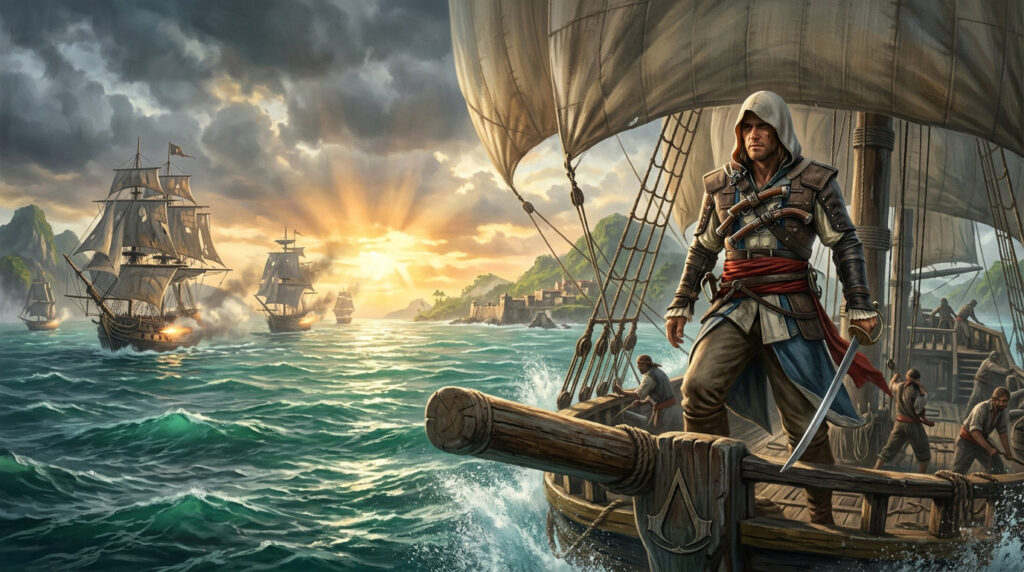
Assassin’s Creed Black Flag Resynced was supposed to be the easy win. A faithful, ground-up remake of the best-loved game the franchise ever shipped, built on new tech, with Edward Kenway sailing back into a Caribbean that finally looks the way people remember it looking. And on that front, it delivers — reviewers are calling it one of the strongest entries the series has produced in years, and it broke Ubisoft’s own concurrent-player record within hours of going live. None of that is the story right now. The story is the Steam store page sitting underneath the game, where roughly $85 in day-one add-ons is quietly outpricing the $59.99 game it’s attached to.
This piece breaks down the actual math behind that cash shop, walks through exactly what’s being gated behind a credit card, tracks how fast the community turned on it, and looks at what Ubisoft’s response tells us about where single-player pricing is heading in 2026. If you’ve been following the wider conversation about how upcoming blockbusters like GTA 6 are pricing their editions, this is the same fight playing out on a smaller, sneakier scale.
The Launch-Day Math: A $60 Game Wrapped Around an $85 Store
Here’s the number that’s driving every angry Steam review right now: buy every single add-on Ubisoft put up alongside Black Flag Resynced and you’re spending more on optional extras than you did on the actual game. The base edition runs $59.99, which on paper looks almost generous next to the $69.99–$70 price ceiling most day-one blockbusters have settled into this generation. But sitting right below it on the store page is a full second storefront’s worth of packs, adding up to roughly $84.91 in total. That’s not a rounding error or an outlier bundle somebody cherry-picked to make a point. It’s the sum of everything on offer, and it’s more expensive than the campaign it’s supposedly decorating.
The $69.99 Deluxe Edition doesn’t fix this, and arguably makes it worse. For an extra ten dollars over the standard version, buyers get exactly two of the roughly eight paid packs bundled in — a fraction of what’s actually for sale. Everyone who wanted the rest is still staring at the same à la carte menu everyone else is, just with the uncomfortable sense that they already paid a premium tier and didn’t get the premium content. It’s the same complaint that dogged several other early-2026 releases this year — Deluxe Editions that exist mostly to raise the price anchor rather than deliver proportional value.
Itemized Breakdown of the Resynced Cash Shop
Strip away the marketing copy and the packs break into two honest categories: things that change how Edward Kenway looks, and things that change how much effort it takes to actually play the game. The first category is easy to shrug off. The second is where the review-bombing started.
| Item / Pack | Price | Classification |
|---|---|---|
| Hellfire Pack (Kenway outfit + weapon skin) | $9.99 | Cosmetic |
| Master Assassin Pack (character skin) | $9.99 | Cosmetic |
| Dragon Tempest Pack (character skin) | $9.99 | Cosmetic |
| Sea Serpent Pack (Jackdaw ship skin) | $9.99 | Cosmetic |
| Additional crew & ship cosmetic bundles | $9.99 ea. | Cosmetic |
| Map Pack (reveals collectible & treasure markers) | $4.99 | Time-Saver |
| Resource Pack (gold & crafting materials) | $4.99 | Time-Saver |
The $9.99 outfit and ship-skin packs — Hellfire, Master Assassin, Dragon Tempest, Sea Serpent — are the kind of thing most players scroll past without much complaint. Nobody needs a different-colored Jackdaw to plunder a Spanish galleon. That’s cosmetic monetization doing what cosmetic monetization has always done, and it’s not really what’s fueling the backlash.
The $4.99 items are the actual flashpoint. The Map Pack instantly reveals collectible and exploration markers across the Caribbean — content that, in the 2013 original, you found by actually sailing around and using your eyes. The Resource Pack hands over gold and crafting materials on day one, cutting out the upgrade grind that’s been part of the Kenway power fantasy since launch. Neither is framed as “pay-to-win,” because there’s no competitive mode to win in a single-player pirate game. But they are, functionally, priced solutions to friction Ubisoft itself built into the game. That’s the part players are calling out by name: monetizing the very systems the original game asked you to engage with for free.
The Backlash: Steam Reviews and Player Sentiment
The commercial numbers looked great for about twelve hours. Black Flag Resynced peaked near 99,500 concurrent players on Steam alone, the biggest single-day debut the franchise has ever posted, and Ubisoft says the game crossed two million units sold within its first day — a sales disclosure so unusual for the publisher that outlets treated the number itself as news. Then the review score started sliding. What opened as a comfortably positive debut dipped hard enough to flash “Mostly Negative” before settling into a “Mixed” rating, dragged down almost entirely by review text about the storefront rather than the game underneath it.
“84,91€ in DLC on day one. They have learned nothing.”
— From a widely-upvoted Steam user reviewScroll the negative reviews and the pattern repeats: people aren’t panning the sailing, the combat rework, or the new Blackbeard and Stede Bonnet material — several call that content genuinely excellent. What they’re panning is a menu screen that greets them with a cash shop before they’ve reached the first fort assault, plus in-game ads that pop up on pause screens pushing Assassin’s Creed Shadows. For a franchise whose fans have spent close to a decade complaining about monetization creep — a fight that’s touched everything from gacha-adjacent mobile economies to full-price live-service tie-ins — the frustration reads less like a one-off controversy and more like a bill finally coming due.
The specific grievance that keeps surfacing is a comparison to 2013. Exploration markers, treasure hunting, resource gathering — these were the core gameplay loop of the original Black Flag, not bonus content bolted on top of it. Selling shortcuts through mechanics that used to be the entire point of playing is what’s turning “Ubisoft did DLC again” into something sharper. It’s the same tension that surfaces whenever a publisher tries to graft live-service spending habits onto a genre that was never built around recurring purchases.
Ubisoft’s Defense vs. Industry Reality
Ubisoft’s response, delivered through its support account replying to Steam reviews, leans on a single argument: everything in the store is optional, and the standard edition is the “full, complete experience,” with every mission, island, and story beat included regardless of what anyone spends afterward. Taken at face value, that’s true. Nothing narrative-critical is locked. It’s a materially different situation than the backlash Rockstar drew over GTA 6’s $100 edition allegedly gating actual content — Ubisoft isn’t doing that here.
But “it’s optional” has stopped landing as a defense for a lot of players, and it’s worth being blunt about why. The complaint was never that the DLC exists. It’s that an $85 storefront, stacked with time-saving purchases for systems the base game already asks you to grind, gets shoved in front of you at the main menu of a $60 single-player campaign — on a franchise that has spent multiple entries, going back to 2017’s Origins, training its own audience to expect exactly this. Ubisoft has previously argued its microtransactions exist for players who “value their time.” That framing works fine in a free-to-live-service context. It reads very differently bolted onto a premium-priced remake of a game people already paid for once in 2013.
What makes this moment feel different from past Assassin’s Creed monetization dust-ups is the contrast with where the rest of the single-player market is drifting. Plenty of 2025–2026 releases have gone the opposite direction, trimming live-service trappings out of campaign-driven games entirely, betting that a clean, self-contained single-player experience is worth more to buyers than a bolt-on economy. Ubisoft’s bet here is the reverse: that a strong enough remake can absorb the goodwill hit from a bloated cash shop. Commercially, on raw sales, that bet has paid off. Reputationally, on Steam, it very clearly has not — and the review section is now functioning as a running public ledger of exactly how much goodwill Ubisoft is willing to spend to keep testing that theory.
Where This Leaves 2026 Pricing Models
Black Flag Resynced isn’t a cautionary tale about a bad game — critics and players broadly agree it’s a genuinely strong remake. It’s a cautionary tale about sequencing and restraint. An $85 day-one store attached to a $60 campaign doesn’t need to gate a single mission to feel exploitative; volume and placement do that work on their own. Publishers watching this launch should be taking one lesson from it: player tolerance for cosmetic monetization is still fairly high, but the moment “time-saver” packs start monetizing systems the base game already promised you for free, the backlash arrives fast, it arrives loud, and it arrives regardless of how good the game actually is.
For a broader breakdown of the remake itself — combat changes, new story content, and technical performance — LemonLama’s Black Flag Resynced coverage is worth a read alongside this piece.