Remember the black hole? You spent two hours polishing your resume, clicked “Submit,” and received a polite auto-reply—then nothing. Weeks later you’d discover the role was quietly filled by someone the recruiter already knew. For decades, that was hiring. A slow, opaque game weighted toward insiders and away from genuine talent.
That game is over. In 2026, a new breed of AI recruitment tools has compressed what used to take six weeks into six hours—and rewired every step of the process, from sourcing to onboarding. What changed isn’t just speed. The entire philosophy of matching humans to opportunity has been rebuilt from the ground up. Here’s what the new playbook looks like, who’s winning the talent race with it, and what you should know whether you’re hiring or being hired.
Beyond Keyword Matching: The Rise of Predictive Hiring
The old Applicant Tracking System was essentially a CTRL+F wrapper with bureaucratic ambitions. It looked for exact phrases, penalized unconventional formatting, and missed half the talent pool in the process. The 2026 generation of ATS platforms—led by enhanced versions of Greenhouse, Lever, and SmartRecruiters—operates in an entirely different dimension.
Modern ATS 2.0 doesn’t just parse resumes; it runs predictive models trained on hundreds of thousands of successful hires. Feed it a job description and it won’t just rank candidates by keyword density—it will estimate culture fit based on communication style in a cover letter, project tenure likelihood based on career arc patterns, and even flag early attrition risk before a first interview is scheduled.
What ATS 2.0 actually does differently
- Semantic understanding: “Managed cross-functional teams” and “led interdepartmental projects” score the same—finally.
- Performance-signal weighting: Promotion velocity, project impact signals, and skill adjacency all factor into ranking, not just title matching.
- Bias detection layers: GDPR-compliant platforms now include algorithmic audit trails, flagging when protected characteristics have statistically influenced shortlisting decisions.
- Dynamic JD analysis: AI compares a job description against internal top-performer profiles and tells recruiters when a role description is too narrow, too vague, or likely to return a homogeneous candidate pool.
For gaming industry developers and studios, this matters more than you might think. The competition for top-tier game developer studios has never been fiercer, and the studios using AI hiring pipelines are reaching qualified engineers weeks before anyone using traditional methods.
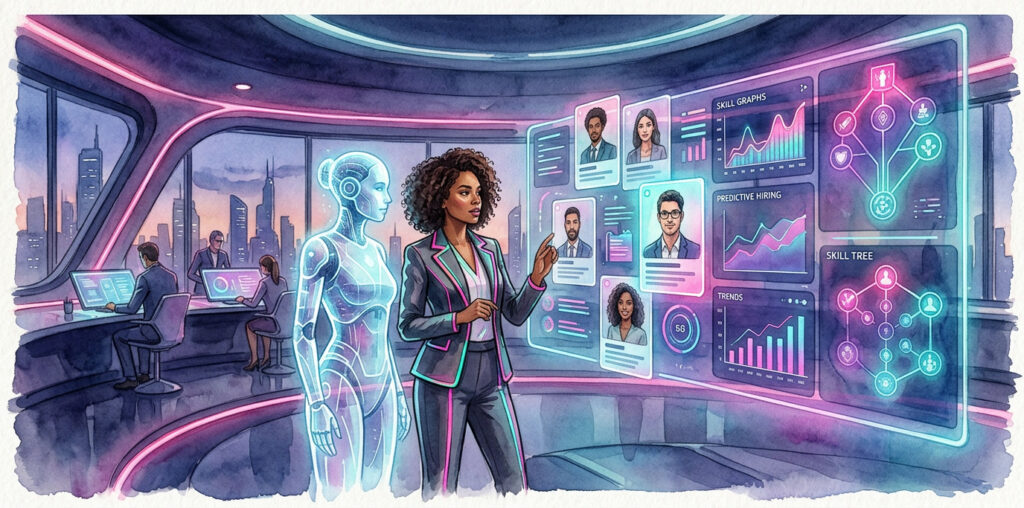
The Gamification of Interviews: Your Career as an RPG Skill Tree
Think about the last RPG you played seriously. Every decision you made—which quests to take, how you allocated skill points, how you adapted when a boss didn’t go as planned—revealed your playstyle more accurately than any character sheet ever could. Now imagine if hiring worked the same way.
AI-powered video assessment platforms like HireVue and Pymetrics have moved from novelty to cornerstone in the enterprise hiring stack. But the 2026 iterations have shed their uncanny-valley awkwardness and become genuinely sophisticated evaluation environments. Candidates don’t just answer questions—they navigate scenario-based challenges designed to surface real competencies under pressure.
This “RPG Skill Tree” model of evaluation is genuinely more equitable than traditional interviewing. A developer who attended a non-target university but solves architecture problems brilliantly will score the same as one from MIT—because the system is measuring what you actually do, not where you’ve been.
This resonates with audiences who grew up gaming. Just as skill-based progression systems reward effort over background in titles built by the best game studios, AI assessments are making the professional world operate on similar meritocratic rails. Even tools used in virtual meeting environments for game developers are being adapted as evaluation layers.
The candidate experience question
Not everyone loves it. A persistent criticism of AI-driven assessments is the lack of human warmth—candidates report feeling like they’re performing for an algorithm rather than connecting with a company. The best platforms in 2026 have addressed this by building in human-review checkpoints at every stage and making the AI scoring transparent: candidates can see which competencies were evaluated and how they scored.
Hyper-Personalized Sourcing: Finding You Before You Apply
The most powerful shift in 2026 recruitment isn’t what happens after a candidate applies—it’s the elimination of the application as the first point of contact. AI sourcing tools have become sophisticated enough to identify passive candidates from behavioral signals across GitHub, LinkedIn, Stack Overflow, Behance, and niche community forums before those candidates have even considered switching jobs.
Where AI sourcing tools are hunting right now
- GitHub commit history: Contribution patterns, project complexity, language breadth, and collaboration behavior surface engineers who are actively building but not actively job-searching.
- LinkedIn engagement signals: Commenting on competitor content, visiting company pages, and sudden profile updates are high-confidence indicators of job-market curiosity.
- Niche forum activity: Contributions to game development communities, modding forums, and technical subreddits identify domain experts who may not have polished professional profiles.
- Publication and talk activity: Blog posts, open-source releases, and conference talks are treated as rich competency signals by modern sourcing AI.
- Skill trajectory: Someone who has mastered Unity, is now learning Unreal Engine, and is engaging with VR development content is signaling a growth path that some employers want to intercept early.
For talent teams hiring software development specialists or those building tools around geometry and game engine fundamentals, AI sourcing means the competitive moat is no longer budget—it’s speed and signal quality. A well-configured sourcing AI running on a startup’s budget can surface the same talent as an enterprise recruiter with a $50,000 LinkedIn Recruiter seat.
| Platform | Primary Use Case | AI Capability | Bias Auditing | Best For |
|---|---|---|---|---|
| Greenhouse | ATS + Pipeline management | Predictive scoring, structured interview kits | ✓ Full | Mid-market to Enterprise |
| Lever | ATS + CRM hybrid | Relationship intelligence, passive nurturing | ◑ Partial | Growth-stage startups |
| HireVue | Video assessment | NLP analysis, cognitive game assessments | ✓ Full | High-volume enterprise hiring |
| Pymetrics | Neuroscience-based assessment | Bias-aware trait mapping | ✓ Full | Diversity-focused orgs |
| Beamery | Talent CRM + sourcing | Predictive talent pooling, skill gap analysis | ◑ Partial | Long-horizon talent pipelines |
| SeekOut | Passive candidate sourcing | GitHub/LinkedIn cross-referencing, DEI filters | ✓ Full | Technical recruiting teams |
| SmartRecruiters | End-to-end ATS | Match scores, collaborative hiring AI | ◑ Partial | Global enterprise operations |
AI as Co-Pilot, Human as Captain: The Ethics Imperative
Every powerful tool carries proportional risk. AI recruitment is no different—and the industry learned this the hard way when early automated screening systems trained on historical hiring data reproduced the exact biases they were supposed to eliminate. A model trained on ten years of successful hires at a company that historically hired few women will learn to deprioritize women. The pattern is statistical. The outcome is discriminatory.
The 2026 response to this isn’t to pull AI out of the loop—it’s to redesign what “in the loop” means for human decision-makers.
The regulatory landscape
The EU AI Act’s high-risk classification of employment AI now requires documented algorithmic impact assessments before deployment. New York City’s Local Law 144 mandates third-party bias audits of any automated employment decision tool. These aren’t obstacles—they’re quality standards that the best HR-Tech platforms have already baked into their core architecture.
Forward-thinking organizations—including studios building the next generation of game development tools and experiences—are now appointing dedicated AI Hiring Auditors: human specialists who review algorithmic decisions weekly, investigate statistical anomalies, and own the accountability layer that no algorithm can carry on its own.
The Talent Race Has New Rules. Here’s How to Run It.
The AI recruitment revolution isn’t coming—it’s already mid-stride. The organizations winning the talent race in 2026 aren’t necessarily the ones with the biggest budgets or the most recognizable brands. They’re the ones who understood that AI doesn’t replace thoughtful hiring; it scales it. It takes the judgment of your best recruiter and runs it at ten thousand times the volume—if you’ve designed the system correctly.
For candidates, the message is equally clear: the black hole is closing. But the skills gap is widening. AI assessments surface genuine competency faster and more accurately than any interview panel ever did. If you’re building real skills—in code, in design, in strategy, in communication—the new system will find you. The question is whether you’re creating the signals that let it.
The best analogy for AI recruitment in 2026 isn’t a robot replacing a recruiter. It’s a GPS: it doesn’t drive the car, but no serious driver navigates without one. The talent race is faster, the map is bigger, and the tools are smarter. The captains who learn to use them will define the workforce of the decade ahead.
Whether you’re a remote game developer building your professional profile, a studio director scaling a team, or simply someone curious about where the future of work is heading—the signal is unmistakable: AI tools have permanently changed what it means to find talent, and to be found.
Related reading: Software Development Tips for Modern Teams · Why ADHD Professionals Excel in Gaming Industries · How AI NPCs Are Changing Game Development Hiring Needs · Game Development in 2025: Tools & Trends