
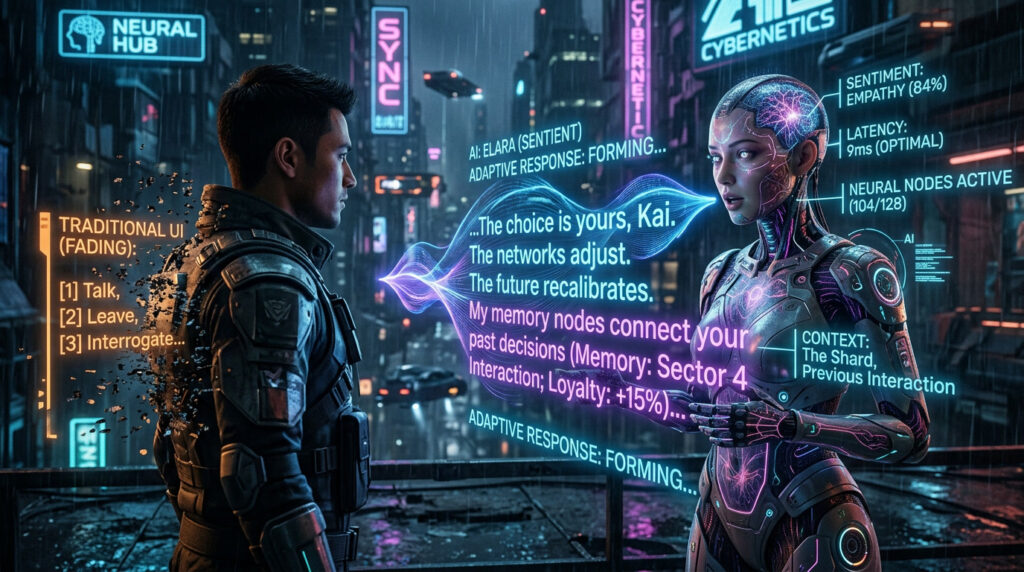
Something irreversible is happening inside game dialogue trees. For three decades, the NPC — the non-player character — has been one of gaming’s most elaborate illusions: a simulation of intelligence built from branching scripts, conditional flags, and the quiet prayer that players wouldn’t ask anything unexpected. Most didn’t. Now they can. And the industry is not ready.
The shift is already underway. Sony Interactive Entertainment has filed patents for real-time emotional response systems. Indie titles like Suck Up! and Vaudeville let players use freeform language to bypass traditional mechanics entirely. Inworld AI is quietly powering NPCs in games you haven’t shipped yet. The question was never if large language models would reach game characters — it was always what happens to storytelling when they do.
In this analysis, you will learn why Sony is betting on emotional AI, how indie developers are already weaponizing LLMs against their own game mechanics, and what the real technical ceiling looks like — hallucinations, latency, and the slow erosion of authorial intent. We’ll examine whether this represents a genuine evolution of narrative agency, or just an expensive new way for players to break immersion.
We’ll cover: Sony’s patent strategy and what it signals for AAA production pipelines; the indie LLM experiment landscape; the three technical challenges nobody is solving fast enough; and a frank assessment of what this means for narrative designers and game writers.
- Sony’s “real-time emotional NPC response” patents represent the first AAA commitment to LLM-integrated character systems at the hardware abstraction level.
- Inworld AI, Vaudeville, and Suck Up! demonstrate that prompt-driven interaction can replace — not just supplement — core gameplay mechanics.
- AI hallucinations in narrative contexts aren’t bugs; they’re design constraints that fundamentally change how writers must structure story logic.
- Latency bottlenecks (200–800ms for cloud inference) remain the primary barrier to “invisible” AI dialogue in real-time 3D environments.
- LLMs will not replace narrative designers; they will eliminate low-value scripting labor and require writers to think architecturally rather than linearly.
The Illusion of Choice vs. True Narrative Agency
Open any classic RPG dialogue wheel and you’ll find the same quiet lie: the appearance of a conversation, engineered by writers who had already decided every possible response before you loaded your save. The “Illusion of Choice” was never a criticism — it was the design philosophy. Fallout, Mass Effect, The Witcher 3. All masterpieces. All fundamentally theatrical rather than conversational.
The traditional model worked because players accepted the contract: you navigate options the developer wrote, and in return they give you a world that feels responsive. The modding communities around games like Fallout 4 exist precisely because players are always pushing past the edges of scripted space, trying to find where the world runs out of answers.
LLM-powered NPCs propose a genuinely different contract. Instead of navigating a decision tree, the player enters an open-ended semantic space. True narrative agency — the ability to say something the writer never anticipated and receive a coherent, in-character response — changes the fundamental relationship between player and story. It also, as we’ll explore, introduces failure modes that are orders of magnitude more complex than a missing dialogue flag.
The branching dialogue tree is a beautiful lie. LLMs are an ugly truth. The question is whether players want truth, or just a better-constructed lie.
— Emergent Narrative Design PrincipleSony’s Patent Strategy: What the Filings Actually Signal
Sony Interactive Entertainment’s patent activity around AI-driven NPC behavior deserves careful reading — not as marketing, but as infrastructure planning. The filings describe systems where character emotional states update in real time based on player actions, contextual environmental data, and prior interaction history. This is not a chatbot bolted onto a character model.
Sony Patent Focus: “Real-Time Emotional Response Systems”
Sony’s filings describe NPCs that maintain persistent emotional memory across sessions, adjust vocal tone and animation blend trees dynamically, and use Natural Language Processing (NLP) to parse player intent rather than match keyword triggers. The system architecture suggests integration at the game engine middleware level — meaning it’s designed to be a platform feature, not a game-specific novelty.
Why does this matter for game development studios specifically? Because Sony patenting at the middleware level signals an intent to make emotional AI a platform expectation — the same way haptic feedback became a PS5 differentiator through DualSense. Studios building for PlayStation in the next generation may face design requirements that assume NPC emotional continuity as a baseline.
What “Adaptive Storytelling” Means at the Hardware Level
The more technically interesting element of Sony’s filings is the relationship between the AI inference layer and the console’s hardware. Running LLM inference locally on a PS5 or PS6 class chip — rather than via cloud round-trips — would eliminate the latency bottleneck that currently makes real-time LLM dialogue feel sluggish. Edge inference for smaller, fine-tuned character models (7B–13B parameter range) is already technically viable on high-end mobile silicon. The question is whether Sony is building toward proprietary AI silicon in future hardware revisions, which their patent language strongly implies.
For game developers thinking about 2025 and beyond, this represents a genuine inflection point: the moment AI dialogue moves from a “cool tech demo” to a platform-level API you’ll be expected to support.
Indie Labs: Where LLMs Are Already Rewriting Game Rules
While Sony files patents, independent developers are already shipping the experiments. The indie sector — with its higher risk tolerance and direct player feedback loops — has become the de facto testing ground for prompt-driven interaction in games.
Inworld AI: The Infrastructure Layer
Inworld AI is the clearest example of what B2B AI infrastructure for games looks like in practice. Rather than a consumer product, Inworld provides a character engine — an API layer that game developers integrate to power NPCs with persistent memory, emotional modeling, and fine-tuned personality parameters. Studios using Inworld don’t just get a generic LLM; they get a system designed specifically for maintaining character consistency across long player sessions, which is where generic ChatGPT-style integrations tend to break down. The platform’s approach to “character brains” — separating personality, knowledge, and goal systems — is the most rigorous industry attempt so far at solving the authorial intent problem.
Suck Up! and the “Conversational Boss Fight”
Suck Up! is arguably the most commercially significant proof-of-concept for LLM-as-mechanic. The game’s core loop requires players to verbally convince NPCs to invite them inside — a social engineering puzzle powered by real LLM inference. The crucial design insight: the NPC’s LLM is the obstacle, not just flavor text. Players use Natural Language Processing to solve problems that scripts would normally gatekeep. When a player discovers they can charm their way past a “boss” character by constructing the right verbal argument, that’s emergent narrative in the most literal sense. It also means the game’s difficulty is partially determined by the player’s real-world ability to prompt an AI effectively.
This has enormous implications for horror game design, puzzle mechanics, and triple-A narrative experiences. If the lock is an LLM, the key is language — and language is unbounded.
Vaudeville and the Emergent Narrative Problem
Vaudeville takes a different approach: a murder mystery where suspects are powered by LLMs with hidden knowledge states. Players interrogate them freely, and the NPCs maintain their secrets (or don’t) based on their AI’s internal consistency. The failure mode here is instructive — because LLMs can be coaxed to “break character” with the right prompting, determined players can sometimes extract information the game design never intended them to have. Emergent narrative becomes emergent exploits. The line between a clever player and a cheating player dissolves entirely.
Scripted vs. LLM-Powered NPC Systems: A Technical Comparison
| Dimension | Traditional Scripted NPC | LLM-Powered NPC | Verdict |
|---|---|---|---|
| Player Input | Predefined options only | Freeform natural language | LLM Wins |
| Response Latency | <16ms (pre-cached) | 200–800ms (cloud) / 40–150ms (edge) | Script Wins |
| Narrative Control | Absolute authorial control | Probabilistic, requires guardrails | Script Wins |
| Localization Cost | Full re-recording per language | Prompt translation + TTS synthesis | LLM Wins |
| Content Scale | Bounded by writer hours | Effectively unlimited | LLM Wins |
| Consistency | Deterministic | Stochastic (hallucination risk) | Script Wins |
| Player Immersion Ceiling | Hard ceiling (script exhaustion) | Higher ceiling, different failure mode | Context-Dependent |
| Production Cost | High upfront (writers + QA) | High inference cost at scale | Context-Dependent |
The Three Technical Challenges No One Is Solving Fast Enough
AI Hallucinations in Narrative Context
LLMs generate plausible-sounding text that may contradict established lore, character history, or world facts. In games, a hallucination isn’t a factual error — it’s a lore-breaking story event. Systems require extensive RAG (Retrieval-Augmented Generation) pipelines to keep characters “grounded.”
Latency Bottlenecks
Cloud inference at 200–800ms is acceptable for turn-based games and dialogue menus. For real-time action titles, even 200ms creates uncanny valley moments where the NPC “thinks” before responding. Edge inference is coming — but not uniformly deployed across platforms yet.
Loss of Authorial Intent
Traditional writers control every word a character speaks. LLMs produce statistically likely continuations of a character prompt. The result can be a character who feels broadly right but is never precisely what the writer intended. Preserving narrative integrity at scale requires architectural thinking, not just good prompting.
The Latency Architecture Problem in Detail
The latency challenge deserves specific attention because it’s the constraint most likely to determine which game genres adopt LLM NPCs first. Turn-based games, visual novels, and point-and-click adventures have natural dialogue pauses — an 800ms LLM response window fits inside the genre’s existing rhythm. Real-time 3D games do not have that luxury. Players expect NPC responses to feel instantaneous in the way pre-cached audio does.
The most promising architectural solution is streaming inference with pre-emptive audio synthesis: begin generating audio from the first tokens of LLM output before the full response is complete. This requires tight integration between the LLM inference layer, a text-to-speech synthesis system, and the game engine’s audio scheduler — which is exactly the kind of vertical integration that Sony’s patent filings describe as a platform-level feature. For developers working on VR games where presence is paramount, latency is not a performance metric — it’s a design constraint that determines whether the entire experience is viable.
Guardrails and the Narrative Safety Layer
A less-discussed technical challenge is content safety in open-ended NPC dialogue. Scripted systems are inherently safe — a writer reviewed every line. LLM systems require runtime moderation: either a secondary classifier that evaluates outputs before they’re played, or carefully constructed system prompts and fine-tuned weights that reduce the probability of off-brand outputs. Neither solution is perfect. Over-aggressive guardrails create NPCs that refuse to engage with thematically dark content — a significant problem for horror game developers and narrative titles dealing with mature themes. Under-aggressive guardrails create PR incidents.
What This Means for Developer ROI and Production Pipelines
The business case for LLM NPCs is genuinely complex — and mostly misunderstood. The naive read is “replace writers with AI, save money.” The realistic read is almost the opposite in the short term: adding LLM capabilities to an NPC system increases production complexity significantly, requires new expertise (prompt engineering, RAG architecture, inference infrastructure), and introduces ongoing per-inference costs that scale with player engagement.
The ROI case is strongest in three scenarios. First, localization at scale: LLM-powered NPCs with text-to-speech synthesis can be localized into 20 languages for a fraction of the cost of re-recording 3,000 lines per language. Second, long-tail content generation: procedurally generated quests, ambient NPC chatter, and side-character dialogue that would never justify a writer’s time can be handled by fine-tuned models at minimal marginal cost. Third, player retention through novelty: if every player’s experience with a key character feels meaningfully different, replay value increases in ways that scripted systems fundamentally cannot achieve.
Studios working on game development in 2025 need to evaluate which of these three cases applies to their project — and resist the temptation to add LLM features for the press release rather than the player experience. The best game development tools in 2025 are the ones that solve real design problems, not the ones with the most impressive demos.
The Indie Advantage in the LLM Race
Counterintuitively, smaller studios may have structural advantages in this transition. AAA production pipelines require sign-off from legal, narrative, QA, and platform certification teams — all of whom have legitimate concerns about open-ended LLM outputs. A two-person indie team can iterate on a Suck Up!-style LLM mechanic in weeks, learn what works, and ship. The most innovative game developer studios in 2025 will not necessarily be the largest — they’ll be the ones most comfortable operating in probabilistic design space.
Scripted dialogue is a solved problem. LLM dialogue is an unsolved one. The industry is about to spend a decade discovering all the ways it can fail — and that’s not pessimism. That’s how technology matures.
— On Emergent Narrative DesignConclusion: Tools, Not Replacements — But the Tools Will Change Everything
Will LLMs replace game writers? The question is framed incorrectly. LLMs will not replace narrative designers any more than non-linear editing software replaced film directors. What they will do is eliminate specific categories of labor — the grinding work of writing 47 variations of “Hello, adventurer” in 12 languages, the QA cycles spent checking that flag combinations don’t produce broken dialogue, the compromises made because a branching tree can only branch so many times before the budget runs out.
What they require in return is a different kind of writer: someone who thinks in systems and constraints rather than scenes and lines. A narrative designer working with LLM NPCs is closer to a game systems designer than a screenwriter — they define what a character knows, what it wants, what it will never say, and how it resolves contradictions. The actual words are generated at runtime. This is a profound shift in creative workflow, and not every writer will find it satisfying.
Sony’s patents tell us the hardware layer is coming. Inworld AI and the indie experiments tell us the game design possibilities are real. The latency and hallucination data tell us we are early — very early — in understanding how to use these tools responsibly. For developers building today, the pragmatic move is to identify the specific friction point in your game’s dialogue system — localization cost, content volume, player expressiveness ceiling — and evaluate whether LLM tooling solves that specific problem better than your current approach.
The scripted dialogue era is not ending. It’s being absorbed into something larger — a design space where scripts define the skeleton and language models breathe into the spaces between. The games that figure out that balance first will define what NPCs feel like for the next decade. The studios watching from the sidelines, waiting for the technology to be “solved,” will find themselves playing catch-up in a world that already moved on.