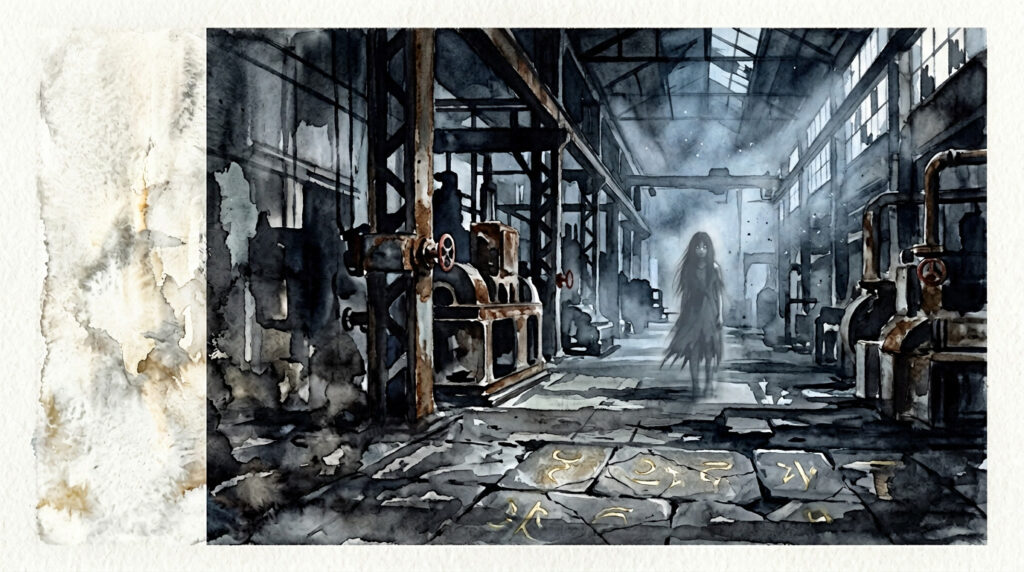
You’re in an abandoned factory, there’s a ghost girl who may or may not want you dead, and somewhere in those rusted halls are stone slabs that can change everything. Here’s the full breakdown.
- Shards of Solitude is a first-person survival horror on Steam (April 2026, Chilling Designs) — not a Roblox or mobile game.
- The “Shards” are inscribed stone slabs scattered across the factory map, required to perform the binding ritual.
- There are 7 endings total: 3 on Normal, 3 on Hard, and 1 secret ending tied to specific choices and all slabs collected.
- Slab placement is procedurally randomised every run — zone knowledge beats any fixed item guide.
- No HUD counter exists for slabs — you track the count yourself, which is the game’s cruelest design choice.
You went to an abandoned factory looking for nothing in particular. You found Miyuki — a ghost girl with a split personality and a disturbingly strong grip on who gets to leave. Now you’re trapped, and the only path to a different fate runs through a handful of scattered stone slabs hidden somewhere in those rusted halls.
If you’ve been wandering in circles trying to figure out what the Shards actually do, why the ritual keeps failing, or how all seven endings connect to the items you collect — this guide covers everything. It’s the kind of horror game experience that rewards patience over panic. So let’s slow down and do it right.
What Are the Shards (Stone Slabs)?
In Shards of Solitude, the collectibles the community calls “Shards” are officially in-game stone slabs — ancient inscribed fragments tied to a supernatural ritual. They are not currency, not crafting materials, and not passive pickups. Their entire purpose is to unlock the ritual ending path, which lets you bind Miyuki rather than simply escape — or die trying.
Each slab carries a piece of information: fragments of Miyuki’s true name and her recorded date of death. Assembled together, they make it possible to perform the binding ritual at a designated altar location inside the factory. Miss even one, and the ritual fails completely — no partial credit, no workaround.
This connects directly to what makes the game stand apart from genre peers. Compare it to something like surviving a horror game as a maid or the frantic item collection in Zoochosis — the slab system here is slower, more deliberate, and emotionally weighted in a way those games aren’t.
The factory map is procedurally configured in terms of item placement. Every run, the slabs spawn in different rooms. This is intentional — the developer designed the game so that players must build a mental model of the factory rather than follow a checklist. Players who’ve memorised door sequences, locked zone routes, and safe corners perform dramatically better.
The second problem: there’s no UI counter tracking collected slabs. You track this yourself. Community feedback consistently names this as the sharpest friction point in the game — and the most unforgiving one when you arrive at the ritual altar one slab short.
Shard Spawn Zones — Factory Map Breakdown
Because placement is randomised, the real knowledge is which zones can contain slabs. Below are the confirmed spawn regions documented across many player runs. Sweep these systematically before Miyuki’s passive phase ends.
High shelving and crate stacks. Check floor-level behind large containers — slabs blend directly into concrete textures here.
Near inactive furnaces. Low light — toggling your lamp is almost mandatory. One of the most consistent spawn areas across runs.
Accessible only after the first key. Off the main loop and rarely patrolled early — worth prioritising for that reason alone.
Most open area — most dangerous. Miyuki’s detection arc is at its widest here. Sprint searches only; never linger.
Small side room via north corridor. Slabs often appear on the desk surface or inside the cabinet near the window.
Vertical search required. Check both first and second level landings — the slab glow is subtle against rusted metal railings.
All 7 Endings — What the Shards Unlock
Your relationship with slab collection determines which endings are reachable. Hard difficulty unlocks three additional conclusions, and a seventh secret ending sits beyond all of them — requiring specific choices across the entire run, not just at the end. If you enjoy discovering branching conclusions in narrative horror, this structure puts Shards alongside games like Doki Doki Literature Club and Lake of Voices in terms of how much your choices actually matter.
| Ending Name | Difficulty | Shard Requirement | Notes |
|---|---|---|---|
| Just Let Me Go | Normal | None — escape without ritual | Standard escape route. Achievement: “Just let me go!” |
| Together. Forever. | Normal | Accept Miyuki’s help mid-run | Trust her during passive phase. Achievement: “I trust you” |
| Resignation to Fate | Normal | None — die without resisting | Does not count toward completion achievements |
| Liberation | Hard | All slabs collected + ritual performed | The “true” ending. Achievement: “Reach the Liberation ending” |
| A Deserved Fate | Hard | Ritual attempt fails | Secret-tagged — precise conditions still being documented by the community |
| Hard Escape | Hard | None — reach exit on Hard | Miyuki is in lethal state throughout; significantly harder than Normal escape |
| Secret Ending | Secret | All slabs + specific passive-phase choices | Trigger community-contested as of June 2026. Likely tied to ritual sequence decisions |
How to Collect Shards Efficiently
The ritual ending — and the Liberation achievement — is the hardest content in the game. Community consensus points to the slab-hunting phase during Miyuki’s aggressive state as where most players fail. This is one of the more demanding horror titles to 100% complete for a reason. Here’s what actually works.
- ◈ Memorise the map layout in Normal first. Room connections don’t change between runs even when item placement does. Two or three Normal clears will build the mental map you need for Hard mode slab routes.
- ◈ Use the passive phase aggressively. In Normal, Miyuki stays non-hostile for several minutes at the start. Use every second to identify slab spawn locations before she shifts state — mark rooms as you move.
- ◈ Place traps near high-density zones. The boiler room and eastern corridor are prime positions — they slow Miyuki down long enough to grab a slab and break line-of-sight before she recovers.
- ◈ Track your count manually. No HUD counter exists. Some players count aloud; others use fingers. Arriving at the ritual altar one slab short means a full run restart — the game has no checkpoints for the ritual phase.
- ◈ The pistol is a delay tool, not a kill weapon. Shooting Miyuki temporarily neutralises her — it doesn’t end the encounter. Save shots for when you’re one slab away and she’s closing fast.
- ◈ Avoid the central factory floor when she’s hostile. Her detection arc in open space is the widest on the map. Clear perimeter rooms first; save the floor for when you’re nearly done with slab collection.
The Ritual — What Happens After You Collect Everything
“She’s just lonely. That’s all this ever was — loneliness with nowhere to go.”
Once you have all slabs, the ritual phase begins at a fixed altar inside the factory. The challenge shifts from scavenging to navigation: you must follow Miyuki’s voice to reach the correct location. The problem is that the factory’s acoustics create heavy reverb, making her exact position genuinely difficult to pinpoint on a first attempt.
Going the wrong direction in the ritual phase means instant death and a full run restart — not a checkpoint. This is the mechanic the community debates most sharply. The reward for getting it right is the Liberation ending, which recontextualises Miyuki’s entire arc and is considered the game’s most emotionally complete conclusion.
For the secret ending, player-documented evidence suggests that specific interaction choices during the passive phase — including accepting Miyuki’s help (the “I trust you” achievement) — influence the ritual sequence outcome. This is still being actively tested as of June 2026. This kind of multi-layered emotional horror, where trust and antagonism are mechanically intertwined, is what separates Shards from straightforward casual horror experiences.
Understanding Miyuki’s Dual Personality
The shard-hunting experience changes drastically depending on which state Miyuki is in. Her split personality is not just narrative texture — it’s the core mechanical tension of the game. Learning to read which state she’s in before committing to a slab pickup is one of the highest-skill elements of play.
- Non-hostile and curious in her movements
- Occasionally makes playful gestures toward the player
- Can be interacted with (hugs, poses) without triggering aggression
- Ideal window for mapping slab locations across the factory
- Interaction choices here may affect secret ending conditions
- Actively hunts the player through factory zones
- Places traps independently throughout the map
- On Hard: gains a lethal mode making direct confrontation near-impossible
- Detection triggered by proximity, line-of-sight, and loud movement
- Central factory floor detection arc is at maximum range
The emotional dissonance of this design is deliberate. You are collecting ritual materials to bind someone who is, by the game’s own notes, just lonely. That weight is exactly what puts Shards of Solitude in the same conversation as Your Boyfriend, Saiko No Sutoka, and other games where the horror comes from a relationship rather than a monster. If Homicipher made you feel something uncomfortable about your captor, Miyuki will do the same.
It also has something in common with narrative horror like Slay the Princess, where the act of following the “correct” mechanical path forces you to confront what that path costs. The slab-hunting loop carries that thematic burden the whole time.
Common Mistakes That Reset Your Run
Beyond slab hunting, players consistently lose runs to a handful of the same avoidable errors. These come up especially for players coming in from other single-player horror titles where resource management is more forgiving.
Burning pistol shots early: The pistol creates breathing room, not kills. Players who use early shots for comfort find themselves defenceless during the slab-heavy mid-run phase when Miyuki has fully entered her aggressive state.
Ignoring the passive phase: The early calm window exists specifically to let you scout. Players who grab only the first visible slab and wait for aggression to start have effectively halved their safe exploration time and go into the hostile phase without a clear mental map.
Attempting the ritual at the wrong altar: There is one correct ritual location. Players who use an incorrect location during the voice-following phase trigger instant death. Listen carefully for which direction the voice source is clearest, and move slowly — this is the one moment in the game where speed punishes you hardest.
Not counting slabs: Again: no HUD counter. The number of players who’ve reached the altar missing one slab is the most common complaint across community forums. Count. Every. Run.