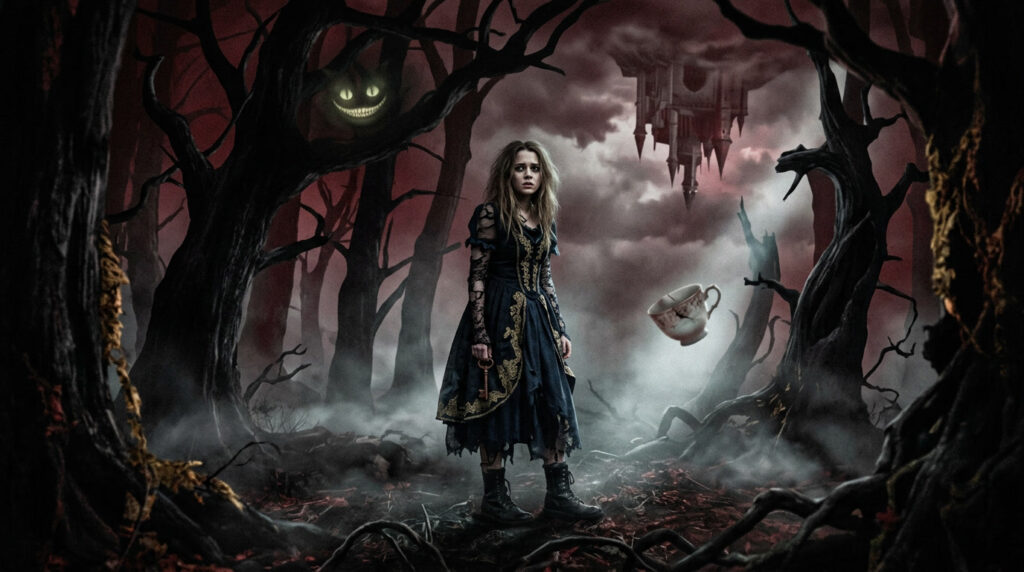
Lewis Carroll never intended to write a horror story. He wrote a dream. But dreams and nightmares share the same architecture — and Wonderland has always sat one teacup away from total psychological collapse. A little girl falls into an impossible world with no map, no rules, and no way home. Creatures speak in riddles. The queen sentences people to death for losing a croquet match. Time itself breaks. If you strip away the pastel illustrations and read Carroll’s original text with fresh eyes, the terror is already there — just waiting for the right medium to set it loose. That medium, as it turns out, is the Alice in Wonderland horror game.
This article traces the dark lineage of Wonderland in interactive horror — from genre-defining masterpieces to the indie projects quietly reshaping psychological horror — and asks why this 19th-century fever dream remains the most powerful raw material in surrealist gaming.
Why Wonderland Is Already a Horror Setting
The argument doesn’t require much stretching. Carroll’s Wonderland operates on dream logic — cause and effect mean nothing, identity is fluid, and authority figures are capricious and violent. Alice shrinks, grows, nearly drowns, and faces an executioner queen before breakfast. These aren’t comforting elements hiding behind bright colors. They are the raw skeleton of existential dread.
Psychoanalysts have long treated Wonderland as a landscape of the unconscious. The rabbit hole is birth trauma. The Caterpillar is the threat of ego dissolution. The Mad Hatter’s tea party is a social ritual emptied of meaning — endlessly repeated, going nowhere. For horror game designers, this is a treasure chest. You don’t need to invent the monster. You just need to turn the lights off.
Retrospective: The Gold Standard of Dark Wonderland
American McGee’s Alice (2000)
Released by Rogue Entertainment and Electronic Arts, American McGee’s Alice arrived like a sledgehammer to the face of what gaming thought Wonderland could be. The premise is brutal: Alice Liddell survives a house fire that kills her family, is committed to Rutledge Asylum, and escapes into a shattered Wonderland that mirrors her fractured psyche. Every environment reflects a broken piece of her trauma — the Queensland castle drips with blood, the Hatter’s domain is a steampunk abattoir of gears and screaming.
- Trauma as world-building: Wonderland’s decay maps directly to Alice’s psychological state
- Gothic art direction: Victorian grotesque meets surrealist horror — angular shadows, organic corruption
- Weapon design as metaphor: The Vorpal Blade, Jack-in-the-Box bombs, and Blunderbuss each carry Wonderland iconography twisted into instruments of violence
- Unreliable space: Levels shift and contradict themselves — architecture that shouldn’t stand, rooms that loop
The game’s impact was seismic. It proved that beloved children’s IP could carry dark fantasy themes without feeling cheap or exploitative — because the source material genuinely supported that reading. McGee didn’t vandalize Carroll. He excavated him.
Alice: Madness Returns (2011)
The sequel, developed by Spicy Horse, pushed deeper into the mechanics of repression. Alice: Madness Returns structures itself around recovered memory — Alice is trying to remember what really happened the night of the fire, and each Wonderland domain she enters is a distorted echo of a real-world trauma. The Dollmaker villain, who erases memories and unmakes identity, is one of gaming’s most effectively disturbing antagonists precisely because he represents forgetting itself.
- Memory corruption: Environments visually glitch and degrade as Alice approaches suppressed truths
- Hysteria mode: A gameplay state where Alice becomes powerful but the screen fractures — power tied to psychological breaking points
- Steampunk-Gothic fusion: The Infernal Train domain merges Industrial Revolution horror with Carroll’s dream logic
- Narrative unreliability: Players constantly question whether what they’re seeing is real, remembered, or invented
Together, these two games established a template: Wonderland horror works best when it’s intimate. When the horror isn’t monsters in the dark, but the protagonist’s own mind turning against her. You can read more about how the best horror games use similar techniques of psychological pressure across the genre.
The Indie Frontier: Wonderland After McGee
The absence of a third American McGee title — despite years of crowdfunding attempts and public demand — left a vacuum. The indie scene filled it with creative ferocity.
Alice: Liddell’s Nightmare (itch.io) leans into visual novel horror, using Carroll’s text as liturgy and corrupting it line by line. Fan projects on itch.io regularly surface with titles like Broken Looking Glass and The Hatter’s Hour, exploring the Alice mythos through point-and-click dread and RPG Maker surrealism. These aren’t AAA productions — but they demonstrate the enduring pull of this horror iconography on independent creators.
What unites the best of these indie projects is their understanding of scale. They don’t try to out-spectacle McGee. They go smaller and more personal — a single room, a single memory, a tea party that never ends. The horror is claustrophobic, intimate, and lingering. Think about how games like Doki Doki Literature Club reframe familiar, gentle aesthetics as vectors for dread — the Alice sub-genre operates on the same principle.
Mechanics of Madness: How Insanity Works in Gameplay
The most interesting design challenge in Alice-inspired horror is mechanical: how do you make a player feel insane without making the game unplayable?
Visual Distortion
Chromatic aberration, warping geometry, and color desaturation signal deteriorating mental states. The world physically becomes less reliable as sanity drops.
Unreliable Narration
The player receives information — through voiceover, text, environmental storytelling — that actively contradicts itself. Truth becomes a moving target.
Surreal Level Design
Non-Euclidean spaces, rooms that loop, staircases leading to their own beginnings. Architecture becomes adversarial — the map cannot be trusted.
Dream Logic Puzzles
Solutions that operate on emotional rather than rational logic. Feeding the right object to the wrong character. Speaking backwards. Solving grief, not sums.
The genius of Madness Returns’ hysteria system was tying power to breakdown. The more damaged Alice became, the more capable she was of violence — a perfect metaphor for trauma survivors who develop fierce resilience at the cost of peace. This kind of horror game design rewards emotional intelligence, not just reflexes. Compare this to Homicipher‘s approach to psychological unease — the best horror mechanics always operate on a level below the conscious.
Tech Spotlight: What a Modern Alice Horror Title Could Become
Imagine an Alice horror game built on Unreal Engine 5’s Nanite and Lumen systems. The implications are staggering.
- Nanite geometry: Infinite geometric complexity means Wonderland’s architecture could twist and mutate in real-time — walls breathing, floors dissolving — without performance hits
- Lumen global illumination + Ray Tracing: Light becomes narrative. Candlelight pooling in corrupted Victorian interiors. The Queen’s roses casting blood-red shadows that move independently of their source
- Spatial Audio (Dolby Atmos / Steam Audio): The Cheshire Cat’s voice drifting from behind walls that don’t exist. The Mad Hatter’s laugh positioned above, then below, then inside the player’s head. Sound design as psychological weapon
- MetaHuman + facial capture: Alice’s face rendering micro-expressions of dissociation — the uncanny valley weaponized as horror tool
- Procedural world corruption: Machine learning-driven environmental decay that responds to player choices, making each playthrough’s Wonderland uniquely fractured
The VR dimension is equally compelling. A Wonderland horror experience in full VR — with spatial audio and haptic feedback — would be genuinely unprecedented in its capacity to induce psychological horror. When you can look up and see the Red Queen’s castle hanging upside down above you, the vertigo becomes visceral rather than visual. Paired with modern game development tools, the technical ceiling for this concept has essentially disappeared.
Final Verdict: The Enduring Legacy of Dark Wonderland
Alice Liddell has spent over 150 years tumbling down that rabbit hole, and she shows no signs of stopping. What Carroll accidentally created — and what American McGee deliberately excavated — is the perfect horror text: a world that is already broken, already strange, already cruel. A protagonist already traumatized. A landscape that is, by its own rules, impossible to navigate safely.
The Alice in Wonderland horror game subgenre endures because it taps something deeper than jump scares or monsters. It taps the horror of a mind that can no longer trust its own perceptions. In an era when psychological horror is the dominant creative mode — when the best horror explores PTSD, dissociation, grief, and identity dissolution — Wonderland is more relevant than ever.
The next great Alice horror title is coming. When it does, it won’t need to invent its terror. It just needs to hold a mirror up to Carroll’s original vision — and let us see what was always looking back. Explore more horror game recommendations and keep watching the horizon for what dark season brings next.