You saw the trailer. A silent girl in a broken spacesuit. A robotic cat. The Moon’s surface cracked open like old bone. Your first instinct was probably: this looks terrifying. And you’re not wrong to think that.
Capcom has spent decades building one of the most iconic horror pedigrees in gaming. So when a new IP arrives wrapped in eerie silence and desolate lunar landscapes, the question feels inevitable: Is Pragmata a horror game?
The short answer is no — but the full picture is far more interesting than a simple label. In this analysis, we’ll decode every trailer signal, examine Capcom’s official statements, and map Pragmata’s DNA against the genre landmarks players actually know. By the end, you’ll understand exactly what kind of game this is, and why it might be something better than horror.
⚡ Key Takeaways
- Pragmata is officially a Sci-Fi Action-Adventure, not a survival horror game — Capcom has categorized it separately from its RE Engine horror titles.
- The game’s uncanny, atmospheric visuals borrow horror aesthetics (isolation, the lunar void, an unsettling android companion) without deploying horror mechanics like resource scarcity or jump scares.
- Think tone of dread without the genre of fear — closer to Death Stranding’s mood than Resident Evil’s mechanics.
- Pragmata targets PS5 and next-gen hardware, using the RE Engine to build a visually ambitious world around a dystopian future Earth.
The Capcom Legacy: Why the Confusion?
Capcom’s reputation precedes every new project it touches. The studio gave us Resident Evil, one of the founding texts of survival horror. It gave us Devil May Cry’s stylized action and Monster Hunter’s grind. But horror is the word that sticks. When Capcom shows a dark, atmospheric world with a small, vulnerable character, players default to pattern recognition — and the pattern says “horror.”
That instinct isn’t irrational. The RE Engine, first deployed in Resident Evil 7, has become Capcom’s workhorse — and it’s been used almost exclusively in horror and horror-adjacent games: Resident Evil 2 Remake, Village, Returnal-esque scenarios. When Pragmata was confirmed to use RE Engine technology, the horror assumption deepened further.
But engine choice is not genre. Capcom has always been genre-fluid — Dragon’s Dogma is a fantasy RPG, Street Fighter is a fighter, Ace Attorney is a legal drama. The horror label fits the studio’s commercial center of gravity, not its entire output. Pragmata represents Capcom stepping deliberately into different territory, and the studio has been clear about that from the start.
Decoding the Pragmata Trailers
The debut trailer, first unveiled at a PlayStation showcase, is a masterclass in controlled atmosphere. It is also, intentionally or not, a generator of genre confusion. Let’s break down the elements that read as horror — and what they actually signal.
The Robotic Cat
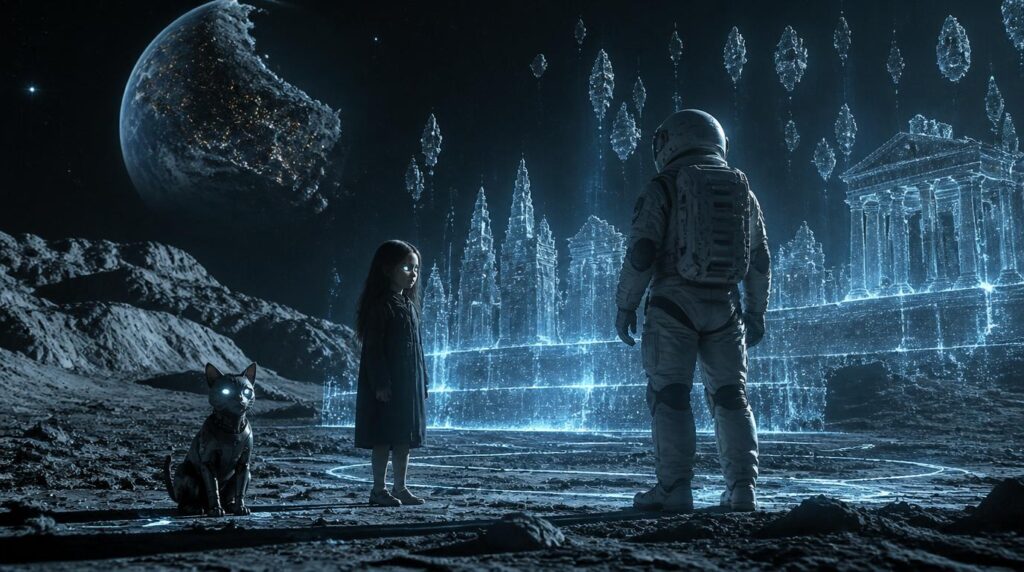
The mechanical feline companion is the trailer’s most unsettling visual. Its movements are slightly off — too smooth, too precise. This is the uncanny valley at work: the sensation of something that looks almost real but triggers a deep, instinctive wrongness. Horror games weaponize this constantly. But in Pragmata’s context, the cat appears to be a companion unit — a technological artifact in a world where technology has outlasted human warmth. It’s eerie, yes. It’s not malevolent.
Diana — The Silent Girl
Diana is the emotional core of the trailer. A young girl, seemingly without explanation or origin, encountered by a suited figure on a broken Moon. Her silence and passive presence echo the horror tradition of the “mysterious child” — think Bioshock’s Little Sisters or the girl from Ico. But Diana isn’t a threat or a symbol of danger. She appears to be a ward, someone to protect, which shifts the tone from dread to something closer to melancholy and purpose.
The Lunar Setting
A desolate Moon. Cities projected as holograms onto its surface. A future Earth presumably in ruins below. This is the backdrop of dystopian sci-fi, not haunted-house horror. The visual references are closer to Interstellar, Blame!, or 2001: A Space Odyssey than to anything in the RE canon. Space is cold and empty — that reads as horrifying in human terms — but it’s atmospheric dread, not manufactured fear.
Official Genre Classification
Capcom has officially described Pragmata as a sci-fi action-adventure. That genre label carries real mechanical implications that separate it categorically from survival horror.
In survival horror, the design pillars are resource scarcity, enemy avoidance, limited saves, and tension built through vulnerability. You survive against the environment. In action-adventure, the player is empowered — the protagonist has tools, has agency, and moves through the world with competence. The threat level is managed, not imposed.
Pragmata’s unnamed protagonist wears a full tactical suit, carries what appear to be advanced weapons, and navigates the lunar environment with clear purpose and mobility. None of that is survival horror language. It’s the visual vocabulary of action sci-fi — a world with danger, but a hero equipped to face it.
This aligns Pragmata with Capcom’s non-horror catalog more than its RE lineage. If you’ve played triple-A action games from major studios, you’ll recognize the template: cinematic world, empowered protagonist, layered narrative delivered through environment and character interaction.
Pragmata vs. Resident Evil vs. Death Stranding
The most instructive comparison isn’t Pragmata to horror games — it’s Pragmata to atmospheric games with overlapping tones. Here’s how it maps against the genre anchors players are already using as reference:
| Category | Pragmata | Resident Evil | Death Stranding |
|---|---|---|---|
| Atmosphere | Cold, melancholic, vast lunar isolation. Beauty through emptiness. | Claustrophobic, oppressive. Tension through confinement and darkness. | Desolate, post-apocalyptic. Quiet dread across open landscapes. |
| Combat | Action-forward; tactical suit suggests combat agency and mobility. | Resource-limited; every bullet counts. Survival through restraint. | Avoidance-first; direct confrontation discouraged. Stealth and evasion. |
| Resource Management | No confirmed scarcity mechanics. Action-adventure inventory expected. | Core mechanic. Ammo, health, and inventory space are constant pressures. | Heavy management of cargo, stamina, and delivery routes. |
| Theme | Dystopian future, human connection, technology and loss. | Biological horror, corporate corruption, survival against infection. | Societal collapse, isolation, the cost of reconnection. |
| Fear Factor | Low intentional fear. High atmospheric unease. | High. Jump scares, enemy design, and tension are design goals. | Moderate. Existential dread, not visceral horror. |
The closest genre sibling isn’t Resident Evil — it’s Death Stranding. Both games use desolation as a canvas. Both center on a lone figure moving through a broken world with a companion. Both earn their emotional weight through atmosphere rather than fright. If you’ve explored other narrative-first single-player experiences, Pragmata fits that lineage far more naturally than the horror shelf.
Atmosphere vs. Fear: Is It Actually Scary?
🔴 Horror Game Markers
- Jump scare design
- Resource scarcity
- Intentional helplessness
- Enemy-driven tension
- Psychological manipulation
- Limited save systems
🔵 Pragmata’s Actual Signals
- Environmental melancholy
- Uncanny companion design
- Isolation as backdrop
- Empowered protagonist
- Mystery-driven narrative
- Cinematic pacing
There is a meaningful difference between a game that is scary and a game that is unsettling. Horror games weaponize fear — they build systems around your discomfort. Atmospheric sci-fi games use unease as texture. The world feels wrong, not because something is hunting you, but because the world itself has been broken in ways that feel irreversible.
Pragmata looks built for the second category. The lunar setting, the silent girl, the holographic ruins of civilization — these are signs of a world that has already been through its disaster. The horror is past tense. What the game puts in front of the player is the aftermath, and that’s a fundamentally different emotional register.
This doesn’t make Pragmata less affecting. Some of the most powerful gaming experiences — Shadow of the Colossus, Nier: Automata, Journey — draw from the same well. They make you feel something without ever trying to frighten you. If Pragmata executes on its promise, it could belong to that lineage.
Players who enjoy exploring atmospheric, story-driven worlds might also want to look at relaxing game formats or actual horror options to understand just how different the tonal registers are in practice.
For those specifically drawn to the horror side of Capcom’s catalog, the comparisons are direct: titles like Arkham Horror and games built around explicit horror mechanics represent a completely different design philosophy than what Pragmata is building toward.
Capcom is making a game about loneliness and survival in a dead world. The Moon doesn’t need monsters. It is already the monster.
Frequently Asked Questions
Pragmata is not a horror game. It is something more precise — and arguably more ambitious. It uses the visual language of dread to tell a story about connection and loss in a world that has already ended. That’s a harder thing to build than fear. Fear is easy to trigger. Melancholy takes craft.
If you’ve been following Capcom’s evolution across its major franchises, this feels like a deliberate signal: the studio is expanding its creative vocabulary. Players who love narrative-driven game design and cinematic next-gen experiences should be watching Pragmata very closely.
The Moon has never looked this lonely. And that’s exactly the point.