You’ve watched it happen. A player who “can’t focus” spends six unbroken hours perfecting a roguelike run. That contradiction isn’t willpower — it’s neuroscience. This article unpacks the brain biology behind ADHD engagement in games and shows you how to apply it deliberately in your design work.
The dopamine deficit: what ADHD brains are actually chasing
ADHD is not a deficit of attention. It’s a deficit of dopamine regulation. Research into dopaminergic pathways consistently shows that ADHD brains produce and recycle dopamine less efficiently, particularly in the prefrontal cortex — the region governing planning, impulse control, and sustained effort.
This matters because dopamine isn’t just a “reward chemical.” It’s a salience signal. It tells the brain: “this moment is worth paying attention to.” Without a reliable baseline, everything feels equally unimportant — until something triggers a spike.
Games are dopamine delivery systems. Every kill confirmation, level-up chime, loot drop, and combo counter is a precision-engineered salience event. For neurotypical players, these are pleasant bonuses. For ADHD players, they’re neurological anchors — the thing that makes the present moment feel real.
Key entity: Dopaminergic pathways govern motivation and reward prediction. ADHD disrupts tonic dopamine levels, making phasic spikes from external stimuli disproportionately engaging. Games are built almost entirely from phasic spikes.
Variable reward schedules — the same mechanism behind slot machines — work powerfully here. Intermittent, unpredictable feedback amplifies dopamine response more than guaranteed rewards do. Game designers use this constantly, often without realising they’re writing a neurological prescription.
The feedback loop: games as external executive function
Executive function is the brain’s project manager. It handles task initiation, working memory, time perception, and goal prioritisation. In ADHD, the project manager is unreliable — not absent, but inconsistent. They show up late, forget the agenda, and get distracted mid-meeting.
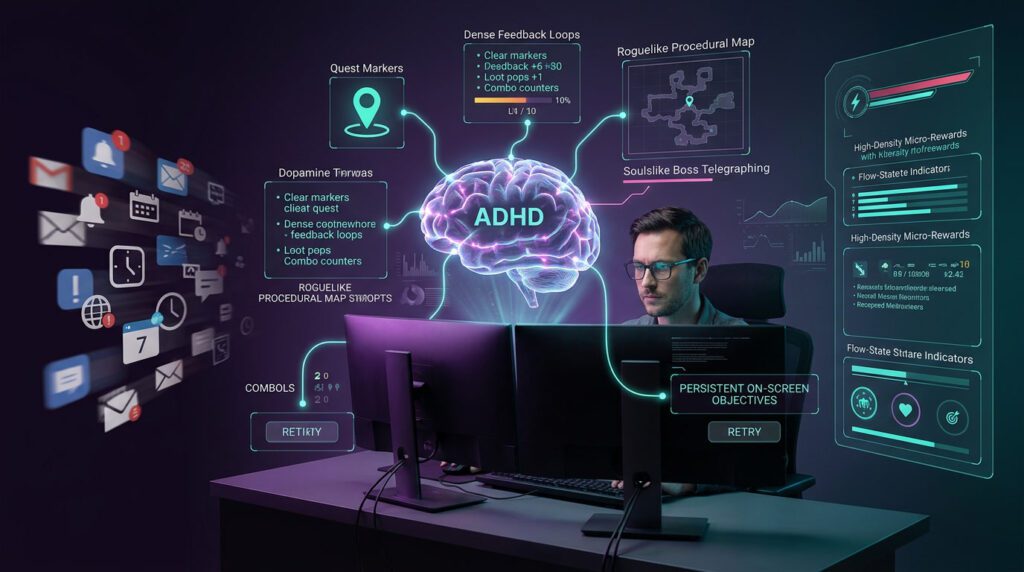
Games compensate with externalised executive function. The UI tells you what to do next. The minimap shows where to go. Quest markers eliminate ambiguity. The countdown timer makes time visceral. In a real-world context, an ADHD person must generate all of this structure internally. Games hand it to them on a HUD.
This is why idle games and goal-driven progression systems hit differently for ADHD players. The sense of forward momentum isn’t self-generated — it’s architecturally provided. When the system is doing the executive heavy lifting, the player can focus entirely on engagement.
Practical design implication
Keep objectives singular and visible. Don’t give ADHD players three competing priorities at once. A single, clear, achievable micro-goal is more engaging than a complex multi-step mission with no intermediate checkpoints. Every checkpoint is a dopamine event. Design for density of small wins.
- Use persistent on-screen goal reminders — not just quest logs buried in a menu
- Break long objectives into 2–3 minute sub-tasks with explicit completion fanfare
- Avoid “wait here” mechanics — dead time kills tonic dopamine and breaks the loop
Hyperfocus and flow state: the architecture of deep immersion
ADHD players don’t struggle with focus. They struggle with directed focus. When something triggers deep interest, they can enter hyperfocus — a state of total absorption that shuts out everything else. Clinicians often describe it as flow state that the individual cannot reliably turn on or off.
Neuroplasticity plays a role here too. Repeated engagement with highly stimulating environments strengthens neural pathways for sustained attention in those contexts. ADHD players who game heavily often develop sophisticated metacognitive skills within gaming contexts that don’t transfer easily to low-stimulation environments.
Games like Balatro and complex strategy titles provide what psychologist Mihaly Csikszentmihalyi called “optimal challenge” — the precise difficulty point where skill meets obstacle. That balance point is also the hyperfocus ignition point for ADHD players. Too easy, and boredom collapses attention. Just hard enough, and they’re locked in for hours.
Semantic concept: Flow state scaffolding — the structural elements of a game (difficulty curves, ambient sound design, absence of interruptions) that sustain immersion rather than break it. ADHD players are more sensitive to scaffolding breaks than neurotypical players.
Notification systems, loading screens, and unskippable cutscenes are scaffolding breaks. Every forced pause is an ejection from flow. Consider this carefully in UX. For ADHD players, re-entry into focus is not automatic — it may not happen at all in that session.
Safe failure: the psychology of “try again”
Rejection sensitivity is a widely documented ADHD trait. Real-world failure often carries social weight — embarrassment, judgement, lost opportunity. This makes risk-taking cognitively expensive for ADHD individuals. They’ve learned that failure costs.
Games reframe failure entirely. Death in a roguelike is mechanical feedback, not social judgement. The “try again” loop strips failure of emotional penalty and replaces it with information. You died because you didn’t dodge in time. Dodge next time. Here’s your next run.
This framing is transformative. ADHD brains that would freeze up in real-world risk scenarios can engage in thousands of iterative attempts within a single gaming session. The game’s consequence structure is predictable, fair, and reversible — a psychological safety net that real life rarely offers.
For a deep look at games built around this loop, our analysis of best horror games shows how tension-and-release cycles use the same mechanism to drive compulsive re-engagement.
Design application: lower the floor, raise the ceiling
- Make early failure consequence-light and clearly instructive — “you failed because X” not just “you failed”
- Autosave frequently. Loss of significant progress is not a motivator for ADHD players — it’s a session-ender
- Celebrate attempts, not just successes. Show streak counters, attempt numbers, progression graphs
Genre analysis: why roguelikes, soulslikes, and MMOs resonate
The roguelike formula is almost neurologically engineered for ADHD engagement. Procedural generation means no two runs are identical — novelty is guaranteed, which prevents habituation and keeps dopamine response elevated. Each run is self-contained, making time commitment feel manageable even when hours pass.
Permadeath sounds punishing, but it actually serves ADHD players well. The finite run structure creates clear start and end points — something ADHD brains struggle to self-impose. “One more run” is psychologically easy to commit to. “Play this 40-hour RPG” is not.
Games like Dark Souls or Elden Ring are textbook hyperfocus triggers. The difficulty demands total attention — there is no autopilot mode. The moment-to-moment feedback is dense (attack, parry, dodge, punish) and the consequence cycle is immediate. Death is always your fault. That clarity of causation is deeply satisfying for ADHD players who often experience unclear cause-and-effect in daily life.
The controlled variables game designers use in soulslike encounter design — attack telegraphing, learnable patterns, precise hitboxes — create a world where effort and outcome are tightly coupled. ADHD players thrive in that environment.
MMOs succeed for different reasons. They layer multiple simultaneous engagement systems — questing, crafting, social play, market economics, PvP — giving ADHD players constant novelty within a persistent world. When one system bores them, another is available immediately. There’s no dead air.
The social accountability of guild membership and raid schedules also functions as externalised executive function. “My guild needs me online at 8pm” is a more reliable commitment trigger for many ADHD players than “I planned to do this.” External obligation activates what internal intention often cannot.
You can see these mechanics in action by exploring Roblox’s engagement charts — platforms built on parallel activity loops show notably longer session times.
Designing for ADHD without losing everyone else
A common design fear: “If I optimise for ADHD, I’ll alienate neurotypical players.” The evidence suggests the opposite. Mechanics that serve ADHD players — clear goals, responsive feedback, low-friction re-entry, procedural novelty — are simply good design. Neurotypical players enjoy them too. They just don’t need them as acutely.
Accessibility in game design is increasingly understood not as accommodation but as quality uplift. The closed captions that help deaf players also help players in noisy environments. The difficulty sliders that help struggling players also let speedrunners play in challenge mode. ADHD-informed design raises the floor for everyone.
For a broader view of how studios are approaching inclusive design, see our breakdown of the best game developer studios in 2025 — several are leading on neuroinclusive UX as a product differentiator.
Final verdict for designers
ADHD isn’t a niche condition — estimates suggest 5–10% of the global population is affected, with gaming communities likely skewing higher. Designing for dopaminergic variability is not charity. It’s market strategy.
The core principles translate directly into your design checklist:
- Externalise executive function through persistent, clear, single-focus objectives
- Engineer dense feedback loops — micro-rewards at 2–3 minute intervals minimum
- Use variable reward schedules deliberately in loot, encounter, and progression design
- Protect flow state — minimise involuntary interruptions and avoid dead-time mechanics
- Reframe failure as information, never as punishment — make retry immediate and frictionless
- Leverage procedural generation to sustain novelty and prevent habituation
- Design social structures that serve as externalised commitment devices
The ADHD brain is not broken. It’s tuned for a different signal-to-noise ratio. Games that understand this don’t just accommodate ADHD players — they become the environments where those players do their best thinking, problem-solving, and play.