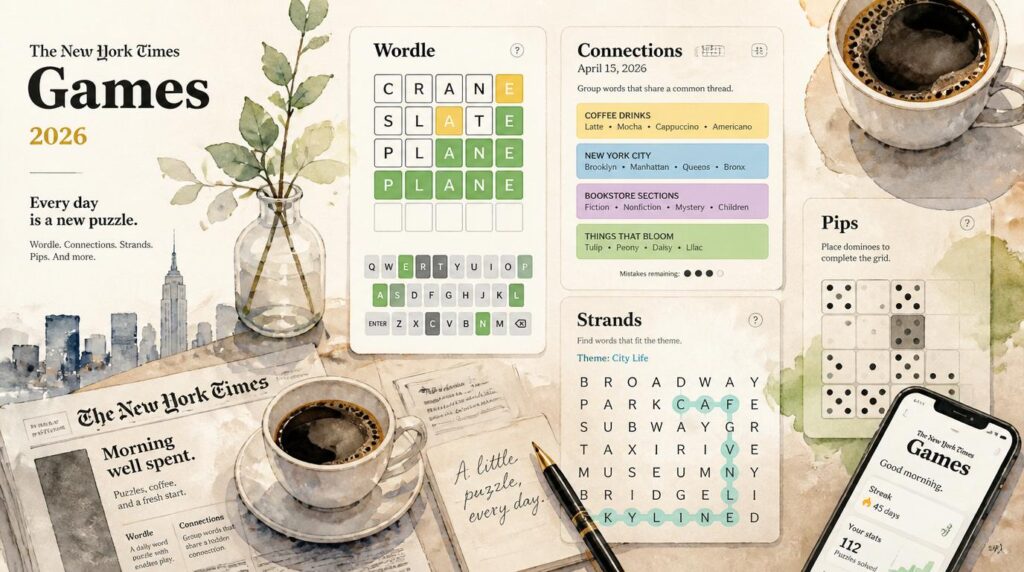
In January 2022, The New York Times paid a reported low-seven-figure sum for a web game built by a single software engineer in Brooklyn for his word-game-loving partner. That game was Wordle. At the time, it seemed like a cute acquisition of a viral fad. Four years later, it is clear that the Times did not just buy a game. It bought the cheapest, most effective on-ramp into one of the most successful subscription businesses in media history. Games are no longer a sidebar to journalism at the Times. They are a strategic pillar — one that drove digital subscription revenue up 16.4% year-over-year in Q2 2026 and helped push total digital subscribers past 10 million. This is the full story of how that happened.
The Timeline: From Crossword to Empire
1942
The Crossword Debuts
The New York Times publishes its first crossword puzzle. It becomes a daily ritual for millions and establishes the Times as a destination for intellectual play, not just news.
August 2014
NYT Games Officially Launches
The Times bundles its puzzles into a standalone digital product: The Crossword, The Mini, and Tiles. It is a modest offering, mostly serving existing newspaper subscribers.
2015
The Subscription Pivot Begins
The Times shifts from an ad-first, print-first model to a subscription-first strategy. Digital subscribers number roughly 1 million. The goal: build a bundle so compelling that readers never leave.
November 2021
Wordle Goes Live — 90 Players
Josh Wardle, a Brooklyn software engineer, releases Wordle publicly. On day one, 90 people play. He built it for his partner, Palak Shah, who loves word games. The shareable emoji result grid has not been invented yet.
January 1, 2022
The Explosion — 300,000 Players
The emoji share feature goes viral on Twitter. Two months after launch, Wordle has 300,000 daily players. The colored square grids flood social feeds. Celebrities post their scores. The game is still completely free.
January 31, 2022
The New York Times Acquires Wordle
The Times buys Wordle for a reported low-seven-figure sum. The announcement frames it as part of the company’s “portfolio of original, engaging puzzle games.” In reality, it is the acquisition that redefines the entire strategy.
2023
Connections Launches
Wyna Liu’s word-association puzzle becomes the Times’ first original viral hit since acquiring Wordle. Players must sort 16 words into four connected groups. It is immediately addictive and expands the Games audience beyond Wordle loyalists.
June 2024
Strands Arrives
The Times’ word-search evolution debuts and quickly becomes another hit. Strands adds a thematic “spangram” mechanic to the classic word search format, creating a daily puzzle that feels fresh while remaining accessible.
Q2 2024
10.2 Million Digital Subscribers
The New York Times hits 10.2 million total digital-only subscribers. Bundle and multi-product subscribers are now the largest and fastest-growing cohort. Games are explicitly credited as a key driver of this growth.
January 2026
Crossplay: The First 2-Player Game
The Times debuts Crossplay, a Scrabble-like competitive word game and its first true multiplayer title. It signals a new phase: NYT Games is no longer just a collection of solo puzzles. It is becoming a social platform.
Q2 2026
16.4% Digital Revenue Growth
Digital-only subscription revenues grow 16.4% year-over-year. The Times is targeting 15 million subscribers by 2027. Games remain the cheapest and most effective acquisition funnel.
The Real Strategy: Games as an On-Ramp
Here is the insight most coverage misses: The New York Times did not become a games company because it loves puzzles. It became a games company because games are the cheapest customer acquisition tool in media.
The Funnel, Simplified
Free Player
Discovers Wordle, Connections, or Strands via social media or search. Costs the Times almost nothing to acquire.
Single-Product Subscriber
Pays ~$1.50–$2.50/week for Games access. ARPU approximately $3.36. Still a low-value customer, but now they are in the ecosystem.
Bundle Subscriber
Upgrades to All Access (news + games + cooking + Wirecutter). ARPU jumps to $7–$10+. This is where the Times makes real money.
The genius is in the psychology. A person who would never pay $6/week for newspaper access will happily pay $2/week for Wordle, Connections, the Crossword, and Spelling Bee. Once they are inside the paywall, the Times cross-promotes: read today’s Wordle companion piece, try the Cooking section, check Wirecutter before your next purchase. The games do not just retain subscribers. They convert non-news readers into news consumers.
Jonathan Knight, SVP and General Manager of NYT Games, has been explicit about this at industry conferences. Games are not a separate business. They are the front door to the bundle. And it is working: single-product Games subscribers are the fastest-growing cohort, even though they are also the lowest-paying one at ~$3.36 ARPU. The Times does not care, because the lifetime value of a subscriber who upgrades to the bundle is exponentially higher.
Why Wordle Worked: The Anatomy of a Viral Hit
Wordle’s success was not an accident. It was the result of a perfectly designed viral loop that hit at exactly the right cultural moment. Here is why it exploded:
One Puzzle Per Day
The daily limit is the core mechanic. You cannot binge Wordle. You cannot grind it. You get one puzzle, and then you wait until tomorrow. This creates scarcity-driven anticipation — the same psychology that makes appointment television work. Players build Wordle into their morning routine: coffee, email, Wordle. The daily cadence also prevents burnout. Most viral games die because players consume them too fast. Wordle’s limit forces moderation.
The Emoji Share Grid
The colored square result grid is the single greatest viral design decision in modern gaming. It is completely spoiler-free — you can share your score without revealing the answer. It is visually distinctive on a Twitter timeline. It creates social proof (“everyone is playing this”). And it triggers competitive curiosity (“if they got it in 3, I can get it in 3”). The grid turned every player into a free billboard. No paid advertising campaign could have replicated this.
Perfect Difficulty Curve
Wordle is hard enough to feel like an achievement but easy enough that most players succeed within six guesses. The average solve rate hovers around 4–5 guesses, which is the sweet spot: challenging without being discouraging. The vocabulary is common English — no obscure words, no crossword-level trivia. Your grandmother and your teenager can both play. That universality is rare in puzzle design.
Zero Friction, Zero Ads
Before the acquisition, Wordle had no login, no ads, no in-app purchases, and no data collection. You opened the site and played. In a mobile-gaming landscape dominated by predatory monetization, this was radical. It built enormous goodwill. Players felt like they were participating in something pure — a game made for love, not profit. That goodwill transferred directly to the Times’ brand when the acquisition happened.
The Full NYT Games Portfolio in 2026
| Game | Type | Launched | Role in Strategy |
|---|---|---|---|
| The Crossword | Classic grid puzzle | 1942 | The anchor. Retains high-value, long-tenure subscribers. |
| The Mini | 5×5 quick crossword | 2014 | The gateway. Takes 1–2 minutes; hooks casual players. |
| Wordle | 5-letter word guess | 2021 (acq. 2022) | The on-ramp. Brought tens of millions of new users. |
| Connections | Word grouping | 2023 | The retainer. Daily habit builder; high completion rates. |
| Strands | Thematic word search | 2024 | The expansion. Proves NYT can create new viral hits. |
| Spelling Bee | Pangram word builder | 2018 | The depth play. “Genius” status drives obsessive replay. |
| Letter Boxed | Path-connecting words | 2019 | The niche. Appeals to hardcore word-game fans. |
| Tiles / Vertex | Visual pattern puzzles | 2019 | The diversifier. Non-word games for visual thinkers. |
| Sudoku | Number logic grid | — | The classic. Broadens appeal beyond word-game fans. |
| Crossplay | 2-player word battle | 2026 | The social pivot. First true multiplayer; opens new era. |
Notice the architecture. The portfolio is deliberately varied: quick games (The Mini, Wordle) for daily habits, deep games (Crossword, Spelling Bee) for obsessive engagement, visual games (Tiles, Vertex) for non-word players, and now social games (Crossplay) for competitive interaction. No single game has to carry the entire business. The portfolio as a whole does.
By the Numbers: What the Data Actually Says
11B+
Puzzles Played in 2025
Across all NYT Games titles
10.2M
Digital-Only Subscribers
As of Q2 2024
16.4%
Digital Revenue Growth
YoY in Q2 2026
$3.36
Games-Only ARPU
Single-product subscriber average
The $3.36 ARPU figure is the most important number in this entire analysis. It tells you exactly why the Times keeps investing in Games. A Games-only subscriber costs almost nothing to acquire (Wordle is free, Connections and Strands have free tiers) and pays a small amount. But they are inside the ecosystem. The conversion rate from Games-only to bundle subscriber is the metric the Times watches most closely — and it is high enough to justify the entire division.
What Comes Next: The Social Pivot
The launch of Crossplay in January 2026 is not just a new game. It is a signal. For the first time, NYT Games is moving beyond solo puzzles into social, competitive play. This matters because social games have higher retention and stronger viral mechanics than single-player puzzles. A player who competes against friends is far less likely to cancel their subscription than a player who plays alone.
The roadmap is clear. The Times has already announced plans to expand multiplayer features across the portfolio: leaderboards for Wordle, head-to-head Connections races, and cooperative Crossword solving. The goal is to transform NYT Games from a daily habit into a social platform. If they succeed, the subscription business becomes even more defensible — because now cancellation means losing not just your puzzles, but your competitive standing and social connections.
The 2027 Target
The New York Times is publicly targeting 15 million subscribers by 2027. Games will not get them there alone — news, Cooking, Wirecutter, and The Athletic all contribute. But Games remain the most efficient acquisition engine. Every viral puzzle, every new game launch, and every social feature added to the portfolio is a calculated move toward that number. The crossword puzzle invented in 1942 is still working, 83 years later, as the original retention tool. Wordle, Connections, and Strands are just the modern expression of the same insight: people will pay for intellectual play.
Frequently Asked Questions
When did the New York Times acquire Wordle? +
The New York Times acquired Wordle on January 31, 2022, for a price reported to be in the low seven figures. At the time of acquisition, Wordle had already grown from 90 players on November 1, 2021, to millions of daily players by early 2022.
How many people play NYT Games? +
In 2025, NYT Games puzzles were collectively played over 11 billion times. The New York Times reached 10.2 million total digital-only subscribers by Q2 2024 and is targeting 15 million by 2027. While exact per-game player counts are not publicly disclosed, Wordle alone brought tens of millions of new users to the platform in 2022.
What games are included in NYT Games? +
As of 2026, NYT Games includes 11 titles: The Crossword, The Mini Crossword, Wordle, Connections, Strands, Spelling Bee, Letter Boxed, Tiles, Vertex, Sudoku, and Crossplay (the first 2-player game, launched January 2026). A Games subscription grants access to all puzzles across web and mobile.
Why did the New York Times invest in games? +
Games serve as the cheapest on-ramp into The New York Times subscription bundle. Single-product Games subscribers pay approximately $3.36 ARPU, making it the lowest-cost entry point. The strategy is to acquire users through free or low-cost games, then convert them into multi-product subscribers who pay significantly more. Digital-only subscription revenues grew 16.4% year-over-year in Q2 2026, driven in part by Games engagement.
Sources & Methodology
Financial data is drawn from The New York Times Company’s Q2 2026 earnings release and 10-Q filing. Subscriber and engagement figures are sourced from official NYT investor communications and Jonathan Knight’s March 2025 INMA presentation. Wordle acquisition details and player growth data are sourced from The New York Times’ official acquisition announcement (January 31, 2022), TechCrunch reporting, and The Conversation. ARPU and cohort analysis data are drawn from Stratrix research (September 2026). Crossplay and multiplayer roadmap information is sourced from AP News and The Seattle Times (January 2026).
More Gaming & Media Guides