There is a reason Sudoku has remained the reigning king of daily logic games for decades. Combining pure mathematical deduction with effortless accessibility, a great 9×9 grid offers the ultimate balance of mental stimulation, stress relief, and cognitive training.
However, finding the right digital experience can be frustrating. Between intrusive full-screen video ads, poorly designed user interfaces, and artificial paywalls, many digital puzzle apps ruin what should be a peaceful brain exercise. Whether you are looking for free browser-based grids, minimalist mobile apps with smooth entry modes, or complex daily challenges, this guide cuts through the noise.
Below, you will explore our top recommendations across mobile, desktop, and web platforms, along with key criteria to evaluate apps and pro tips to refine your solving techniques. If you enjoy daily mental workouts, explore our guide to finding your perfect puzzle across our broader New York Times puzzle breakdown and daily word games.
Key Takeaways: Finding Your Ideal Sudoku Game
- Best for Minimalists: Clean, web-based tools like NYT Sudoku or Web Sudoku offer instant play without installations.
- Best for Learning & Progression: Mobile titles with interactive smart-hint engines teach advanced solving techniques (like X-Wing and Swordfish) rather than simply giving away answers.
- Key UI Feature: Always select apps featuring auto-candidate tracking (pencil marks) and custom error highlighting toggles.
- Puzzle Variety: Gamers seeking fresh spins can explore variants like Killer Sudoku, or branch out into mechanics featured in classic titles like Bloxorz and Boggle.
What Makes a Great Sudoku Game?
Not all Sudoku applications are built equal. While the core logic rules remain identical across every platform—filling a 9×9 grid so every row, column, and 3×3 box contains digits 1 through 9—the software architecture determines whether an app is enjoyable or tedious.
When testing digital Sudoku titles, we evaluate five core parameters:
- Clean Design & Ad Restraint: Unobtrusive banner placement or offline premium modes that prevent breaking your focus during intense deduction sessions.
- Smart Hint Systems: Educational algorithms that explain why a number fits a cell using tactical logic rather than simply filling in the square.
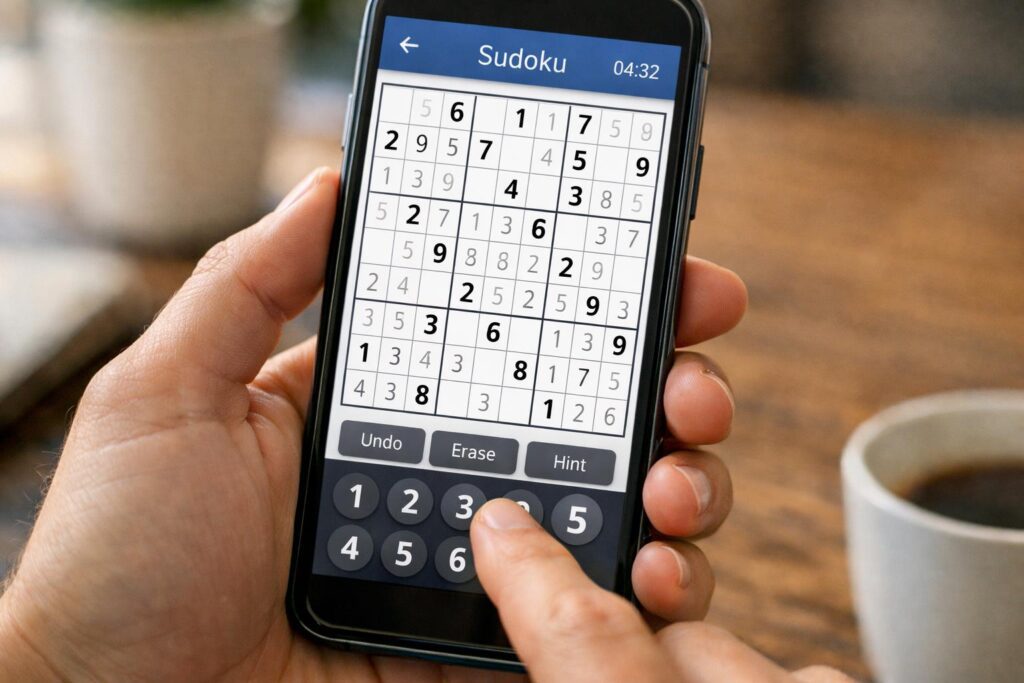
- Flexible Input Controls: Fast digit-first or cell-first input modes optimized for mobile touchscreens or desktop keyboards.
- Dynamic Candidate (Pencil) Marking: Automated or manual note-taking options that reduce visual clutter as numbers are placed.
- Verified Solvability: Truly generated puzzles with a single valid mathematical solution that never require blind guessing.
Beginners should choose apps featuring built-in tutorials, error-highlighting toggles, and multi-tier difficulty scaling (Easy to Expert). Look for games with a ‘Smart Hint’ function that explains basic solving rules like Naked Singles and Hidden Pairs rather than forcing trial-and-error.
Top Sudoku Games Compared
Here is a quick snapshot of the best digital Sudoku experiences evaluated across platform availability, primary focus, and standout features:
Exploring Sudoku Variants & Brain-Training Alternatives
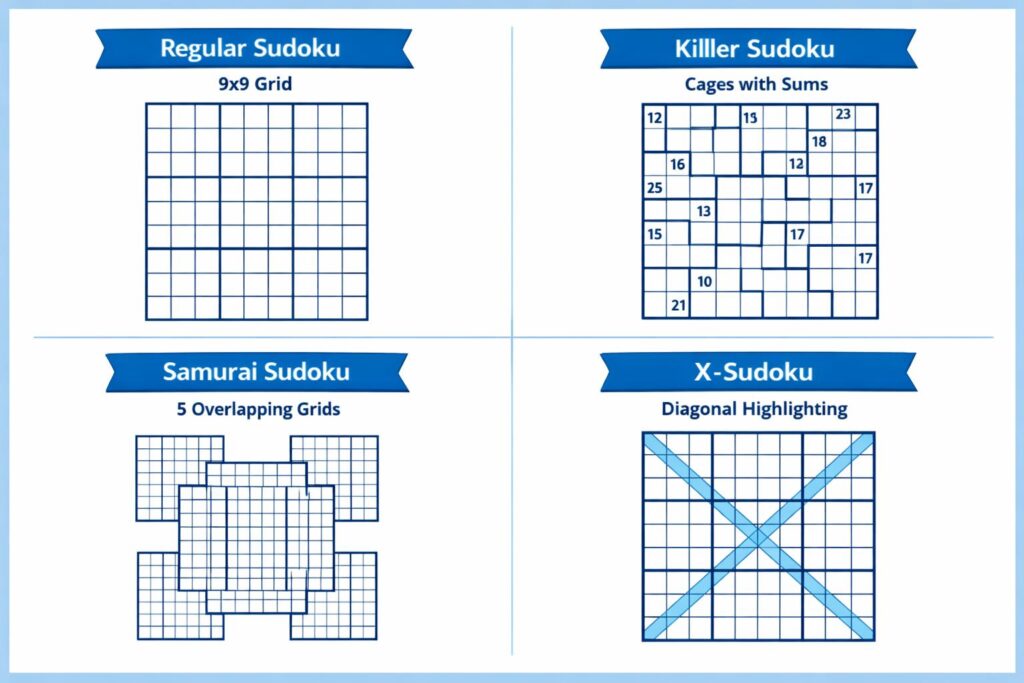
Once you master standard 9×9 grids, exploring variant mechanics keeps your problem-solving skills sharp. Variants alter boundary conditions and mathematical constraints, pushing your logical reasoning into new territory:
Popular Sudoku Variants
- Killer Sudoku: Adds caged sub-regions with arithmetic target sums; combines basic addition with standard elimination rules.
- Jigsaw (Irregular) Sudoku: Replaces standard 3×3 square blocks with asymmetrical, interlocking 9-cell shapes.
- Thermo & Arrow Sudoku: Features directional visual lines where values must strictly increase along thermometer tracks or sum up along arrow shafts.
If you love daily brain challenges beyond numbers, check out analytical tools like our Connections solver and hint guide, test your speed in typing and word puzzle tools, or explore spatial reasoning in hashtag word games.
Pro Tips to Improve Your Solving Speed
Moving from intermediate to advanced Sudoku solving requires ditching trial-and-error guessing in favor of structured pattern recognition:
- Focus on Highly Constrained Units: Scan rows, columns, or 3×3 boxes that already contain 6 or more digits first to easily spot missing “Naked Singles”.
- Master Pencil-Marking Discipline: Use Snyder notation (pencil marking candidate numbers only in boxes where a digit can go in exactly two spots) to keep your board readable.
- Look for Hidden Pairs and Triples: If two candidates appear exclusively in the same two cells within a row or box, no other digits can occupy those cells.
- Avoid Blind Guessing: Every legitimate Sudoku puzzle can be solved through pure logic. If you reach a deadlock, double-check your existing candidate marks for missed eliminations.
Frequently Asked Questions About Sudoku Games
Answer: Yes. Regular Sudoku play improves logical thinking, enhances short-term memory, sharpens pattern recognition, and promotes concentration by exercising working memory capacity.
Answer: The difficulty of a Sudoku puzzle is determined by the logical techniques required to solve it rather than the number of given clues. Easy grids require basic elimination, whereas expert boards demand advanced techniques like X-Wings, Swordfish, and XY-Chains.
Answer: Most free Sudoku apps from reputable developers on iOS and Android are completely safe. However, look for titles with reasonable privacy policies that do not request intrusive permissions like full contact access or precise location tracking.
Answer: Yes. A properly constructed Sudoku puzzle has exactly one unique solution that can always be reached strictly through logical deduction without ever needing to make an unverified guess.