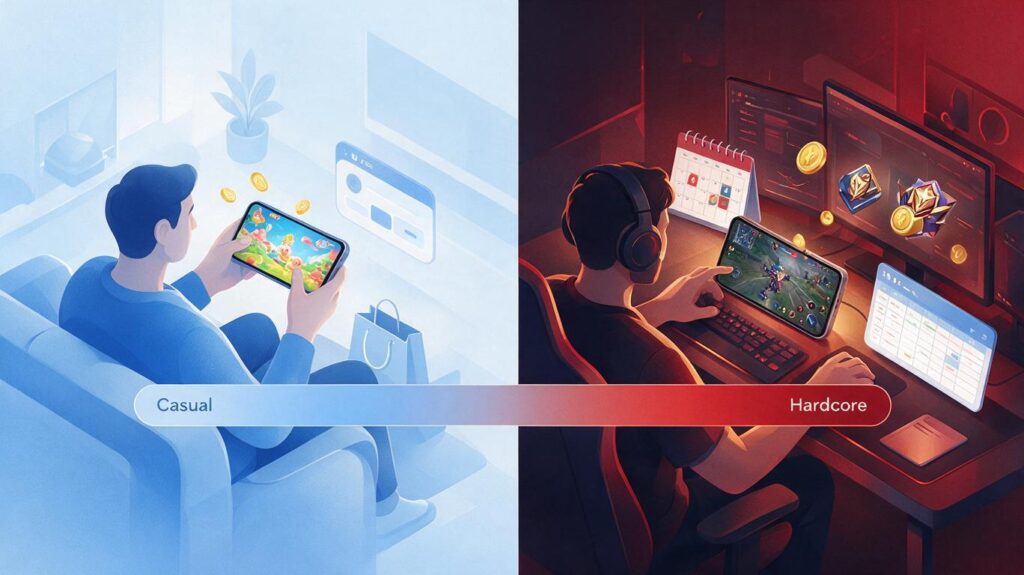
Two players open the same game. One plays for ten minutes on a bus ride. The other has a spreadsheet tracking event timers. Same app, same currency, completely different relationship with money and time, and most gaming coverage still treats them like one audience.
It’s easy to assume every mobile gamer approaches PUBG Mobile or Genshin Impact the same way, but the split between casual and hardcore play runs deep. That divide isn’t just about who plays more hours, it shapes how games are designed, what features make or break the experience, and even how players budget for gaming expenses each month. Most discussions gloss over how those distinct mindsets affect what people buy, why they seek out certain deals, and what truly counts as “value” in mobile gaming.
For casual players, mobile games are often about low-commitment fun. Download, play, maybe invite a friend if there’s time, then set it aside. Spending rarely enters the conversation beyond a few dollars here and there, the same low-pressure approach that makes something like Subway Surfers stay relevant years after launch. Hardcore players, on the other hand, see their devices as main entertainment hubs. They spend hours in competitive matches, value premium currency for cosmetic upgrades, and hunt for advantages that make gameplay smoother or more rewarding. It’s why search interest in ways to buy cheap PUBG UC keeps rising, currency purchases offer a practical shortcut to custom outfits or event entries without overspending. But both groups are navigating the same in-game economy, just with very different priorities.
Casual vs. Hardcore: What Actually Differs
- Plays in short, irregular sessions
- Spends rarely, usually on impulse
- Prioritizes low-commitment fun over optimization
- Rarely tracks events, timers, or seasonal content
- Satisfied with free or default content most months
- Treats the game as a primary entertainment hub
- Budgets deliberately for currency and cosmetics
- Actively compares deals before every purchase
- Tracks battle passes, events, and limited windows closely
- Views spending as a reward tied to engagement
Budget Gaming: More Than Just Low Prices
Many people misunderstand what budget gaming actually means. At its core, budget gaming is a value-focused approach to playing more while spending less on hardware, games, or subscriptions. It’s not about settling for outdated devices or free-only titles; it’s about maximizing entertainment per dollar, comparing options, and making smarter purchase decisions. The best solutions tend to recognize that what counts as “budget-friendly” changes drastically between a casual player, who may spend nothing most months, and a hardcore enthusiast happy to grab every top-up deal for exclusive content, the same range you’ll see between a light Brawl Stars session for a younger player and a dedicated fan chasing every brawler unlock.
Savvy buyers are now seeking platforms where trust signals are clear. Eneba stands out as one such marketplace, thanks to upfront region tagging and ongoing merchant verification. Before buying, users can see whether a code works for their platform and region, compare deals from different sellers, and avoid unwanted surprises once their purchase is complete. This setup not only lowers costs but reduces common risks linked to third-party digital products, the same verification instinct that shows up when checking a reviewed platform before spending anywhere new.
Budgeting smart, regardless of playstyle
- Set a monthly ceiling first.Decide the number before browsing, not while looking at a tempting bundle.
- Separate cosmetic spending from progress spending.Know which purchases are for looks versus actual time savings.
- Compare currency deals across sellers.Prices for the same premium currency can vary more than expected.
- Check region compatibility before buying.A mismatched region wastes both money and time to resolve.
- Review what you actually used last month.Unused currency or skins are the clearest signal to adjust the budget.
Misconceptions About Value, Skill, and Pay-to-Win
A major misconception is that spending money always creates an unfair skill gap between casuals and committed players. The reality is more nuanced. In many top mobile games, spending unlocks convenience or personalization, cosmetics, quick access to new content, or skipping a grind, not direct gameplay advantages. For the most part, the main divide is time and intent. Hardcore players might treat the acquisition of skins or battle passes as a reward for their engagement, while casual players feel satisfied sticking to basics, the same split visible in how players approach gacha currency systems or chase a specific redeem code the moment it drops.
| Factor | Casual approach | Hardcore approach |
|---|---|---|
| Monthly spend | Occasional, small amounts | Planned and recurring |
| Purchase trigger | Impulse or a specific sale | Event timing or battle pass cycles |
| Priority | Low commitment, low risk | Value per dollar, deal comparison |
| Deal-hunting behavior | Rarely compares sellers | Actively checks multiple marketplaces |
| Region awareness | Often overlooked | Checked closely before every purchase |
Yet both types influence how publishers build reward systems, balance free and paid content, and even run seasonal events to keep their audiences engaged. What’s sometimes overlooked: everyone benefits when there’s healthy competition between merchants, when buyer protections reduce risk, and when clear labeling keeps platform compatibility transparent, the same transparency players rely on when comparing a Robux calculator or a DevEx calculator before converting time or currency into real value.
- ✓Casual spenders benefit from setting a hard cap. A small, fixed monthly limit prevents impulse purchases from adding up unnoticed.
- ✓Hardcore spenders benefit from comparing sellers every time. Loyalty to one storefront often costs more over months of regular top-ups.
- ✓Both benefit from checking region tags. This single habit prevents the most common purchase failures on any platform.
- ✓Both benefit from verified merchants. Trust signals matter the same amount whether you spend five dollars a year or fifty a month.
The divide between casual and hardcore play isn’t about who “wins”, it’s about how choice, value, and trust redefine what fun and fair really mean in mobile gaming. That shift toward more careful spending and wider access to deals is already visible on platforms like Eneba, where choice and transparency keep both casual and competitive mobile players coming back, the same balance that keeps players checking a lab-tested VPN comparison before shopping across regional storefronts, whatever their playstyle.
The short version: casual and hardcore players aren’t on opposite teams, they’re solving the same value equation with different budgets and different time horizons. The habits that protect one, region checks, verified sellers, deal comparison, protect the other just as well.
Quick Answers
In most major titles, spending primarily unlocks cosmetics or convenience rather than direct power, though this varies by game, so it’s worth checking a specific title’s monetization model.
Yes, occasional buyers benefit from the same region clarity and merchant verification as frequent spenders, just on a smaller and less regular basis.
Premium currency is typically tied to the account region it was issued for, so a mismatch is the most common reason a top-up fails to apply.