
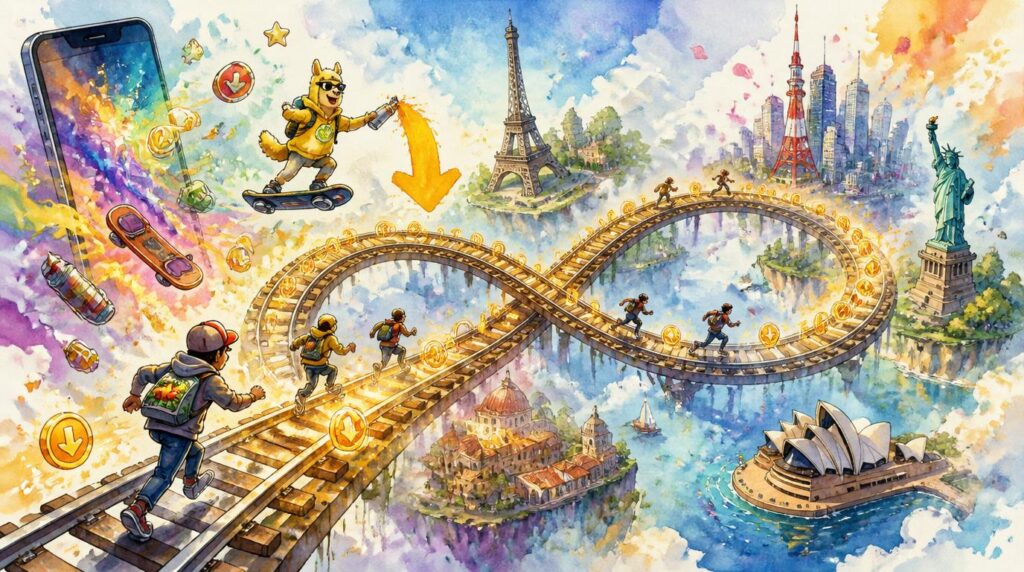
It starts the same way every time. A kid named Jake sprays graffiti on a train. An angry inspector and his dog give chase. You swipe left, right, up, down — and suddenly twenty minutes have vanished. That’s the Subway Surfers trap, and over four billion people have fallen right into it.
Launched on May 24, 2012 by Danish studio SYBO Games, Subway Surfers didn’t just survive the brutal churn of the mobile gaming market — it conquered it so completely that it became the most downloaded mobile game in history. Not for a week. Not for a year. For over a decade. In a market where yesterday’s hit is tomorrow’s deleted app, that’s nothing short of extraordinary.
So what’s the secret? Why does a game about a cartoon kid running from a train conductor still pull in millions of sessions every single day in 2025? Let’s break it down — from the genius of its design to the TikTok pipeline that handed it a second life nobody saw coming.
The Anatomy of Addiction: Why We Can’t Stop Swiping
Game designers talk about “the loop” — that core cycle of action and reward that keeps players coming back. Subway Surfers’ loop is practically perfect. You run. You collect. You fail. You immediately want to try again. The entire session from launch to game-over takes under two minutes on average, which is precisely why it thrives on commutes, waiting rooms, and every other stolen slice of dead time in your day.
But the mechanics go deeper than just “simple and fast.” Here’s what makes the design genuinely clever:
Visual Warmth
Bright, saturated colors with zero threatening imagery. No blood, no horror — the aesthetic is welcoming to literally every age group.
Hoverboard Safety Net
One free crash before game over. This single mechanic dramatically reduces frustration and makes near-misses feel exciting rather than punishing.
Sound Design
Coin collection sounds, speed-up jingles, and the satisfying thwack of power-ups all deliver tiny dopamine hits that reinforce continued play.
Subway Surfers vs. Temple Run: Why One Won
🛤️ Subway Surfers
Three-lane system, forgiving hoverboard mechanic, vibrant city aesthetics, and regular content updates. Controls feel silky even at high speed.
🌿 Temple Run
Darker, more claustrophobic jungle theme, punishing fail state with no buffer mechanic, and significantly less frequent content refreshes.
Both games launched in the same era. Both were smash hits. But Subway Surfers understood something crucial: casual players don’t want to feel bad. The hoverboard buffer, the cheerful palette, the three-lane grid that’s wide enough to feel manageable — every decision was subconsciously reassuring. Temple Run felt like a chase. Subway Surfers felt like a party.
The World Tour & Modern Evolution
In 2013, SYBO made a move that most studios wouldn’t have had the confidence to attempt: they started rotating the game’s entire visual world. Instead of one permanent city backdrop, Subway Surfers would visit a new real-world location every few weeks — complete with local architecture, cultural details, exclusive characters in traditional costumes, and region-specific collectibles.
It was brilliant. The World Tour system transformed a static game into a living, breathing event calendar. Players who’d drifted away had constant reasons to return: “Tokyo is live this month,” “Paris just dropped,” “There’s a limited Día de los Muertos character I need to grab.”
🌍 The World Tour has now visited over 100 cities across every continent — from New York and Mumbai to Cairo, São Paulo, and Sydney. Each edition brings exclusive characters, boards, and themed collectibles that expire when the tour moves on.
Recent Major Milestones
-
🏙️Subway Surfers City The next-generation sequel launched as a separate experience, bringing upgraded visuals, expanded mechanics, and a fresh take on the endless runner formula for a new generation of mobile hardware.
-
🐦Angry Birds Crossover A high-profile collaboration that brought Red and the Angry Birds flock into the Subway Surfers universe — proving the brand’s power as a crossover partner for major gaming IP.
-
👾Among Us Collaboration Capitalizing on the peak Among Us cultural moment, this crossover introduced crewmate-themed boards and characters, bridging two completely different gaming audiences.
-
🏆Miniclip Acquisition Era After Miniclip acquired SYBO, Subway Surfers gained major additional resources for global marketing, cross-promotional events, and infrastructure — fueling another download surge that pushed the total past 4.5 billion.
For players who love collecting and comparing gaming milestones, check out our breakdown of live player count statistics across the biggest games — the numbers around Subway Surfers are genuinely jaw-dropping in context.
The No Coin Challenge & TikTok’s Second Wind
The No Coin Challenge
The No Coin Challenge became the game’s defining viral mechanic of the modern era. The rules are simple: achieve the highest score possible without collecting a single gold coin. What sounds straightforward becomes increasingly agonizing as coins flood every lane at higher speeds.
The challenge spread rapidly across YouTube Shorts and TikTok because it’s immediately watchable — viewers instinctively cringe every time a coin appears in the runner’s path. It turned a 13-year-old mobile game into appointment content. For more on how gaming communities fuel virality, our Roblox culture deep-dive covers similar mechanics.
The Surfer’s Guide: Pro Tips for High Scores
Whether you’re chasing leaderboard glory or just trying to finally beat your personal best, these strategies separate casual runners from serious score hunters.
Master the Score Multiplier — It’s Everything
Your score multiplier increases by collecting sets of letters that spell SUBWAY SURFERS. Each completed set bumps your multiplier permanently for that run. High-level players prioritize letter hunts over coin collection in early game because a x10 or x15 multiplier transforms a mediocre run into a massive score. Don’t ignore the mystery boxes — they’re your fastest letter source.
Hoverboards Are Emergency Tools, Not Toys
New players burn hoverboards constantly. Experienced players save them exclusively for high-speed moments when lane changes become nearly impossible to read. Activate a hoverboard after a close call — not during calm sections. The board’s crash protection lasts 30 seconds, which at top speed can yield enormous score gains without the game-ending risk.
Complete Daily Missions Before Going for Score
Daily missions award keys, coins, and mystery boxes that directly power score runs. Many players skip them to chase high scores immediately — but the upgrade resources from missions compound over time. Completing three missions per day for a week yields significantly more long-run score potential than ignoring them entirely.
Which Upgrade Should You Buy First?
🧲 Coin Magnet
Collects coins in a wide radius automatically. Higher levels extend both the magnet’s range and duration. Since coins fund every other upgrade, this is the highest-leverage early investment in the game.
🚀 Jetpack
Lifts you above the tracks entirely, guaranteeing coin collection while eliminating collision risk. Longer duration at higher levels means safer high-score windows. Upgrade this immediately after Coin Magnet is maxed.
💡 Bonus tip: The Score Booster power-up doubles all points earned during its active window. Stack it with a maxed multiplier and a Jetpack activation for the highest possible scoring windows — this is how world-record runs are structured.
If you’re into mobile gaming strategy more broadly, our guide on gacha games and upgrade systems covers similar progression mechanics across different titles.
Will the Chase Ever End?
Here’s the honest answer: probably not. Subway Surfers has done something that virtually no other mobile game has managed — it became culturally ambient. Like Tetris before it, the game transcended its original audience to become a shared reference point that spans generations, continents, and gaming habits.
SYBO under Miniclip continues to evolve the product smartly: new sequels, collaborations with relevant IP, seasonal events timed to global moments. They’ve never tried to reinvent what works — they’ve just kept the original loop running while building new reasons to return around it.
Could a new title dethrone it? The raw download numbers suggest the gap is essentially insurmountable at this point. But more importantly, Subway Surfers has proven that in mobile gaming, longevity isn’t about staying trendy — it’s about being trustworthy. Players know exactly what they’re getting every single time. In an era of endlessly complex games competing for attention, that consistency is a superpower.
Jake’s still running. The inspector’s still chasing. And somewhere right now, across a billion phones, someone is desperately swiping left — just one more run.
🏆 What’s your personal best score? Drop it in the comments — and tell us: are you a hoverboard hoarder or do you burn them immediately? Let’s settle this.