sony playstation disc phase ou
Sony has never announced an execution date for killing the PlayStation disc drive. But the signals — supply-chain filings, patent activity around modular drive units, and public FTC testimony about next-generation timelines — now point to the same window: 2028. That’s the year industry watchers expect internal Blu-ray disc production for PlayStation hardware to wind down for good, and it’s also the year most leaks place the launch of the next-generation console, widely referred to as PS6.
None of this happens overnight. It’s the end point of a trend that’s been building since the PS5 Slim quietly turned the disc drive into a $79 add-on. What follows is a breakdown of where the hardware roadmap is heading, why the economics of digital distribution make this shift almost inevitable, and what gamers, retailers, and developers stand to lose — or gain — along the way.
Sony’s Hardware Roadmap: Modular Drives to Digital-Only (2024–2028)
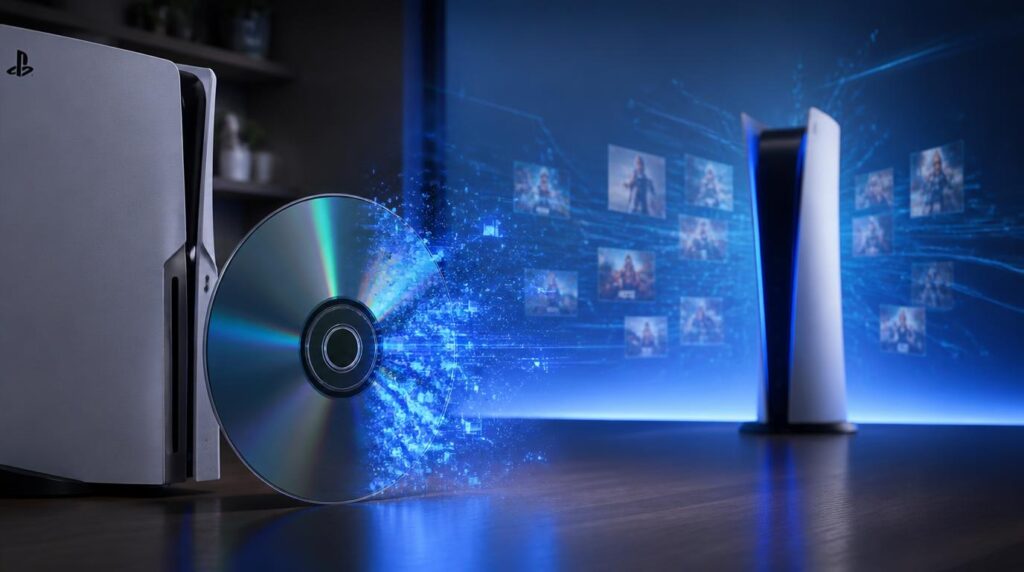
The turning point wasn’t a single announcement — it was a design decision. When Sony split the PS5 Slim into a digital edition and a version with a detachable disc drive, it reframed the drive as optional hardware rather than a core console component. That’s a meaningfully different posture than the PS4 or PS3 generations, where the drive was inseparable from the machine.
Once a disc drive becomes a bolt-on accessory, it starts behaving like one commercially: a low-margin, logistics-heavy SKU that Sony has to keep stocking, shipping, and supporting, for a shrinking share of buyers who actually want it. Reporting around Sony’s next hardware generation — sometimes referenced through prototype leaks like the one covered in our PlayStation “Puga” prototype breakdown — suggests the company is treating PS6 as an opportunity to formalize that split rather than reverse it.
What PS6 hardware likely looks like
- A digital-first base unit as the default SKU, with disc support sold as a separate USB or proprietary drive accessory — not bundled in the box.
- No first-party commitment to internal disc manufacturing past the early years of the generation, mirroring how PC gaming abandoned optical drives a decade earlier.
- Continued backward compatibility for existing PS5 discs via the external drive, softening the transition for collectors rather than cutting them off cold.
This mirrors a pattern gamers have already watched play out around other Sony hardware bets — including the once-rumored Halo-adjacent PS5 exclusivity chatter covered in our PS5 release strategy piece — where platform-level decisions get made quietly through SKU structure long before they’re confirmed on stage.
The Economics of Going 100% Digital
Physical media has always carried a cost structure that digital distribution simply doesn’t. Every boxed copy of a game involves disc pressing, case assembly, printed inserts, palletized shipping, warehousing, and — critically — a cut for the retailer. Digital sales collapse nearly all of that into a single transaction routed through PlayStation Network.
| Cost Center | Physical Retail Model | Digital Distribution Model |
|---|---|---|
| Manufacturing | Disc pressing, case, print | None |
| Logistics | Freight, warehousing, restocking | Server bandwidth only |
| Retailer margin | Typically ~20–30% cut | Platform fee, no reseller cut |
| Returns / shrinkage | Real, ongoing cost | Effectively zero |
| Patch / day-one update delivery | Disc + mandatory download | Single build, no duplication |
Retailers are adjusting in step. Big-box chains have been steadily narrowing physical game aisles for years, a pattern that echoes what’s already happened to services like subscription-first platforms such as Xbox Game Pass, where the entire value proposition assumes players never touch a disc at all. As shelf space shrinks, physical releases become a marketing exercise for collector’s editions rather than a mainstream retail channel — a trend already visible in how publishers treat PlayStation’s remaining physical game commitments as a niche rather than the default.
Game Preservation & Consumer Concerns
The economics favor Sony. They don’t obviously favor the player. A disc-free future removes several rights and behaviors gamers have taken for granted for decades:
- Used game sales and trading — a secondary market worth billions annually disappears when there’s no physical object to resell or lend.
- Offline ownership — a digital license tied to an account is not the same legal or practical object as a disc sitting on a shelf, and it can be revoked, delisted, or rendered unplayable if licensing terms change.
- Long-term preservation — server shutdowns can make digital-only games completely unplayable, a risk physical media never carried in the same way.
Sony’s own track record on digital licensing has already given preservationists reason for concern. Our coverage of PlayStation’s video library licensing issues — where purchased movies could vanish from user libraries when studio licensing deals lapsed — is frequently cited as a preview of what could happen to game libraries if physical backups disappear entirely.
Impact on Game Developers & Publishers
For studios and publishers, a digital-default PS6 generation isn’t a threat — it’s mostly already the operating reality. Live-service titles, seasonal content drops, and day-one patches have trained the industry to treat the game disc as a starting checkpoint rather than the finished product.
What changes for the B2B side of the industry
- Release strategy shifts fully to digital storefronts — PSN store placement, algorithmic discovery, and pricing/discount cadence become as important as retail box art once was.
- Cloud infrastructure scaling becomes core budget, not an afterthought — publishers need to plan for day-one download traffic the way they’d plan for a physical print run, a pattern already visible in region-by-region live-service rollouts like those detailed in our Genshin Impact regional launch analysis.
- Patch delivery replaces manufacturing lead time — without a disc print deadline forcing a hard “gold master” cutoff, day-one patches become the norm rather than the exception.
- Cross-platform pressure increases — as seen in ongoing questions around titles like the one raised in our GTA 6 / Switch 2 availability piece, digital-only distribution makes multi-platform simultaneous releases logistically simpler than physical manufacturing ever allowed.
- Indie and AA developers benefit most — digital-only publishing removes the capital barrier of minimum print runs, letting smaller studios compete for shelf space they never actually needed in the first place, a shift already reflected in curated digital lineups like our best PC games roundup.
The net effect by 2028 is a PlayStation ecosystem built primarily around PSN as the storefront, patch server, save-sync layer, and licensing gatekeeper all at once. That’s a more efficient business. Whether it’s a better deal for the people actually buying the games is the debate this transition will keep generating all the way to launch.