Some stories make you uncomfortable. Killing Stalking makes you question why you kept reading.
That’s the genius of it. You pick up the Killing Stalking comic thinking you know what you’re getting into — a dark thriller, maybe some gothic romance vibes. Then Koogi pulls the rug out from under you. Hard. What follows is one of the most psychologically brutal reads in modern manhwa history, and it’s earned every bit of its cult status.
Published on Lezhin Comics, this Korean webtoon ran from 2016 to 2019 and became an international phenomenon. Fans couldn’t stop talking about it. Readers who swore off dark content found themselves bingeing chapters at 2am. Why? Because Killing Stalking doesn’t just tell a dark story — it makes you feel uncomfortably close to it. If you enjoy other dark love horror visual novels or media that blurs the line between attraction and dread, this is the manhwa that started conversations nobody expected to be having.
What Is Killing Stalking About?
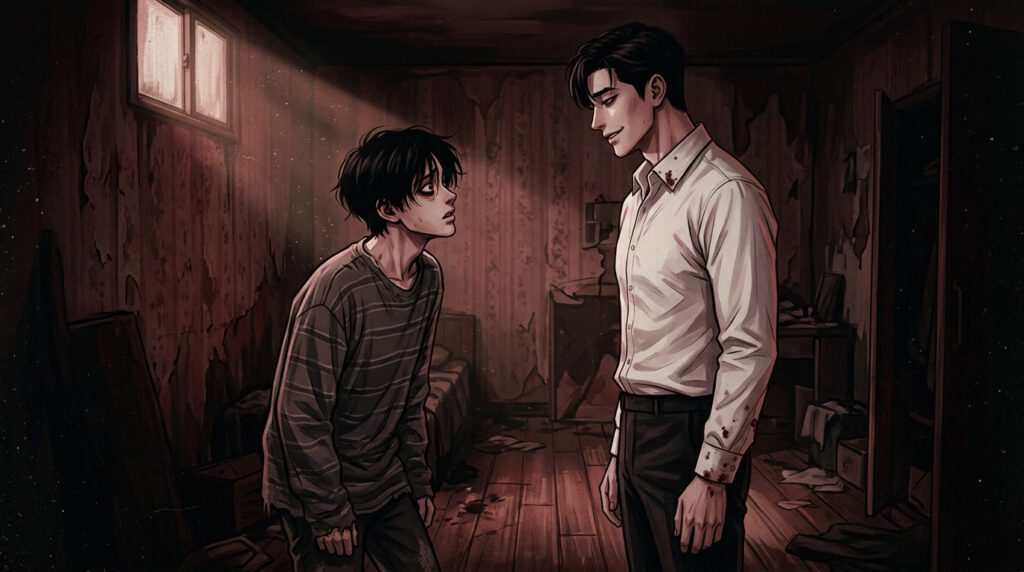
Meet Yoon Bum. He’s a quiet, deeply troubled young man with a painful past and an obsessive fixation on his classmate, Oh Sangwoo. Sangwoo seems perfect on the surface — handsome, popular, charming. Yoon Bum has followed him, watched him, built an entire fantasy around him.
Then one night, Yoon Bum breaks into Sangwoo’s house.
What he finds there shatters everything. And it’s from that single moment of discovery that the entire killing and stalking comic unravels into something far darker than a thriller. Yoon Bum doesn’t escape. He can’t. And what happens next is a sustained, suffocating exploration of captivity, manipulation, and the horrifying psychology of two broken people.
Koogi doesn’t rush it. The pacing is deliberate — sometimes agonizingly so. Chapters breathe. Tension builds in silence and in glances. Then it snaps. Violently, suddenly, and without warning.
- Genre: Psychological horror, thriller, dark romance (contested)
- Platform: Originally published on Lezhin Comics
- Author/Artist: Koogi
- Length: 67 chapters across 4 volumes
- Status: Completed
The Two People at the Centre of Everything
You can’t understand Killing Stalking without sitting with these two characters. They’re not heroes or villains in any clean sense. They’re something messier.
A survivor of trauma and neglect, Yoon Bum’s obsession with Sangwoo is rooted in deep isolation and a desperate need for connection. He is both sympathetic and deeply flawed — his choices often make readers feel conflicted rather than comfortable.
Charming, intelligent, and deeply disturbed. Sangwoo is one of manhwa’s most chilling antagonists — precisely because he doesn’t always act like one. He shifts between cruelty and warmth with terrifying ease, making readers as confused as Yoon Bum.
The Psychology of an Obsessive Relationship
What makes these two so compelling — and so disturbing — is the dynamic Koogi constructs between them. This isn’t a romance. But it uses the language of romance. It borrows the beats: longing, jealousy, moments of tenderness, the thrill of proximity. Then it shows you exactly why those beats are dangerous in this context.
Yoon Bum’s attachment to Sangwoo reads as a textbook case of trauma bonding. Isolated, dependent, intermittently rewarded and punished — he begins to interpret moments of Sangwoo’s reduced cruelty as kindness. Readers who recognize this pattern will find the manhwa deeply uncomfortable for entirely different reasons than horror fans expecting gore.
Sangwoo, meanwhile, represents something rarer in fiction: a portrayal of charismatic malevolence that never fully explains itself. Koogi gives him a backstory. She gives him moments of almost-humanity. But she never excuses him. That restraint is what separates Killing Stalking from exploitation — the author knows exactly what she’s doing.
Why Readers Feel Complicated Things
The discourse around Killing Stalking has always been loud. Some readers romance the dynamic. Others are horrified by that response. The debate itself is part of what the manhwa provoked.
Here’s the honest read: Koogi wrote a story designed to put you inside the distorted logic of an abusive relationship. You feel Yoon Bum’s hope because you’re in his head. You see Sangwoo’s appeal because Yoon Bum sees it. The discomfort of finding yourself almost sympathizing — that’s the point. Dark media that explores obsessive relationship dynamics or yandere psychology, like Saiko no Sutoka, often walks this same line. Killing Stalking just walks it further than almost anything else.
What the Story Is Really About
Peel back the horror and the suspense, and Killing Stalking is a story about psychological abuse and its mechanics. It shows how abusers isolate their victims. How victims internalize their captors’ logic. How the outside world either fails to see the signs or actively looks away.
It’s also about loneliness. Yoon Bum’s fixation on Sangwoo didn’t start in that house. It started long before, in a life that offered him very little warmth or safety. Sangwoo’s violence, too, connects to a fractured history Koogi reveals carefully over the story’s four volumes.
- Trauma bonding — how victims attach to abusers as a survival mechanism
- Obsession vs. love — the story deconstructs idealized attraction ruthlessly
- Social invisibility — how marginalized people fall through every safety net
- Complicity — the manhwa implicates the reader in uncomfortable ways
If you enjoy psychological horror that goes beyond jump scares and monsters — the kind of darkness you find in games like Corpse Party or narratives like Doki Doki Literature Club — this manhwa operates on that same level of psychological dread. It just does it with two people in a house.
The Art Style: Beautiful and Unsettling
Koogi’s linework is deceptively clean. Characters are drawn attractively — deliberately so. The contrast between that aesthetic softness and the brutality of what happens on-panel is part of the horror. She knows how to make a scene feel intimate before it becomes terrifying.
The black-and-white format works in the story’s favor. Shadows do heavy lifting. Facial expressions carry enormous weight. A single panel of Sangwoo smiling at the wrong moment can make your stomach drop.
The Ending — Does It Satisfy?
Without giving away specifics: the ending of Killing Stalking is exactly as bleak as the story earns. It doesn’t offer catharsis in any traditional sense. There’s no redemption arc, no rescue fantasy, no neat moral conclusion.
What Koogi delivers instead is consequence. The story closes in a way that feels inevitable given everything that came before — and that inevitability is its own kind of craft. Readers looking for resolution will find something closer to an exhale. Those who wanted more will argue about it forever. Both reactions are valid.
The ending generated enormous online discussion when it released. Some felt it was too abrupt. Others felt it was the only honest conclusion the story could have reached. That ongoing argument — years after publication — tells you something about how much the manhwa got under people’s skin.
Who Should Actually Read This?
Be honest with yourself before you start. This is not a dark-but-fun thriller. It’s genuinely heavy material. It earned its content warnings.
Read it if you:
- Have a strong tolerance for graphic violence and psychological horror
- Are interested in complex, morally challenging narratives
- Want to understand what the discourse around this manhwa has actually been about
- Enjoy dark media that treats difficult subjects seriously rather than sensationally
- Are already familiar with love-horror as a genre — see free love horror novels as a gentler entry point
Skip it if you:
- Are sensitive to depictions of captivity, physical abuse, or sexual violence
- Are looking for a romance story — this is not that
- Prefer your dark fiction with some hope threaded through it
- Are in a vulnerable mental space right now — seriously, come back later
If you want something that scratches a similar itch with less intensity, try Boyfriend to Death, A Date With Death, or Signalis — each explores dark obsessive dynamics through slightly different lenses. For horror fans more broadly, our guide to best horror games covers the interactive side of this genre well.
Final Verdict
Killing Stalking is a landmark of psychological horror comics. Koogi wrote something that genuinely disturbed people — not through cheap shock value, but through sustained, intelligent discomfort. The characters are unforgettable in the worst possible ways. The art is gorgeous despite the darkness. The ending is as uncompromising as everything that came before it.
Is it a great manhwa? Undeniably. Is it an easy one? Absolutely not. Read it knowing what you’re walking into. That’s the only responsible way to approach it — and it’s also what Koogi would probably want.
Rating: 9/10 — A masterwork of psychological horror that earns every uncomfortable moment.