There are legends that chill you when you read them, and then there are legends that burrow under your skin and refuse to leave. Hachishakusama — literally “Eight-Foot-Tall” — belongs to the second category. Born on the Japanese imageboard 2channel in 2008, this creepypasta spread so fast and so far that it’s now considered one of the defining horror myths of the internet age. And right now, in 2025 and into 2026, she is having a full-blown second life — not on forums, but on Steam.
Indie developers have discovered what horror fans already knew instinctively: Hachishakusama is basically built for video games. The tension in her legend isn’t about gore or monsters jumping out of the dark. It’s about being hunted. It’s about the paralyzing impossibility of escape. It’s about hearing your grandmother’s voice call your name, and knowing something terrible is wearing it like a mask. That specific flavor of dread translates to interactive media with terrifying precision — and the games currently storming indie horror communities on Steam are proof.
From Creepypasta to Game Engine: Why This Legend Works
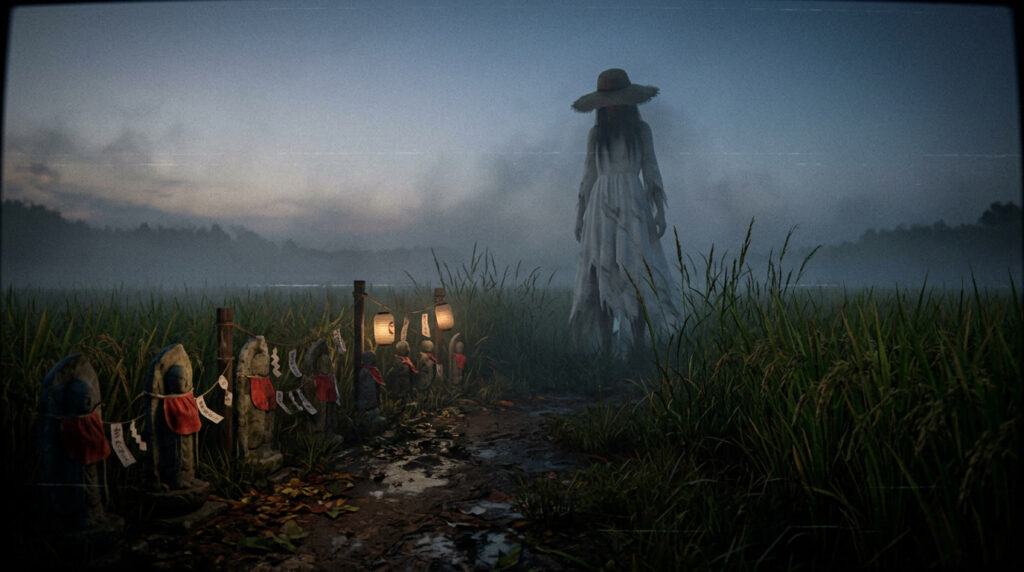
The original 2ch story is deceptively simple. A young boy visiting his grandparents in rural Japan catches a glimpse of an impossibly tall woman in a white dress and wide-brimmed hat, standing just beyond the treeline. She turns, smiles — and makes a sound. Po-po-po. That night, his grandparents explain what she is: an ancient supernatural entity that targets young people, particularly those who make eye contact with her. She is persistent, patient, and her tactics are psychologically precise. She mimics the voices of people you love. She calls your name in your mother’s voice. She lures you outside, into the dark, toward her.
Escape requires elaborate ritual: paper seals, a specific route out of the village, and not once looking back. The window for escape is narrow. The consequences of failure are permanent. This is, structurally, an almost perfect video game premise. You have a resource — the seals, the ritual, your nerve. You have a relentless, intelligent pursuer. You have an environment you don’t fully understand, full of objects and paths that matter. And you have sound as your primary threat indicator, because when the po-po-po gets louder, she’s getting closer.
The “stalker horror” format — pioneered by games like Amnesia, perfected by Outlast, and recently reimagined in dozens of indie titles — thrives on this exact architecture. You’re not fighting. You’re surviving, problem-solving, and desperately hoping your footstep doesn’t carry to wherever she’s standing right now.
The Definitive Hachishaku Games You Need to Play
The surge of player interest has produced a small but compelling cluster of indie games directly adapting the legend. Here’s where to start — and what makes each one tick.
“Hachishaku” by Trash Panda Games
This is the most mechanically developed adaptation on Steam right now, and the one currently dominating the search trend. Set in the isolated rural village of Nananani Mura — itself a name layered with folklore — the game drops you into a claustrophobic, almost painfully accurate depiction of a mid-century Japanese countryside. The objective mirrors the original legend: locate and seal a series of Jizo statues scattered across the village using ofuda paper charms before she finds you.
What makes this game genuinely interesting beyond its premise is the unexpected customization layer. Players can modify aspects of Hachishakusama’s behavior — her patrol routes, her responsiveness to noise, even the frequency of her po-po-po vocalizations — creating a difficulty ecosystem that ranges from suspenseful to genuinely maddening. The sealing mechanic itself is tense and time-consuming: you can’t rush it, and the animation leaves you completely vulnerable. If she’s anywhere nearby when you kneel at a Jizo stone, you already know what happens.
“Hachi: Eight Feet Tall” by Medo
If Trash Panda’s take is grounded survival horror, Medo’s interpretation is something rawer and stranger. “Hachi: Eight Feet Tall” leans hard into the PSX retro aesthetic — that deliberately degraded PlayStation 1 visual style, with its low-poly geometry, texture warping, and aggressive fog draw distance — to create something that feels less like a game and more like a recovered memory. The Silent Hill DNA is unmistakable, right down to the way a narrow forbidden forest closes around you and makes every footstep feel like a mistake.
The game’s structure builds toward a final escape ritual that demands you’ve paid attention to every environmental detail along the way. Nothing is clearly signposted. Medo trusts the player to be curious and observant, which means the horror hits harder — you’ve earned your dread. The sound design here is exceptional. The po-po-po isn’t just an audio cue; it’s a spatial proximity system. Learn the rhythm and you can roughly triangulate her position. Lose focus and it comes from directly behind you.
Hyakushaku-sama and the Parody Pipeline
Because the indie horror community is what it is, Hachishakusama has also spawned its own parody subgenre. “Hyakushaku-sama” — the 100-foot-tall variation — represents a strand of the trend where developers deliberately collapse the folklore’s tension into absurdist comedy. The pursuer is so large that stealth becomes farcical. The po-po-po is a foghorn. The sealing rituals are bureaucratic nightmares. It’s the same structural skeleton dressed in chaos, and it works precisely because the source material’s rules are so clearly established that breaking them lands with comedic force.
How Indie Devs Engineer the Terror
The mechanics these games use to generate fear aren’t accidental. They’re carefully calibrated systems that exploit what horror games have learned over the past decade.
Like RE3’s Nemesis or Outlast’s Chris Walker, Hachishakusama has no health bar, no weakness, no fight mechanic. You outmaneuver or you die. The absence of a combat option shifts the player’s entire psychological framework.
The po-po-po vocalizations function as a proximity system. Headphones are mandatory. Stereo positioning tells you direction; rhythm tells you urgency. Turn off the sound and you’ve essentially blinded yourself.
Running is almost always a mistake. These games reward patience, slow movement, and environmental awareness — which means players are always tense, always deliberate, always vulnerable to a sudden mistake.
Ofuda, light sources, safe zones — all of it is limited. Every decision to use a resource carries weight because the next situation might be worse. Scarcity makes every seal placement a calculated gamble.
The rural Japanese setting also deserves credit as a horror environment. These games understand what cramped farmhouses, narrow irrigation paths, and dense bamboo groves do to a player’s sense of spatial awareness. There’s nowhere to see clearly, nowhere to run freely. Compared to the open corridors of Western horror games, the environment itself feels like an opponent — which is exactly how the original legend positions the village of Nananani Mura.
There’s also the psychological layer that the best of these titles handle with care: voice mimicry. When the game uses audio to simulate a character calling your name in a familiar voice, and you have to consciously override the urge to respond, you’re experiencing a specifically Japanese horror concept that Western games rarely attempt. It’s the sound of trust being weaponized, and it lingers long after you’ve closed the game.
Hachishakusama as a Modern Horror Icon
The comparison to Slender Man isn’t arbitrary. Both emerged from internet folklore around the same era, both have a visual design so simple it becomes iconic — an inhuman silhouette in ambiguous clothing — and both found their ideal form as video game antagonists rather than passive creepypasta antagonists. But where Slender Man’s game adaptations largely burned through their goodwill with repetitive mechanics and a limited lore pool, Hachishakusama’s legend has more structural complexity baked in. The ritual. The mimicry. The specific vulnerability of youth. There’s more for developers to work with.
The current wave of games is still early. What’s on Steam right now represents the first generation of serious adaptations — competent, atmospheric, and occasionally brilliant — but the legend has room to grow into something much larger. The folklore has barely been touched in terms of narrative depth, the psychological angle of voice mimicry remains mostly unexplored mechanically, and the village-as-level design concept is still finding its footing.
If you’re a horror game player who enjoys the tense, pursuit-driven end of the genre — the games that make you hold your breath and think before every move — the Hachishaku adaptations are worth your evening. Start with Trash Panda Games’ title for the most complete experience, then follow it with Medo’s PSX-aesthetic interpretation for a tonal contrast that demonstrates how elastic the source material really is.
She’s eight feet tall, she’s wearing your grandmother’s voice, and she’s getting closer. The po-po-po says you have maybe thirty seconds to find that last Jizo stone. What are you waiting for?
The hachishaku horror game trend is one of the most creatively promising micro-genres in indie horror right now. The source folklore is mechanically rich, the visual iconography is unforgettable, and the best current adaptations prove the concept works. For fans of pursuit-based horror, Japanese folklore aesthetics, or anyone burned out on conventional Western haunted house games — this is exactly where to look next.
Stalker Horror Japanese Folklore Indie Steam PSX Aesthetic Survival