Most games give you a roster. Mewgenics gives you a species. What started as Edmund McMillen’s “cat game” side project has quietly evolved into one of the most technically audacious tactical RPGs ever attempted — a game where no two playthroughs can ever produce the same cat, the same team, or the same fight. The breeding system alone makes most procedural-generation titles look like they’re rolling a single die. If you’ve been sleeping on this one, here’s everything you need to understand before it lands.
Breeding & Genetics: Where the Real Game Lives
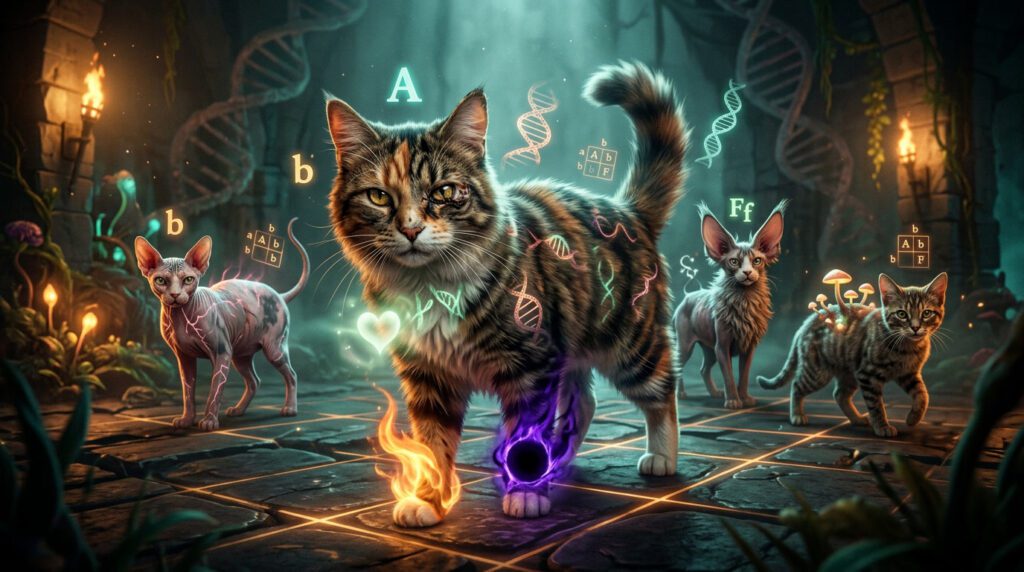
Here’s the short version: Mewgenics uses a real allele-based inheritance model. Each cat carries paired genes — dominant and recessive — across dozens of traits. Breed two cats together and the offspring isn’t randomized nonsense. It follows actual Mendelian probability. That matters because it means you can plan, selectively breed toward specific traits over generations, and still be surprised when a recessive allele surfaces three litters later.
Edmund McMillen and co-developer Tyler Glaiel spent years stress-testing this system. The goal was never to make a Tamagotchi. It was to create a game where the genetic layer produces emergent strategy that no designer scripted.
How the Inheritance System Actually Works
Dominant Traits
Express in the cat’s visible stats and abilities. One dominant allele is enough to activate the trait — size bonuses, elemental affinities, passive combat skills.
Recessive Traits
Hidden carriers. Both parents must contribute a recessive allele for it to manifest. These often carry the most powerful — or most dangerous — mutations.
Mutations
Random deviations during breeding. Can be entirely beneficial (bonus damage type), neutral (cosmetic), or actively harmful. Permadeath makes bad mutations sting permanently.
Linked Genes
Certain trait clusters travel together on the same chromosome strand — breeding for one often drags along another. Learn the links or get blindsided.
The result is a gameplay loop that rewards long-term thinking. You’re not just assembling a team for the next fight — you’re curating a genetic lineage for the next ten fights. Lose a key cat to permadeath and you lose those genes from your pool. That’s not just an emotional hit. It’s a strategic one.
Tactical Combat & Class Synergy: It’s Not Just Cute Cats
The combat system is where the genetic complexity pays off. Mewgenics uses grid-based, turn-based tactical battles — think XCOM by way of a much weirder biology lab. Your cats occupy tiles, move across the grid, and execute abilities shaped entirely by their genetic expression. A cat with a dominant fire-affinity allele doesn’t just deal extra heat damage — its entire ability tree shifts toward area denial and burn stacking.
Class isn’t a menu selection. It emerges from genetics. Breed two high-speed, high-evasion cats and the offspring leans toward a rogue-type profile. Breed tank-stat dominant cats and you get frontliners. But those classes aren’t locked — a mutation can shift a cat’s combat role mid-generation, forcing you to rethink positioning on the fly.
Combat Synergy Table: Known Class Archetypes
| Archetype | Genetic Driver | Combat Role | Synergy Tag |
|---|---|---|---|
| Bruiser | Dominant size + strength alleles | Frontline, crowd control, tile locking | Melee DPS |
| Phantom | Recessive evasion + speed cluster | Flanking, assassination, action economy | Mobile |
| Voidcat | Rare double-recessive dark mutation | Debuff stacking, AoE suppression | Control |
| Mender | Linked healing gene cluster | Support, revival, HP regen aura | Support |
| Blazeclaw | Dominant fire affinity + high attack | Burn application, terrain control | Area |
The crucial thing: synergy isn’t additive, it’s multiplicative. A Phantom flanking into a tile that a Bruiser has locked down doesn’t just get a small bonus — it triggers entirely different ability combos. The grid becomes a puzzle where your cats’ genetic profiles are the puzzle pieces. No two runs give you the same pieces.
Roguelike Structure: How Procedural Generation Stacks
McMillen has spent his career perfecting procedural design — The Binding of Isaac proved that layered randomness creates longer-lasting player investment than any hand-crafted campaign. Mewgenics takes that philosophy further. There are at least four distinct procedural layers running simultaneously:
- Map generation — world layouts, encounter zones, and resource nodes are seeded differently each run
- Genetic pool initialization — your starting cats carry semi-random allele combinations weighted toward your chosen starting condition
- Enemy mutation variance — hostile cats also have genetic diversity; you won’t face the same enemy twice
- Event & narrative branching — random events carry genetic consequences (a disease can corrupt a dominant allele; a blessing can unlock a new recessive expression)
The genius is how these layers talk to each other. A disease event doesn’t just deal damage. It mutates a gene. That mutation changes what offspring you can produce three encounters later. The procedural systems are causally linked, not just cosmetically random.
⚙ Industry Perspective: Building Systems This Complex
What Mewgenics is attempting technically is not trivial. A true allele-based inheritance model — with hundreds of trait combinations, linked gene clusters, and runtime mutation generation — requires careful state management across an entire game session. Most studios avoid this level of systemic depth because the QA surface area is enormous.
Studios specializing in complex game architecture and AI-driven systems — like eJaw and Heronbyte — understand this challenge firsthand. Designing procedural systems that feel fair rather than arbitrary demands robust simulation logic, weighted probability tables, and extensive playtesting of edge-case genetic combinations. Getting that balance right is what separates a compelling emergent system from one that just feels broken and random.
For McMillen, working with Tyler Glaiel (whose procedural and systems programming background is substantial) provides the technical foundation to actually ship this kind of ambition. Most solo-studio projects with this scope never make it out of prototype. The fact that Mewgenics has been in active development, with steady community updates, suggests the architecture is solid enough to hold.
Development Roadmap & Steam Status
Mewgenics has been a long time coming. McMillen first announced it back in 2012, then shelved it for years as The Binding of Isaac: Rebirth and subsequent DLC consumed his studio. When development resumed with Glaiel as co-developer, the scope had grown substantially — the genetics system alone represents years of design iteration.
- Original concept & early prototype (2012–2014) McMillen introduces the cat breeding concept publicly. Project shelved as Isaac work escalates.
- Revival & scope expansion (2019–2022) Tyler Glaiel joins as co-developer. Core genetics engine rebuilt from scratch. Tactical RPG layer added.
- Steam page & community updates Official wishlist page live. Regular dev blog updates confirm active development. Community engagement ongoing.
- Current: Pre-release refinement Combat systems being balanced. Mutation pool expanded. Permadeath curve adjusted based on playtester feedback.
- Release — TBA No confirmed launch window. Community consensus points toward a 2025–2026 window based on dev communication cadence.
Why Mewgenics Stands Apart From Every Other Roguelike
Most tactical roguelikes hand you a fixed set of characters with randomized stat rolls. You optimize what you’re given. Mewgenics asks a different question: what if you were responsible for what you’re given? The breeding layer makes you the author of your own team’s capability ceiling. Make smart genetic decisions and your late-game roster is powerful in ways no random drop system could produce. Make poor ones and you’re fighting with the genetic equivalent of a bad draw — except you drew the deck yourself, three generations ago.
That accountability is rare. Most procedural games let you blame the RNG. Mewgenics makes that harder. Your allele choices have consequences that ripple forward in time. That’s uncomfortable. It’s also deeply compelling.
Compare it to other standout titles in the idle and strategy genre or even complex triple-A games — almost none of them attempt multi-generational systemic depth. This is genuinely new territory for indie game design.