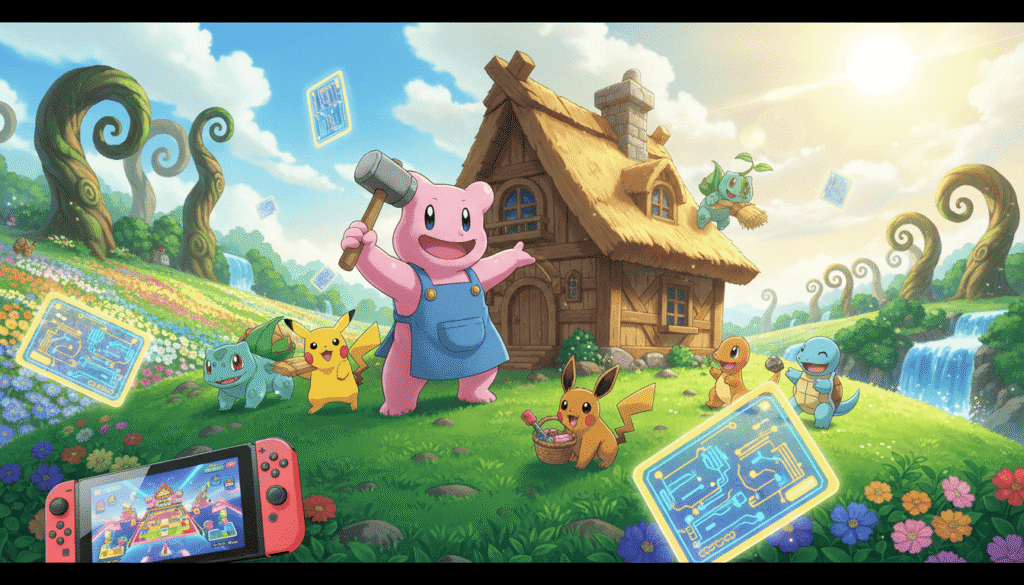
Pokémon Pokopia dropped March 5, 2026 — and it’s the boldest thing Game Freak has shipped since Legends: Arceus. Built for Nintendo Switch 2 with a physical “Key Card” system that reshapes your biome on the fly, it draws Palworld comparisons from the first hour. But the deeper you go, the clearer it becomes: this is its own beast. Here’s our full breakdown of what works, what’s overhyped, and whether the Pikachu redesign was worth it.
Pokémon Pokopia launched March 5, 2026, and the discourse has been loud ever since. Not the usual “it’s good but the story is thin” kind of loud. More like: the franchise just did something genuinely unexpected and not everyone knows how to process it yet.
We’ve put serious hours into it. Long enough to hit the late-game Key Card content, long enough to watch a Pikachu show up — and disappear — from our biome twice. Long enough to have a real opinion. This isn’t a day-one hot take. It’s a considered look at whether Pokopia delivers on years of pre-release buildup, and whether the Palworld comparison the internet won’t stop making is actually fair.
Short answer: it’s more interesting than either camp is giving it credit for. Let’s get into why.
Hardware Nintendo Switch 2, Key Cards, and What They Actually Do
The pre-release speculation around Pokopia’s relationship with Nintendo Switch 2 turned out to be mostly right — and a little wrong in the interesting ways. Yes, it’s a Switch 2 exclusive. Yes, it uses the console’s expanded cartridge architecture in ways no previous Pokémon title has. But the Key Card system is more elegant in practice than the leaks suggested, and slightly less revolutionary than the hype implied.
Here’s how it works in the actual game: Pokémon Pokopia Key Card mechanics are physical game cards — sold separately, priced at $9.99 each — that slot into your Switch 2 alongside the base game. Each card encodes a specific biome seed: terrain configuration, regional weather patterns, a curated Pokémon encounter pool, and what the game calls “ambient memory” — the behavioral tendencies of wild Pokémon native to that biome. Insert a card, and within about 90 seconds of in-game time, your world restructures around it.
Launch shipped with 6 Key Cards available at retail, with 4 more confirmed for Q2 2026. Two cards can run simultaneously, creating hybrid biomes. Card data is read-only — your save progress is stored on the Switch 2’s internal memory, so losing a card doesn’t lose your hours. Each card also unlocks a corresponding set of physical Pokémon cards via a bundled QR code. That’s the merchandising layer Nintendo has been steering toward for years.
The Switch 2 angle matters beyond the cartridge slot. Pokopia runs at a locked 60fps in handheld mode — something the original Switch couldn’t have managed with this level of biome detail. The larger screen makes the environmental storytelling land the way it’s supposed to. Playing docked on a big screen is technically fine, but you feel the game was designed for handheld. It’s intimate in a way Scarlet and Violet never managed to be.
Is the Key Card system a bold design move or a clever monetization mechanism dressed up in ecological costume? Honestly, both. We’d rather be honest about that than pretend it’s purely artistic. That said, the base game is self-contained and genuinely complete — the cards expand it, they don’t finish it.
Mechanics The Core Loop — And the Palworld Shadow
Here’s where it gets genuinely complicated — and where most takes online are getting it slightly wrong. The moment anyone mentions survival mechanics and creature-collection in the same sentence, the Pokémon Pokopia vs. Palworld comparison floods in. And there’s a surface-level version of that comparison that’s fair. Then there’s what the game actually does.
Palworld’s 2024 explosion proved there’s a massive appetite for monster-taming with resource gathering, base building, and open-world stakes. Game Freak clearly watched that happen. But where Palworld leans into creature-as-resource (deliberately, satirically), Pokopia goes the other direction with equal deliberateness.
“Palworld asked: what if your Pokémon could work for you? Pokopia appears to ask something harder: what if you had to earn their trust?”
Pokopia’s survival loop isn’t about exploiting Pokémon as labor. The game frames it as a symbiotic ecosystem — and it actually commits to that framing in ways the pre-release materials only gestured at. You don’t build a base and assign tasks. You establish a habitat, and Pokémon migrate to it, modify it around you, and occasionally tear down sections you’ve built if you’ve mismanaged the biome’s balance. We’ve had a mid-tier camp dismantled twice by a grumpy Ursaring who decided our clearing was encroaching on his territory. It stings. It also makes the world feel alive in a way no previous Pokémon game has managed.
Core Mechanics That Actually Shipped
- Biome Management: Your camp evolves based on which Pokémon you attract, what resources are present, and the Key Card inserted in your Switch 2. A Fire-type biome card transforms the environment — and genuinely repels Water-types over time. It’s not instant. It takes about two in-game days, and the transition period creates unexpected encounter opportunities.
- Key Card Slots: Up to two cards active simultaneously, creating hybrid biomes with encounter combinations that aren’t available in any single-card configuration. This is the primary endgame collection driver — and it works. We’ve spent more time card-swapping than we expected.
- Trust Economy: Wild Pokémon have trust meters, not catch rates. You build trust through consistent habitat quality, feeding schedules, and — the detail that surprised us most — by deliberately losing battles in their territory. Winning too often triggers a stress response in local Pokémon populations that tanks your trust scores.
- Battle Overhaul: Real-time positioning elements built into a turn-adjacent structure. Battles are faster and more spatial than anything in the mainline series. Strategy depth is genuine — we’d argue it’s deeper than Scarlet/Violet, though the lack of a post-game battle facility is a real miss.
- Dynamic Weather: Weather determines encounter rates, Pokémon behavior, and crafting material availability. Key Cards influence regional weather — a Rain Card stacked with a Fog Card created a micro-climate we hadn’t read about anywhere. The game rewards experimentation.
- Crafting (Intentionally Light): Unlike Palworld’s sprawling factory logistics, Pokopia’s crafting is focused on habitat enhancement items. Some players will find this thin. We found it appropriately scoped for the audience this game is actually targeting.
| Category | POKOPIA Approach | PALWORLD Approach |
|---|---|---|
| Core Fantasy | Earn creature trust through environmental stewardship | Capture creatures and optimize them for production |
| Base Building | Organic habitat growth, semi-procedural | Manual construction, factory-style logistics |
| Crafting Depth | Light — habitat tools and Key Card accessories | Deep — weapons, ammo, complex machinery |
| Combat Tone | Strategic, spatial, turn-adjacent | Action-based, shooter elements |
| Multiplayer | Co-op biome sharing confirmed — up to 4 players | Full co-op and PvP |
| Tone | Ecological wonder, cozy-adventure hybrid | Dark humor, satirical capitalism critique |
| Target Demo | Nintendo’s existing audience + lapsed fans | PC survival game audience, broader 18–35 |
The honest critical read: Pokopia is less ambitious than Palworld in raw systemic complexity, and that’s confirmed now that we’ve played both at length. Palworld’s factory chain is genuinely intricate. Pokopia’s crafting is streamlined by design. That’s a deliberate targeting decision, not a technical limitation — but it does mean Palworld veterans chasing deep automation loops will find this underwhelming on that axis. Own that rather than oversell it.
Where Pokopia clearly wins is emotional texture. The trust mechanic creates a fundamentally different relationship with the creatures in your world. You’re a steward, not an employer. That’s harder to quantify in a comparison table — but it’s the thing that will make people remember this game in a decade. We’ve already caught ourselves feeling genuinely bad about neglecting a camp we built early on.
For a sense of where survival-lite mechanics sit across the genre right now, our breakdowns of Palworld dungeon locations and the Palworld × Terraria crossover give a useful benchmark for where the bar sits.
Mascot Pikachu’s Role in Pokopia — Actually Earned This Time
Pikachu’s role in Pokémon games has followed a predictable arc. Starter in Yellow, cameo in everything since, promotional mascot in perpetuity. He’s the brand. He’s rarely a narrative device.
Pokopia changes that — and it does it through systems rather than cutscenes. Pikachu isn’t your starter. He’s not on anyone’s team. He’s a wild apex creature of the base biome, and he functions as a living health indicator for your habitat. Thriving ecosystem? A Pikachu appears at your camp’s perimeter, usually at dusk. Let your biome degrade — over-hunting, neglecting water sources, running conflicting Key Cards too long — and he vanishes. No warning. No cutscene. He’s just gone.
This reframing works. Pikachu becomes a feedback mechanism you actually care about — more like a spirit animal than a collectible. It solves the “Pikachu is everywhere but means nothing” problem that’s plagued the franchise since Gen II. He’s still central to the marketing. But within the game, he earns his presence. We lost our camp Pikachu on day three of playing and spent two hours course-correcting before he came back. That’s design doing its job.
Players who maintain a Gold-tier biome for five consecutive in-game days unlock a named Pikachu bond — a specific individual with behavioral quirks, a distinct charge pattern in battle, and a 12-mission quest chain that serves as Pokopia’s emotional centrepiece. We won’t spoil where it goes. We will say the ending hit harder than anything in the mainline series since Gen V.
It’s also smart IP management. Pikachu stays central for merchandise and card partnerships. But the game earns that centrality through mechanics. If every future mainline title did this with its mascot, the franchise would be in a much healthier creative place.
Criticism What Pokopia Gets Wrong — And What’s Genuinely Missing
No honest review pretends a game has no flaws. Pokopia has a few, and some of them matter.
- The Key Card monetization will age badly. Six cards at launch, four more confirmed for Q2, likely more after that. The base game is complete on its own — but the hybrid biome combinations are so compelling that players will feel pressure to buy cards to access content that feels intentionally withheld. That’s not a neutral design choice.
- The story is thin in the middle. Acts 1 and 3 are strong. The 15-hour stretch between them — the part most players will spend the most time in — lacks narrative drive. The ecosystem mechanics carry it, but the writing doesn’t.
- No post-game battle facility. The combat system is the deepest Game Freak has shipped in years. There’s nowhere to really stress-test it once the credits roll. That’s a baffling omission that a patch could fix — but shouldn’t have needed a patch.
- Online co-op has stability issues at launch. Four-player biome sharing works beautifully in theory and crashes more than it should in practice. Nintendo’s track record on patching these issues quickly is good — but it’s week one, and it’s a problem.
- Key Card storage isn’t solved. Physical cards with no included storage solution. You’ll lose one within a month. Nintendo needs a first-party Key Card wallet situation, and they don’t have one yet.
None of these are dealbreakers. But taken together, they paint a picture of a game that shipped with the confidence of a studio that knew its core concept was strong enough to carry some rough edges. That confidence isn’t wrong — Pokopia’s ecosystem loop is genuinely excellent. It just means the edges are rougher than they should be for a $60 title.
The monster-collector genre is not standing still. What the best game developer studios in 2025 demonstrated is that creature-collecting mechanics are migrating toward greater systemic depth. Pokopia is ahead of most of the competition on that axis. But “ahead of the competition” and “fully realized” aren’t the same thing.
The biome trust loop. The Pikachu bond arc. The hybrid Key Card combinations. The combat’s spatial depth. The way the world actually reacts to your decisions. These things work — and they work better than anything in the mainline series since Black & White. That’s enough to make Pokopia essential, flaws and all.
Related Reading from PinkCrow
Is Pokopia the Franchise Reset We Actually Needed?
Yes. With caveats.
Pokémon Pokopia is the most creatively ambitious mainline Pokémon title in over a decade. The biome trust loop is genuinely novel. The Key Card system is clever, collector-brained, and slightly predatory — all at once. Pikachu’s role as a living biome indicator is the best use of the mascot in franchise history. The combat system deserves a sequel that gives it a proper endgame arena to breathe in.
The Palworld comparison will follow this game forever, and it’s not unfair — but it’s not quite right either. Palworld asked what happens when you weaponize the creature-collector formula. Pokopia asks what happens when you slow it down, give it weight, and make you feel the consequences of every decision. Different games. Different answers. Both worth playing.
What Pokopia proves — definitively, now that we have the actual game in hand — is that Game Freak was listening. Not just to the Palworld discourse, but to years of criticism that the franchise was on autopilot. This doesn’t feel like autopilot. It feels like a studio that took a genuine swing. Some of it lands cleaner than other parts. The swing itself is what the franchise needed.
Buy it. Play it on handheld. Keep your Key Cards somewhere you won’t lose them. And check back at the PinkCrow blog — we’ll have a full Key Card tier list and endgame biome guide up before the end of the month.