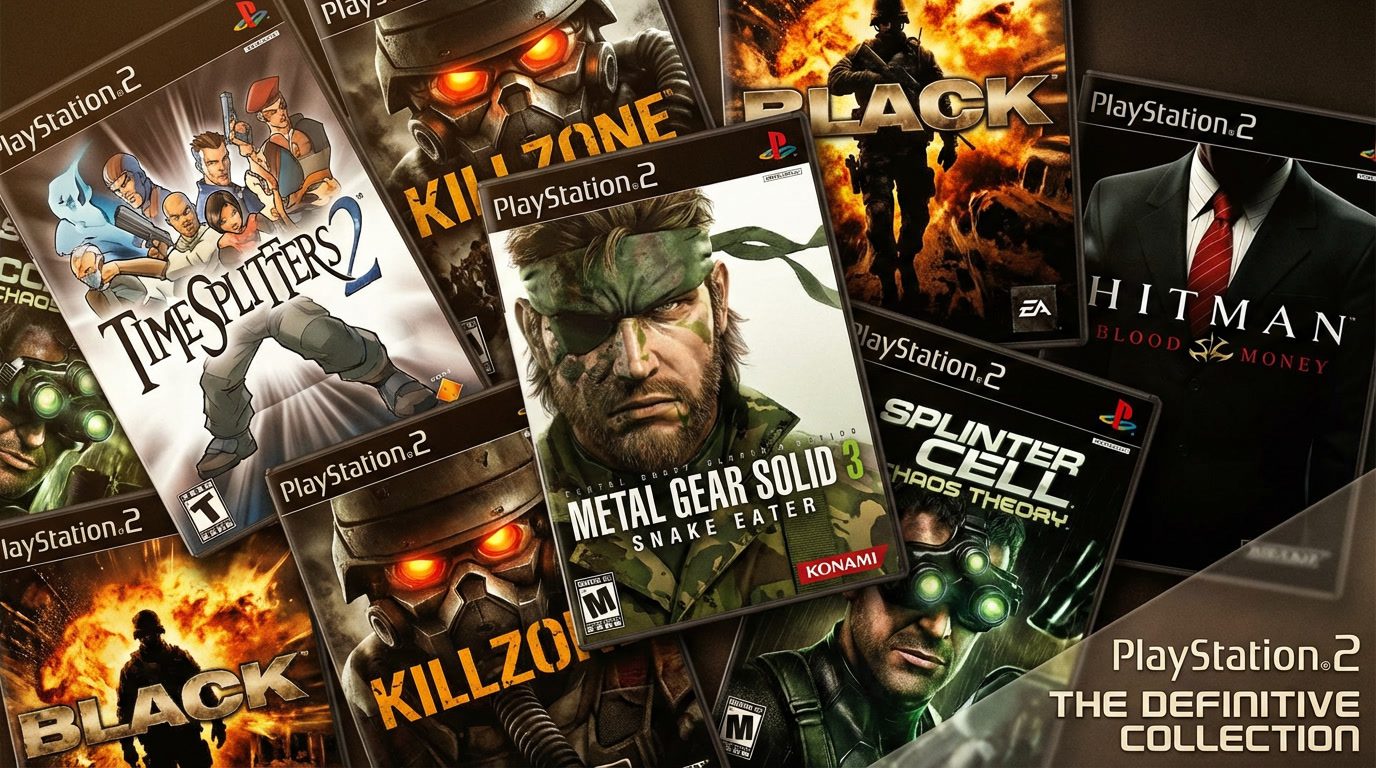
The PlayStation 2 era represents a transformative period for both first-person shooters and stealth games. As one of the best PS2 games collections ever assembled on a single console, the PS2 library showcased innovation that would define these genres for decades to come. The console’s 128-bit architecture enabled developers to create experiences that pushed beyond what gamers thought possible on home consoles. For aspiring developers interested in understanding what made these games special, exploring how to make a video game in 2026 can provide insights into translating classic design principles to modern development.
Between 2000 and 2013, the PS2 hosted an incredible variety of shooters and stealth titles, from military simulations to sci-fi adventures, from tactical espionage to pure action mayhem. This comprehensive guide explores the essential games that made the PlayStation 2 the ultimate destination for action gaming enthusiasts.
Whether you prefer the calculated patience of stealth gameplay or the adrenaline-fueled chaos of shooters, the PS2 delivered unforgettable experiences that remain influential today. Many modern games still draw inspiration from the mechanical innovations and design philosophies pioneered during this era.
The Best PS2 Shooters
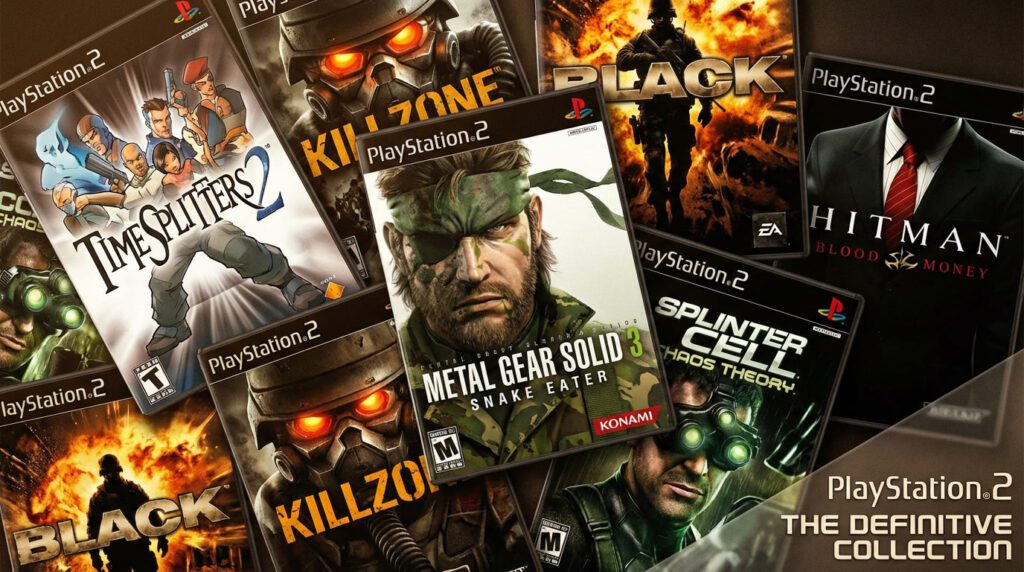
TimeSplitters Series: Time-Traveling Mayhem
The TimeSplitters trilogy stands as perhaps the most beloved shooter franchise exclusive to PlayStation 2 during its early years. Developed by Free Radical Design—a team formed by ex-Rare developers who created GoldenEye 007 and Perfect Dark—these games brought that legendary N64 shooter DNA to Sony’s powerhouse console.
TimeSplitters (2000)
Launching alongside the PlayStation 2 in North America, the original TimeSplitters established the series’ signature blend of humor, variety, and split-screen multiplayer excellence. The game’s story mode spans nine missions across different time periods from 1935 to 2035, featuring 18 playable characters each dealing with their own challenges while fighting the alien TimeSplitter race.
What truly distinguished TimeSplitters was its MapMaker feature, allowing players to create custom levels from pre-made tiles, adjust lighting, and populate maps with items and weapons. This gave the game nearly unlimited replay value as players crafted their own arenas for multiplayer battles.
The split-screen multiplayer supported up to four players locally, featuring various game modes and an enormous roster of characters unlocked through gameplay. Despite hardware limitations, Free Radical maintained impressive frame rates even in four-player split-screen, prioritizing smooth gameplay over graphical flourishes like anti-aliasing.
TimeSplitters 2 (2002)
GameSpot declared TimeSplitters 2 as potentially the best split-screen multiplayer-focused first-person shooter ever created. This sequel expanded everything that made the original special while addressing its story mode weaknesses.
The campaign now featured proper narrative context, following a space marine recovering time crystals across ten missions spanning 1853 to 2401. Each era brought distinct visual themes, weapons, and enemies—from Wild West revolvers and Winchester rifles to futuristic plasma rifles and sci-fi technology.
Weapons varied dramatically by time period, including everything from bricks and fire extinguishers to rocket launchers and flamethrowers. Most weapons featured alternate fire modes, adding tactical depth to combat encounters.
The multiplayer offerings expanded significantly, with more game modes, characters, and customization options. The MapMaker tool received improvements, giving players even greater creative freedom. The game’s only major criticism was its lack of online multiplayer, which would have extended its community longevity.
TimeSplitters: Future Perfect (2005)
The trilogy concluded with Future Perfect, which featured brilliantly bonkers time-travel mechanics where protagonist Cortez traveled from 2401 to various points in history including 1969 and 1994, meeting and even fighting alongside past and future versions of himself.
This creative approach to time travel created unique gameplay scenarios impossible in other shooters. You might lay down covering fire for your past self attempting to complete an objective, or receive assistance from your future self during difficult battles.
Future Perfect finally introduced online multiplayer for up to 16 players, addressing the series’ longstanding limitation. The single-player campaign represented the pinnacle of the franchise’s storytelling ambitions, with memorable characters, comedic writing, and satisfying mission variety.
All three TimeSplitters games received a re-release on PlayStation 4 and PlayStation 5 in 2024 as PS2 Classics, featuring trophy support, rewind functionality, and improved loading times, making these classics accessible to modern audiences.
Killzone: Sony’s Answer to Halo
When Killzone launched in November 2004, Sony positioned it as their premier first-person shooter to compete with Microsoft’s Halo franchise. While it didn’t quite reach those lofty expectations at launch, Killzone established a universe and gameplay foundation that would spawn a successful franchise.
Set during a planetary colonization era, players join the ISA (Interplanetary Strategic Alliance) defending against an invasion by the militaristic Helghast faction. The campaign features four playable characters—ISA Captain Jan Templar, hot-headed Sergeant Rico, Shadow Marshal Luger, and half-human spy Hakha—each offering different perspectives on the conflict.
Killzone pushed the PS2 hardware to its limits with impressive graphics for the time, though it struggled with occasional frame rate drops during intense action sequences. The game featured over 27 weapons inspired by modern military technology, from assault rifles and sniper rifles to rocket launchers and energy weapons.
What distinguished Killzone from competitors was its gritty, war-torn aesthetic. Environments felt genuinely hostile, with rubble-strewn streets, industrial facilities, and desperate defensive positions. The atmosphere communicated the brutal reality of this interplanetary conflict more effectively than most contemporary shooters.
Multiplayer supported up to 12 players online, offering team-based and competitive modes. While not as refined as its sequels, the multiplayer provided solid tactical gameplay that rewarded communication and coordination.
Killzone received an HD remaster for PlayStation 3 in 2012, running at 720p with improved textures, MSAA filtering, and trophy support, breathing new life into the original vision.
Black: The Most Explosive PS2 Shooter
Released in 2006 near the end of the PS2’s prime, Black arrived from Criterion Games (developers of the Burnout franchise) with a singular focus: making the most visceral, explosive, destructive shooter possible on PlayStation 2 hardware.
Black featured cinematic firefights through destructible environments, with virtually everything in the environment capable of being shot apart, blown up, or otherwise demolished. Wooden crates splintered realistically, concrete walls crumbled under sustained fire, and glass shattered with satisfying physics-based fragmentation.
The game’s weapon handling felt exceptional, with each gun having significant weight and impact. The audio design particularly impressed, featuring some of the most powerful gun sounds ever heard in console games at the time. Every shot from your arsenal felt meaningful, from the crack of sniper rifles to the thunderous boom of shotguns.
The campaign followed black ops operative Jack Kellar through eight missions set in fictional Eastern European locations. While the story remained fairly straightforward, it served its purpose framing the action setpieces. Missions escalated in intensity, culminating in explosive finales that pushed the PS2’s capabilities.
Black prioritized single-player experiences over multiplayer, offering no online or split-screen modes. This allowed Criterion to dedicate all resources toward perfecting the destructive gunplay and environmental interactions. For players seeking pure shooting satisfaction rather than competitive multiplayer, Black delivered an unmatched experience.
The game’s only significant limitation was its relatively short length—skilled players could complete the campaign in 6-8 hours. However, harder difficulty modes and unlockable weapons encouraged replays for players wanting to master every encounter.
Call of Duty Series on PS2
Before Call of Duty became synonymous with modern military shooters, several entries in the franchise launched on PlayStation 2, bringing intense World War II combat to console players.
Call of Duty: Finest Hour (2004)
The first console-exclusive Call of Duty game featured campaigns across three perspectives: Soviet, British, and American forces. Players experienced iconic WWII battles from the Eastern and Western fronts, including the Battle of Stalingrad and the Allied advance into Germany.
Call of Duty 2: Big Red One (2005)
Following the U.S. Army’s 1st Infantry Division from North Africa through Sicily and into Germany, Big Red One emphasized squad-based combat and camaraderie between soldiers. The narrative thread connecting missions created more emotional investment than typical WWII shooters.
Call of Duty 3 (2006)
The final PS2 entry in the series, Call of Duty 3 introduced vehicle sections and expanded to include Canadian and Polish forces alongside American, British, and French campaigns. The game pushed for more cinematic presentation while maintaining the series’ intense firefight gameplay.
Call of Duty: World at War – Final Fronts (2008)
This PS2-exclusive spin-off of World at War featured entirely unique campaigns not found in the main game, focusing on American soldiers in the Pacific Theater. Despite being released years into the PS3 era, it demonstrated the PS2’s continued relevance for action gaming.
Medal of Honor Series
Before Call of Duty dominated military shooters, Medal of Honor defined the genre on PlayStation platforms. The PS2 hosted several entries that continued the series’ tradition of authentic WWII experiences.
Medal of Honor: Frontline (2002)
Perhaps the most memorable entry, Frontline featured the iconic D-Day landing opening sequence that became legendary among PS2 gamers. The campaign followed Lt. Jimmy Patterson through missions behind enemy lines, including covert operations, sabotage, and reconnaissance.
Medal of Honor: Rising Sun (2003)
Breaking from the European theater, Rising Sun focused on the Pacific War against Japan. The game introduced branching paths where player choices affected mission outcomes, adding replay value beyond the typical linear shooter campaign.
Medal of Honor: European Assault (2005)
This entry refined the formula with improved AI, destructible cover systems, and non-linear mission objectives. Players could approach objectives from multiple angles, bringing tactical freedom uncommon in the series.
Star Wars Battlefront II
Star Wars Battlefront II stands as the number one PS2 FPS game for many players, offering unparalleled variety with space combat, ground battles, and Jedi gameplay, alongside massive multiplayer support that made it endlessly replayable.
The game’s scope exceeded most PS2 shooters, with dozens of maps spanning all six Star Wars films (at the time), multiple playable factions, and diverse gameplay modes. The campaign followed the 501st Legion clone troopers from the Clone Wars through the rise of the Empire, providing narrative context for the Galactic Civil War.
Space battles represented a major addition, allowing players to pilot fighters, bombers, and transports in objective-based missions. You could board enemy capital ships, sabotage systems, and engage in dogfights—all seamlessly integrated with the ground combat focus.
Hero characters like Luke Skywalker, Darth Vader, Yoda, and others became playable under specific conditions, dramatically shifting battle dynamics. Controlling these iconic characters felt empowering, with force powers and lightsaber combat providing satisfying power fantasy moments.
Split-screen multiplayer supported two players, while online modes (via network adapter) accommodated larger matches. The variety of content ensured players could enjoy hundreds of hours without exhausting the available options.
Other Notable PS2 Shooters
Half-Life (2001)
The legendary PC shooter received a PlayStation 2 port with enhanced graphics optimized for console hardware. While purists preferred the PC version, the PS2 adaptation introduced Gordon Freeman’s Black Mesa adventure to players who might never have experienced it otherwise.
Red Faction (2001) and Red Faction II (2002)
These sci-fi shooters featured groundbreaking destructible environments powered by the GeoMod engine. Players could blow holes through walls, create new paths through caves, and collapse structures on enemies—environmental interaction far ahead of its time.
James Bond Games (Various)
Multiple 007 titles graced the PS2, including Agent Under Fire, Nightfire, and Everything or Nothing. These combined first-person shooting with gadget-based gameplay, stealth elements, and Bond’s signature style, appealing to both shooter fans and 007 enthusiasts.
Area 51 (2005)
Despite questionable voice acting from David Duchovny, Area 51 remained one of the PS2’s most underrated shooters, featuring alien conspiracies, viral mutations, and atmospheric government facility exploration.
Brothers in Arms Series
Road to Hill 30 and Earned in Blood emphasized tactical squad combat over run-and-gun action. Players commanded AI teammates, coordinated suppressing fire, and executed flanking maneuvers, bringing strategic depth to WWII shooter gameplay.
The Best PS2 Stealth Games
Metal Gear Solid Series: Defining Tactical Espionage Action
No discussion of PlayStation 2 stealth gaming can begin anywhere except with Hideo Kojima’s Metal Gear Solid franchise. The series revolutionized stealth mechanics, narrative complexity, and cinematic presentation in video games.
Metal Gear Solid 2: Sons of Liberty (2001)
Metal Gear Solid 2 blended stealth-based gameplay mechanics with high-octane action sequences and introduced Raiden as protagonist alongside Solid Snake, sparking considerable debate among fans who expected to play as Snake throughout.
The game’s deceptive marketing, which prominently featured Snake, masked Raiden’s role as the primary playable character through most of the campaign. This controversial decision served Kojima’s narrative themes about identity, manipulation, and player expectations—making the game more interesting in retrospect than initial reactions suggested.
Sons of Liberty expanded stealth mechanics significantly from the original Metal Gear Solid. Enemies could now investigate alerts more intelligently, check lockers and under tables, and work together to corner players. The first-person aiming system added precision to combat while maintaining the overhead tactical view for general movement.
The setting aboard the Big Shell offshore facility provided varied environments from industrial exteriors to tight interior corridors, each requiring different stealth approaches. Environmental hazards like slippery surfaces and explosive materials added complexity to encounters.
The game’s greatest strength remained its intricate story, exploring themes of information control, digital manipulation, and societal conditioning through increasingly bizarre plot developments. While confusing on first playthrough, the narrative’s complexity rewards careful attention and multiple playthroughs.
Metal Gear Solid 3: Snake Eater (2004)
Metal Gear Solid 3: Snake Eater completely got there in terms of gameplay, becoming the most satisfying and challenging Metal Gear title with its camouflage system and modern camera that basically changed the way players approach stealth.
Set in 1964 during the Cold War, Snake Eater functions as a prequel showing Big Boss’s origins. The jungle setting dramatically shifted the series’ aesthetic from industrial facilities to natural environments, requiring entirely new stealth mechanics.
The camouflage system became central to gameplay—players constantly needed to change outfits and face paint to blend with surrounding environments. The Camo Index percentage indicated how effectively Snake blended in, with higher percentages making detection less likely. This system rewarded environmental awareness and careful preparation.
The Cure Menu added survival elements, requiring players to treat injuries sustained during missions. Broken bones needed splints, bullet wounds required extraction and bandaging, and various ailments needed specific treatments. This deepened the immersive simulation aspects.
Hunting and eating animals restored stamina, while catching rare species provided additional benefits. The ecosystem felt alive, with animals behaving naturally until disturbed. Some could even be used strategically—throwing poisonous animals at enemies or using food as bait.
Boss battles in Snake Eater achieved legendary status, particularly The End’s sniper duel that could last real-world hours (or be bypassed by setting the console clock forward to simulate his death from old age). The Sorrow’s psychologically haunting river crossing and The Fury’s flamethrower battle showcased Kojima’s creative boss design philosophy.
The emotional narrative, focusing on Big Boss’s relationship with his mentor The Boss and the betrayal that defines his character, elevated Snake Eater above typical action game storytelling. The ending remains one of gaming’s most powerful moments.
Metal Gear Solid 3: Subsistence (2005)
This expanded edition added the critically requested camera improvements—introducing a fully controllable third-person camera similar to modern action games rather than the fixed overhead view. This “Subsistence” camera made stealth gameplay more intuitive and accessible.
Subsistence also introduced online multiplayer through Metal Gear Online, allowing players to compete in stealth-based competitive modes. While primitive compared to modern online games, it demonstrated how Metal Gear mechanics could translate to competitive play.
Splinter Cell: Chaos Theory
Splinter Cell: Chaos Theory is described as one of the most old-school stealth games ever seen, since it does not underestimate the player, not even for a second, featuring political intrigue, warfare crises, and deadly conspiracies that would make James Bond and Ethan Hunt jealous.
Sam Fisher’s third outing perfected the formula established in earlier Splinter Cell games. The gameplay emphasized gadgets, environmental interaction, and player creativity in approaching objectives. Unlike some stealth games that funneled players down specific paths, Chaos Theory provided genuine freedom in tackling situations.
The multi-vision goggles (night vision, thermal, and electrical systems vision) gave players various ways to analyze environments. Sound meters indicated noise levels, encouraging silent movement. The light and shadow system remained core to gameplay—staying in darkness made detection nearly impossible while lit areas required extreme caution.
Interrogation mechanics allowed Sam to extract information from guards through physical coercion, often providing tactical intelligence or keypad codes. The whistle function could lure guards into ambush positions. These interactive elements made enemies feel like thinking opponents rather than scripted obstacles.
The knife and close-quarters combat system felt brutally efficient. Sam could grab enemies from behind, knock them unconscious, interrogate them, or eliminate them lethally. The animation quality and context-sensitive actions made stealth kills satisfyingly cinematic.
Chaos Theory’s level design showcased masterful environmental storytelling. The Penthouse level, the Bank mission, and the Bathhouse particularly demonstrated how architecture could create gameplay challenges while feeling like authentic locations. Multiple paths through each area accommodated different playstyles.
The cooperative multiplayer mode introduced missions designed specifically for two players working together. Communication became essential as partners coordinated movements, provided boosts to reach high areas, and covered each other during infiltration. These co-op missions felt distinct from the single-player campaign while maintaining the stealth focus.
Hitman: Blood Money
Agent 47 epitomizes the modern stealth genre as a scientifically created assassin designed to be invisible, and Blood Money represented his finest PS2 contract, giving players unprecedented freedom in eliminating targets.
Unlike linear stealth games, Blood Money emphasized social stealth and improvisation. Agent 47 could disguise himself as anyone from waiters to security guards, each outfit granting access to different areas. Maintaining cover required behaving appropriately—suspicious actions while disguised could blow your cover.
The disguise system worked brilliantly with the crowd mechanics. Large gatherings of NPCs created opportunities to hide in plain sight, approach targets naturally, and disappear after assassinations. Blending into parties, conventions, or public events felt remarkably realistic.
The notoriety system added long-term consequences to sloppy assassinations. Leaving witnesses, getting caught on camera, or leaving bodies discovered increased Agent 47’s public profile. Higher notoriety made subsequent missions more difficult as NPCs recognized you more easily. Destroying surveillance equipment and bribing witnesses reduced notoriety.
Environmental kills became Blood Money’s signature feature—arranging accidents that eliminated targets without evidence of assassination. Pushing someone off a balcony, sabotaging gas heaters, rigging chandeliers to fall, or poisoning food all counted as accidents rather than murders. Perfect executions left no trace of Agent 47’s involvement.
The mission variety impressed, from infiltrating a New Orleans mansion during a party to assassinating targets at an opera house to eliminating a target during his daughter’s wedding. Each scenario required different approaches and rewarded creative problem-solving.
The weapon customization system allowed upgrading Agent 47’s signature weapons with suppressors, extended magazines, and improved accuracy. While stealth remained paramount, having reliable tools for when plans went wrong provided necessary insurance.
Manhunt: Controversial Stealth Horror
Rockstar’s Manhunt combined stealth mechanics with horror aesthetics and extreme violence, creating one of the most controversial PS2 games. Players controlled James Earl Cash, forced to participate in snuff films by a mysterious director, executing gang members in increasingly brutal ways. For those interested in horror gaming beyond shooters, check out our guides to the best horror games and titles like Zoochosis.
The game mechanically functioned as a stealth game—hiding in shadows, attracting attention with noise, and executing enemies from behind. However, the execution animations emphasized graphic violence far beyond typical stealth games, with three brutality levels depending on how long players charged attacks.
The psychological horror atmosphere, grainy filter, and oppressive urban environments created genuine tension. Unlike power fantasy stealth games where skilled players felt invincible, Manhunt maintained constant pressure and vulnerability.
The controversy surrounding Manhunt’s violence overshadowed its solid stealth mechanics and innovative use of the USB headset peripheral, which allowed players to create in-game noise by making real sounds, adding immersive interactivity.
Sly Cooper Series: Family-Friendly Stealth
Not all PS2 stealth games featured grizzled soldiers or cold-blooded assassins. The Sly Cooper franchise brought cartoon aesthetics and lighthearted heist gameplay to the genre, proving stealth mechanics could appeal to all ages.
Sly 2: Band of Thieves (2004)
The sequel significantly expanded the original’s foundation, featuring large hub worlds rather than linear levels. Players switched between Sly Cooper, Bentley, and Murray, each offering unique abilities and gameplay styles suited to different mission objectives.
The heist structure requiring elaborate multi-stage operations added strategic planning elements. Missions built toward major thefts, with each stage gathering intelligence, eliminating security, or positioning equipment. The final heist brought everything together in satisfying climaxes.
The cel-shaded art style and Saturday morning cartoon presentation made Sly Cooper accessible to younger players while maintaining enough challenge and sophistication for older audiences. The characters’ personality and humor elevated the experience beyond simple stealth gameplay.
Tenchu: Wrath of Heaven
The Tenchu series specialized in feudal Japanese ninja stealth, and Wrath of Heaven refined the formula to near-perfection on PS2. Players controlled Rikimaru or Ayame, executing missions requiring patience, precision, and mastery of ninja tools.
The stealth system emphasized vertical movement—grappling to rooftops, hiding in trees, and dropping on enemies from above. The kill system graded assassinations on stealth, with silent kills from behind or above earning the highest ranks.
Ninja gadgets included smoke bombs for escape, poisoned rice to eliminate guard dogs, caltrops to slow pursuers, and throwing stars for ranged attacks. Proper tool selection before missions proved as important as in-mission execution.
The atmospheric Japanese environments, traditional music, and authentic ninja aesthetic created an experience distinct from Western stealth games. The level design encouraged exploring rooftops and finding hidden paths rather than confronting enemies directly.
Syphon Filter Series
Continuing from its PlayStation 1 origins, the Syphon Filter series brought spy thriller stealth to PS2. Protagonist Gabe Logan handled missions requiring both stealth infiltration and action combat, offering flexibility in approach.
Syphon Filter: The Omega Strain (2004)
Although Snake was the more prominent stealth figure in the early PlayStation days, Gabe Logan’s exploits were always a bit more action-heavy, though this entry increased stealth options significantly with cover-to-cover movement, blind firing, and hostage mechanics.
The Omega Strain introduced full character customization and class-based multiplayer, unusual for stealth games at the time. Players could spec into stealth specialists, heavy weapons experts, medics, or demolitions—each role contributing differently to team objectives.
Underwater combat sections opened new infiltration possibilities, with stealth swimming, underwater combat, and aquatic approaches to objectives. This added environmental variety and tactical options unavailable in most stealth games.
Second Sight: Psychic Stealth
This underrated gem combined stealth mechanics with psychic powers, creating unique gameplay possibilities. Players controlled John Vattic, who possessed telekinesis, charm, healing, and projection abilities that could be used for stealth or combat.
Unlike the similar Psi-Ops: The Mindgate Conspiracy, Second Sight scaled things back and rewarded players for approaching each encounter strategically or using powers to avoid combat altogether, focusing more on puzzle-solving than outright combat.
The charm ability allowed possessing guards, making them complete objectives or eliminate other guards before freeing them from control. Projection created an astral form to scout ahead safely. Telekinesis could move objects to create distractions or disable security systems.
The narrative delivered satisfying psychological thriller twists, with the story unfolding non-linearly through flashbacks that gradually revealed Vattic’s mysterious past and the truth about his powers.
Thief: Deadly Shadows
While primarily associated with PC gaming, Thief: Deadly Shadows received a PS2 port bringing Garrett’s shadow-lurking adventures to console players. The game’s emphasis on avoiding combat entirely, stealing valuables, and using darkness and sound to avoid detection influenced countless stealth games that followed.
The light gem mechanic showing visibility levels became iconic, with the gem darkening as Garrett moved into shadows. Different surface materials produced different footstep sounds—moving across stone made more noise than carpet, requiring environmental awareness.
The AI guard behavior, including realistic investigation patterns and communication between guards, created dynamic stealth scenarios where each playthrough could unfold differently based on player choices and guard responses.
Technical Innovations and Legacy
The PlayStation 2’s hardware capabilities enabled innovations that defined modern shooters and stealth games. The 128-bit architecture and dual analog controller setup (building on the DualShock introduced late in the PS1 era) provided the processing power and control schemes necessary for complex 3D action games.
Controller Evolution
The DualShock 2 controller refined the original’s design with pressure-sensitive buttons, allowing games to register how hard players pressed buttons. While few games utilized this feature extensively, it demonstrated Sony’s commitment to controller innovation that would continue through subsequent generations.
The dual analog stick configuration became standard for FPS and third-person shooters, with the left stick controlling movement and the right stick controlling camera/aiming. This layout, refined on PS2, remains the console shooter standard today.
AI Advancements
PS2 stealth games particularly showcased improved enemy AI. Guards followed patrol routes, investigated suspicious sounds, checked hiding spots, and communicated with teammates. These behaviors created dynamic encounters where player actions and enemy responses generated unique scenarios each playthrough. Understanding the technical foundations that enabled these AI systems can be explored through resources on geometry formulas in game development, which detail the mathematical principles behind pathfinding and line-of-sight calculations.
Games like Metal Gear Solid 3 and Splinter Cell: Chaos Theory featured AI that reacted contextually to their environment—taking cover during firefights, calling for backup when outmatched, and searching systematically for hidden players.
Physics and Destruction
Red Faction’s GeoMod engine pioneered fully destructible environments, allowing players to alter level geometry dynamically. Black pushed destructible object physics further, with nearly everything in the environment reacting realistically to gunfire and explosions.
These physics systems added tactical depth—creating new pathways through obstacles, collapsing structures on enemies, or using environmental destruction strategically to gain advantages.
Online Multiplayer Evolution
While the PS2 launched without built-in networking, the optional network adapter enabled online play for supported titles. Games like SOCOM, Killzone, and TimeSplitters: Future Perfect demonstrated console online multiplayer’s potential years before it became standard.
The community features, voice chat, and competitive modes tested during the PS2 era laid groundwork for the robust online ecosystems that would dominate PS3 and Xbox 360 gaming.
Why These Games Still Matter
The PS2 shooter and stealth library remains relevant for several compelling reasons beyond nostalgia.
Mechanical Innovation
Many systems pioneered on PS2 became industry standards. The cover systems, contextual actions, and environmental interactions developed during this era influence modern action games. Studying these foundational titles reveals how contemporary mechanics evolved.
Design Philosophy
PS2-era games often prioritized tight, focused experiences over expansive open worlds. Missions had clear objectives, levels featured deliberate design, and campaigns delivered carefully paced narratives. This focused approach contrasts with modern gaming’s tendency toward endless content. Many of these design principles remain relevant—artists can learn from these focused experiences through guides on things to draw for game development, which emphasize how visual design supports gameplay mechanics.
Accessibility and Entry Points
For players new to shooters or stealth games, PS2 titles offer more forgiving learning curves than punishing modern equivalents. They introduce core mechanics gradually, provide clear feedback, and generally respect players’ time more than games designed around retention metrics.
Historical Importance
Understanding gaming history requires experiencing the titles that shaped the medium. The PS2 generation represents when 3D action gaming matured, establishing conventions and expectations that persist today. For anyone interested in game design or industry history, these games are essential education.
Playing PS2 Games Today
Modern players have multiple options for experiencing these classic titles:
Original Hardware
PlayStation 2 consoles remain widely available through secondhand markets. Games can be found at retro game stores, online marketplaces, and sometimes even thrift stores. Original hardware provides the authentic experience, though aging consoles may require maintenance.
Backwards Compatibility
The PlayStation 3’s early “fat” models featured full PS2 backwards compatibility, playing both physical PS2 discs and supporting PS2 memory cards. Later PS3 models removed this feature, but early units remain valuable for their backwards compatibility.
HD Remasters
Many popular PS2 games received HD remasters for PS3, PS4, and PS5. Collections like the Metal Gear Solid HD Collection and individual remasters like Killzone HD offer updated graphics, modern control schemes, and trophy support while preserving the core gameplay.
Emulation
For preservation purposes, PS2 emulation through PCSX2 allows playing games on modern PCs. Emulation enables enhancements like upscaled resolutions, improved texture filtering, and save states. However, emulation requires legally owned game copies to remain legitimate.
PlayStation Plus Premium
Sony’s premium subscription tier includes PS2 Classics—digitally re-released PS2 games downloadable on PS4 and PS5. The library continues expanding, providing legitimate access to classic titles with trophy support and other modern features.
Building Your PS2 Collection
For collectors and enthusiasts wanting to experience these classics, prioritize these essential titles:
Shooter Essentials:
- TimeSplitters 2 and Future Perfect
- Killzone
- Black
- Star Wars Battlefront II (which also influenced Star Wars games on future platforms)
- Call of Duty 2: Big Red One
- Medal of Honor: Frontline
Stealth Essentials:
- Metal Gear Solid 2 and 3
- Splinter Cell: Chaos Theory
- Hitman: Blood Money
- Sly Cooper series
- Tenchu: Wrath of Heaven
Many of these games remain affordable, though certain titles like Metal Gear Solid 3: Subsistence or complete-in-box copies of TimeSplitters games command premium prices among collectors. If you’re building a collection, consider checking out gifts for gamers for display cases and preservation supplies.
Conclusion: The Enduring Legacy
The PlayStation 2 shooter and stealth game library represents a golden age when developers refined fundamental mechanics, experimented with ambitious concepts, and delivered focused, memorable experiences. These games shaped not just their genres but gaming culture broadly.
Modern shooters owe debts to TimeSplitters’ mapmaking tools, Black’s destructive environments, and Killzone’s gritty aesthetics. Contemporary stealth games still reference Metal Gear Solid’s complexity, Splinter Cell’s gadget-based problem-solving, and Hitman’s social stealth systems.
Whether you’re discovering these games for the first time or revisiting childhood favorites, the PS2’s action library offers timeless experiences that remind us why we fell in love with gaming. The creativity, craftsmanship, and player-focused design philosophies represented here deserve recognition and preservation. For those looking to experience other classic gaming eras, explore the best GameCube games which similarly showcase innovative design from the same generation.
These aren’t just old games—they’re foundational texts in interactive entertainment history. They demonstrate what’s possible when developers prioritize tight mechanics, creative level design, and respecting players’ intelligence over chasing trends or maximizing engagement metrics.
The PlayStation 2 proved that consoles could deliver experiences rivaling their PC counterparts, democratizing genres previously dominated by keyboard-and-mouse gaming. This accessibility expanded the shooter and stealth game audiences, creating communities that persist today. The console’s success also paved the way for other platforms to showcase diverse gaming experiences—sports enthusiasts can explore the best PS2 sports games to see how other genres flourished during this era.
As gaming continues evolving toward service models, battle passes, and live operations, revisiting these complete, self-contained experiences offers refreshing perspective on what video games can be when designed as discrete artistic statements rather than ongoing revenue streams.
The PS2’s shooter and stealth legacy lives on not just in its direct sequels and spiritual successors, but in the fundamental vocabulary of modern action gaming. Every cover system, every stealth game, every destructible environment—they all trace lineage back to innovations pioneered during the PlayStation 2 era.
For more classic PlayStation experiences, explore our guides to the best 3DS games, underrated PS2 hidden gems, and best PS2 racing games. Gaming history is worth preserving, and these collections showcase why the PS2 generation remains beloved decades later.