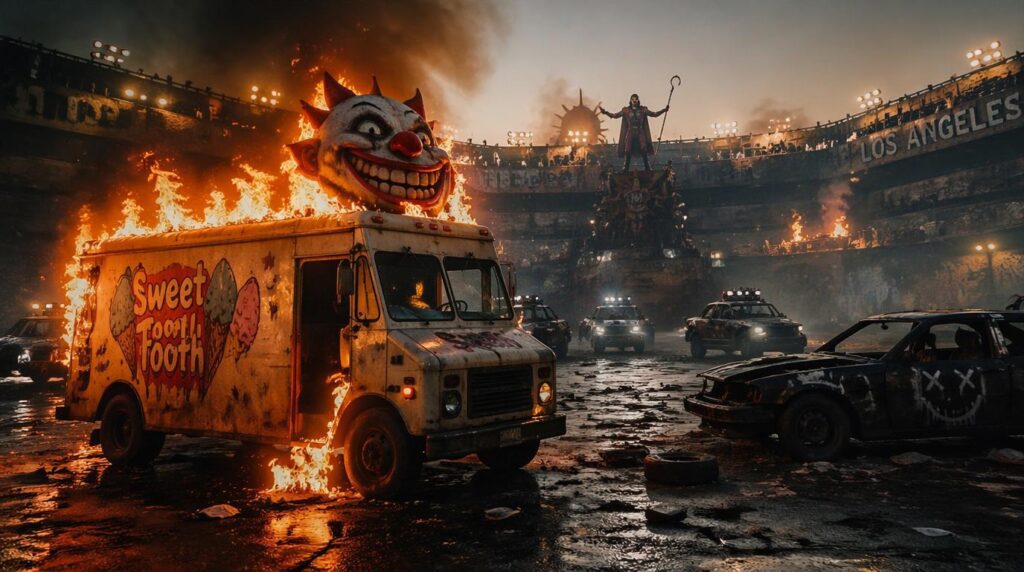
Picture it: 1995. You’ve just unwrapped a PlayStation. You put in a disc. A clown in a burning ice cream truck materialises on screen. He will haunt your nightmares for thirty years.
Welcome to Twisted Metal — Sony’s most gloriously unhinged franchise, the game that defined the vehicular combat genre, and the phenomenon that somehow, improbably, just keeps burning brighter.
There are games that age gracefully. Then there are games that corrode beautifully, like rust on a war machine. The original Twisted Metal arrived at the exact moment Sony needed something dangerous. The PlayStation was fighting for cultural oxygen. Twisted Metal handed it a flamethrower.
The premise was blunt and brilliant: demolition derby in an apocalyptic Los Angeles, run by a demonic contest-master named Calypso, who offers the survivor a single wish. Sweet Tooth wanted freedom. Axel wanted release. Everyone else wanted something dark and specific to their broken psychology. You’d blast, ram, and rocket through eight arenas. It was raw. It was barely pretty. It was absolutely mesmerising.
David Jaffe — the series’ director — called the original a “happy accident.” But genius often looks like an accident from the outside. Twisted Metal didn’t just launch the vehicular combat genre. It proved PlayStation could be transgressive in ways Nintendo simply wouldn’t allow. In a landscape of cartoon plumbers and hedgehogs, a horror-tinged demolition derby felt genuinely subversive. Check out our roundup of the best horror games to see how rare that tone still is.
The golden era: when Twisted Metal got extraordinary
Twisted Metal 2 — the masterpiece nobody argues about
If the original was a rough sketch, Twisted Metal 2 (1996) was the oil painting. It’s the Symphony of the Night of car combat — richer, stranger, more generous in every dimension. Jaffe’s team squeezed global arenas out of PS1 hardware: Paris, Moscow, a floating Antarctic base. Drivers doubled. The storytelling sharpened. The endings got darker.
The Sweet Tooth backstory crystallised here. Needles Kane — the clown behind the wheel of the burning ice cream truck — wasn’t a mascot. He was a serial killer whose head had been set on fire as punishment. A punishment that became his identity. His wish to Calypso wasn’t world domination. It was much more personal. This is the narrative cruelty the triple-A games industry would spend years trying to replicate.
TM2 also nailed the vehicular combat mechanics in ways competitors never matched:
- Weapons that changed strategy rather than just dealing damage
- Arenas with destructible geometry and environmental hazards
- Distinct handling models for each vehicle — a feeling, not just a stat
- Split-screen multiplayer chaos that rivalled anything on the platform
Twisted Metal: Black — the psychological horror chapter
Then came 2001. The PS2 was out. And David Jaffe decided to rebuild everything from pitch-black scratch.
Twisted Metal: Black remains one of the most unsettling games ever made on the PlayStation 2 — and the PS2 catalogue is extraordinary. Gone were cartoonish colours. In came industrial textures, a broken mental institution setting, and endings dark enough to belong in a David Fincher film.
Every driver in Black had a bleak origin story. These weren’t video game archetypes. They were case studies. And Calypso’s wishes here felt less like wish-granting and more like demonic therapy — giving each broken soul exactly enough of what they craved to destroy themselves completely.
In 2026, TM: Black still holds up for a specific reason: it understood that psychological horror is scarier than jump scares. The world felt broken long before the tournament started. If you want to understand why the horror gaming genre keeps returning to psychological dread, Black is your textbook. See how today’s best entries compare in our horror game guides.
The TV bridge: Calypso’s wish, finally granted
Adapting Twisted Metal for television should have been impossible. The franchise’s appeal is fundamentally about feel — the crunch of metal, the anarchic joy of launching a homing missile at an ice cream truck. How do you translate that without a controller in your hands?
The Peacock series found the answer by treating the games’ world as mythology rather than instruction manual. John Doe, played by Anthony Mackie, isn’t a named combatant from the game canon. He’s a milkman — a delivery driver crossing the wasteland. A blank-slate protagonist who encounters the franchise’s grotesqueries from the outside in. Smart pivot.
The John Doe / Quiet dynamic maps onto the games’ DNA in satisfying ways. In Twisted Metal, every driver has a wish — a desperate, specific need that Calypso exploits. John and Quiet carry their own versions: belonging, safety, identity. The show gave them chemistry the original FMV cutscenes could never produce, and used that emotional anchor to make the carnage around them feel meaningful rather than gratuitous.
Peacock Twisted Metal Season 3 — the 2026 hype is real
The build to Season 3 has been relentless. Fans from the games are rewatching TM: Black for context. New viewers are hunting down emulation setups and asking which game to start with. This is franchise cross-pollination working exactly as intended — and it’s rarer than it should be.
Season 3 is expected to lean harder into Calypso’s wishes as a structural device. If the showrunners are smart — and they’ve shown they are — they’ll use the game’s central mechanic not as plot device but as thematic architecture. Every character in Twisted Metal is defined by what they want badly enough to kill for. That’s not just good pulp. That’s tragedy in the classical sense.
The lost art: why vehicular combat died — and why Twisted Metal survived
At the genre’s peak, the vehicular combat space was genuinely competitive. Vigilante 8, Destruction Derby, Interstate ’76, Full Auto — all tried. None made it past the PS2 era with their franchise intact. By the mid-2000s the genre was effectively dead.
Why? A few honest answers:
- The skill ceiling was too niche. Twitch shooters and open-world games absorbed the exact demographic that drove vehicular combat sales
- Online multiplayer changed everything. Split-screen chaos felt limited when 16-player deathmatches became standard
- Narrative had nowhere to go. Competitors never built lore that made their characters worth caring about
- The graphical arms race was brutal. Arena budgets couldn’t compete with open-world production values
Twisted Metal survived for a reason that sounds almost embarrassingly simple: it had a soul. Calypso, Sweet Tooth, the wish mechanics, the psychological darkness — these gave the franchise a reason to exist beyond the shooting. Competitors were selling a gameplay loop. Twisted Metal was selling a world.
Compare that to today. Single-player games with strong narrative DNA are thriving. Pure gameplay loops without world-building are struggling. Twisted Metal was ahead of its time in understanding that even an arcade experience needs an emotional address. The closest modern analogues — extraction shooters, vehicular battle royales — have borrowed the chaos but not the character.
The future: is it time for a new game?
Here’s the uncomfortable truth: there hasn’t been a mainline Twisted Metal game since 2012. That’s 14 years of silence from a franchise that now has a hit TV show, a renewed fanbase, and a cultural moment that feels genuinely ripe.
Sony has been notably aggressive about returning beloved IPs to active status — a pattern visible across their console strategy. The Peacock series proves the Twisted Metal name carries real market weight in 2026. And the vehicular combat genre, for the first time in a decade, has a mainstream entry point via the show.
What would a new game need to be? Not a remaster. Not a battle royale cash-in. It would need to be genuinely uncomfortable — a game that understands why Black worked, why TM2 was a masterpiece, and why the TV show connected. It would need David Jaffe, or someone who understood what he understood: that the destruction is the surface, and the human wreckage beneath it is the actual game.
The franchise has survived thirty years. A clown in a burning ice cream truck made it from PS1 to Peacock. The wheels keep turning. The fire keeps burning. Whether or not a new entry lands by the time you read this, the Twisted Metal legacy is secure — and the hunger for its return has never been louder.
FAQ: everything you need to know in 2026
Calypso is the demonic contest-master who runs the Twisted Metal tournament and grants the winner a single wish. He’s the franchise’s central figure — part devil, part game show host, entirely sinister. What defines him is how he grants wishes: technically correct, catastrophically wrong. A contestant who wishes to “fly” might get hurled into the sky with no way down. Calypso’s wishes are the franchise’s core metaphor — be careful what you want badly enough to kill for. In the Peacock series, his role is reinterpreted for television, but the deal-with-the-devil dynamic remains intact.
Sweet Tooth (real name Needles Kane) is the franchise’s mascot villain — a serial killer who drives a burning ice cream truck with a perpetually flaming head. In the original game lore, Kane’s head was set on fire as punishment; rather than being destroyed by it, he adopted the burning clown identity as his own. In Twisted Metal: Black, his origin is reimagined with psychological horror depth — a psychiatric patient driven by compulsions darker and more specific than simple villainy. Across every version, he is the most iconic character in vehicular combat gaming history.
Not directly. The Peacock series is a loose adaptation — it treats the games’ world as mythological source material rather than strict continuity. Characters like Sweet Tooth and Calypso appear, but protagonist John Doe (Anthony Mackie) is original to the show and doesn’t exist in the game canon. The show borrows the tournament premise, post-apocalyptic setting, and wish-granting mechanic, then builds its own story around them. You don’t need game knowledge to enjoy the series. For franchise veterans, spotting the references and divergences is half the fun. Explore more game-to-media adaptations on the blog.
Start with Twisted Metal 2 — the most balanced, most creative, most universally beloved entry. Play via emulation (PCSX2 handles it perfectly) with a modern controller. Then go straight to Twisted Metal: Black on PS2 — harder, darker, more demanding, but it delivers some of the best storytelling the vehicular combat genre ever produced. If you’re a new fan from the TV show, TM2 is your entry point. To understand why the franchise has such devoted long-term fans, pair it with a dive into the broader PS2 catalogue.
The genre peaked in the late 1990s and early 2000s alongside Twisted Metal, then largely collapsed. Competitors didn’t build the franchise lore needed to survive platform transitions. The core gameplay loop got absorbed by open-world games and later battle royale formats. Twisted Metal is the only franchise to survive with its identity intact — precisely because it was never only about the mechanics. The wish mythology and character psychology gave it a reason to exist that pure gameplay loops couldn’t sustain.