
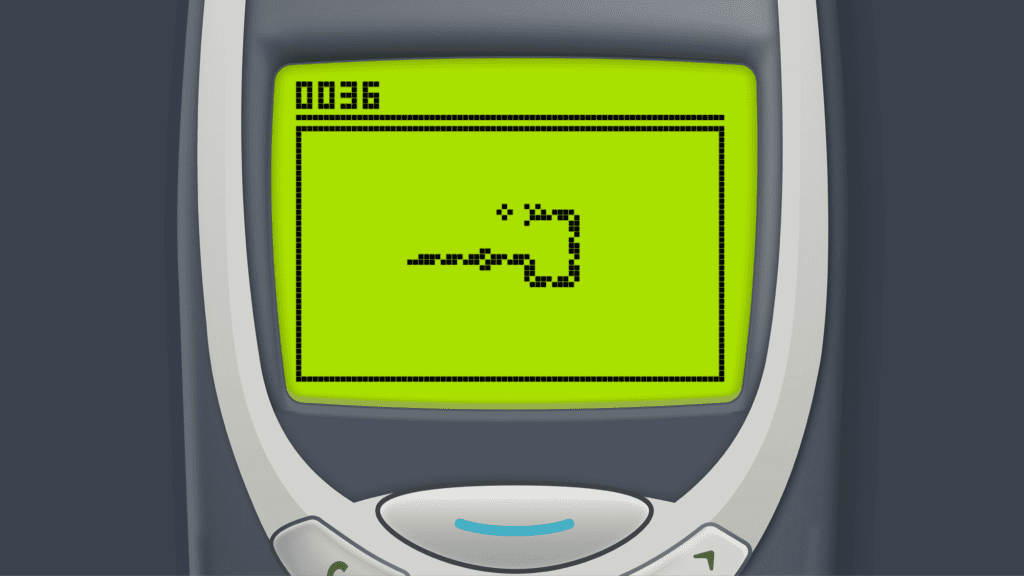
The Snake Apple game is one of the most iconic arcade concepts in video game history. From its monochrome Nokia roots to modern Google Search Easter eggs, the simple loop of guiding a hungry snake to eat apples while avoiding its own growing tail remains addictive across generations.
Whether you are revisiting classic versions for nostalgia or climbing global high-score leaderboards on mobile web browsers, mastering spatial planning and turn timing is essential. Below, we break down core rules, modern platform variants, top scoring strategies, and FAQs to help you hit a flawless board clear.
New to the genre? Start with our overview of snake games, or go back to where it all started with the Nokia Snake game.
Key Takeaways: Snake Apple Game Mechanics
- Core Gameplay: Navigate a grid to collect apples; each apple increases your snake’s length by one segment and accelerates game speed.
- Primary Defeat Conditions: Colliding with outer grid walls (in bounded modes) or running directly into your own body.
- Best Strategy for High Scores: Maintain a strict zigzag or perimeter-loop movement pattern to prevent trapping your head inside body coils.
- Popular Modern Versions: Google Snake, Apple Arcade Snake, and retro browser ports with custom map modifiers.
What Makes the Snake Apple Game Timeless?
Originating from the 1976 arcade game Blockade and popularized globally on Nokia mobile devices in the late 1990s, the Snake Apple formula relies on pure risk-reward scaling. Every apple consumed increases your total score but simultaneously restricts your future movement area.
Modern adaptations have expanded the base formula by adding special items, variable map shapes, speed toggles, and multiplayer slither-style arenas. Despite visual upgrades, the underlying grid-based pathfinding challenge remains identical. If you want a refresher on the basics before diving into strategy, our guide on how to play the Snake game walks through the fundamentals step by step.
To achieve maximum scores, follow a Hamiltonian cycle—a continuous loop that covers every square on the grid without crossing itself. Keep your snake’s head trailing right behind its tail, avoid cutting across open central space once your body covers over 50% of the board, and refrain from making panic turns at high speeds.
Popular Platforms & Game Variations
Depending on where you play, the Snake Apple game offers unique rulesets and environmental modifiers:
Pro Tips to Master Grid Pathfinding
High-level Snake gameplay requires disciplined board management rather than quick reflexes alone. Follow these techniques to maximize grid utilization:
- Hug the Outer Borders: Travel along perimeter walls during early growth stages. This leaves the center open for easy maneuvering when collecting mid-grid apples.
- Avoid Pocketing Yourself: Never drive your head into a dead-end pocket created by your tail unless you are certain the tail will clear out before your arrival.
- Use S-Curve Zigzags: When traversing long open spaces, move in tight “S” shapes to compact your body and preserve open grid space behind you.
- Patience Over Speed: It is better to take a long, safe path around your entire tail to reach an apple than to take a direct shortcut through a narrow gap.
If you enjoy classic arcade logic games, sharpen your grid-planning skills with our Bloxorz level walkthrough, test your word-finding speed in how to play Boggle, or work on spatial reasoning with our guide to the best Sudoku games.
Frequently Asked Questions About the Snake Apple Game
Answer: Yes. By following a closed Hamiltonian cycle, you can hit every single tile on the grid without crashing into your body, resulting in a completely filled board and a maximum theoretical score.
Answer: Simply search “Snake game” in Google Search on desktop or mobile, then click the interactive “Play” card at the top of the search results page to launch the browser version.
Answer: In classic Snake builds, tick speed accelerates as your score increases. Maintaining rhythm and planning turns 3 to 4 tiles in advance helps manage high-speed movement.
Answer: In bounded modes, hitting outer grid borders instantly ends the game. In wall-less (or wraparound) modes, passing through a border teleports the snake’s head to the opposite side of the screen.