
“The first principle is that you must not fool yourself — and you are the easiest person to fool.”
— Richard P. Feynman, Caltech commencement address, 1974
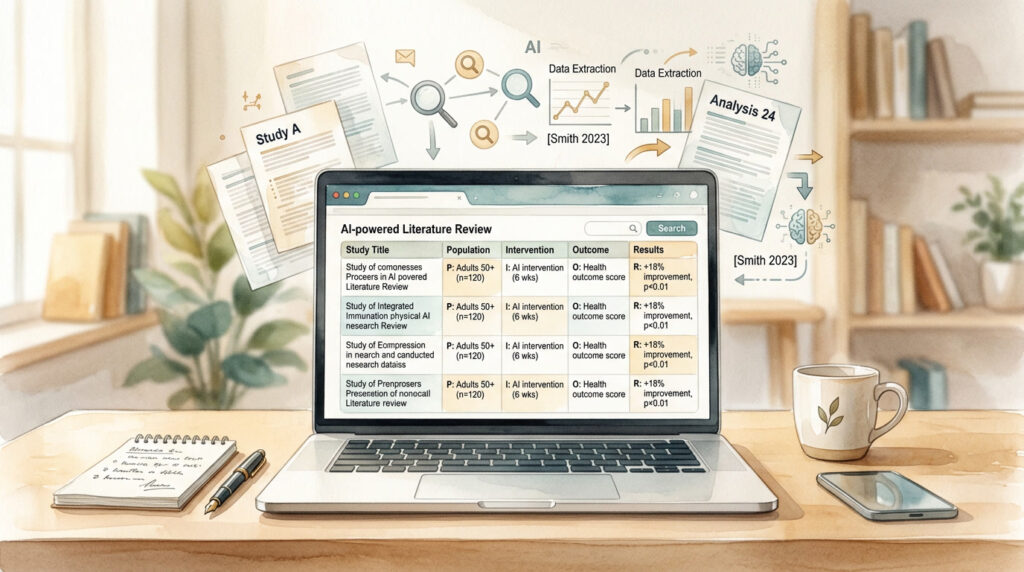
Elicit doesn’t just find papers — it reads them for you and drops the answer straight into a table. We put the AI research assistant through its paces: the search, the data extraction, the systematic review tools, and whether it’s actually worth paying for.
Anyone who has run a literature review knows the real bottleneck isn’t finding papers — it’s reading forty of them just to pull out the same five data points from each one. Elicit was built specifically to automate that grind. Instead of returning a list of links, it reads full-text papers and extracts the exact information you asked for — sample size, intervention, outcome, methodology — into a structured, exportable table. Here’s what it gets right, what it doesn’t, and what it costs in 2026.
TL;DR
| What it is | AI research assistant that searches, summarizes, and extracts structured data from academic papers |
| Best for | Empirical researchers doing literature reviews, systematic reviews, and evidence synthesis |
| Database size | 125M+ papers via Semantic Scholar, OpenAlex, PubMed, and ClinicalTrials.gov |
| Pricing | Free tier, Plus ~$12/mo, Pro ~$49/mo, Team/Enterprise from ~$79/seat/month |
| Standout feature | Extracts data straight from full-text papers into custom, exportable tables |
| Biggest limitation | Weaker coverage for humanities/social science topics; best suited to empirical, hypothesis-style questions |
What is Elicit?
Elicit is an AI-powered research assistant built to automate the more tedious parts of academic research: searching for relevant papers, summarizing what they found, and pulling structured data out of them. It began as a project inside Ought, a nonprofit machine learning research lab co-founded by Andreas Stuhlmüller and Jungwon Byun, before spinning off in September 2023 as an independent public benefit corporation backed by a $9M seed round and a later Series A.
Where a tool like Google Scholar hands you a list of links, Elicit works more like a research assistant sitting next to you: it interprets your question, finds papers that are semantically related even without exact keyword matches, and — for the papers you select — extracts specific fields (population, intervention, outcome, sample size, and more) into a table you can edit, filter, and export. It’s especially built around empirical, hypothesis-style questions common in biomedicine, machine learning, and the social sciences, phrased like “What is the effect of X on Y?”
The extraction table: Elicit’s core feature
This is what actually distinguishes Elicit from a search engine or a general chatbot. Instead of summarizing a paper in a paragraph, it reads the full text and drops specific answers into columns you define yourself.
| Paper | Population | Intervention | Outcome |
|---|---|---|---|
| Kessler et al., 2024 | 412 adults, mixed setting | 12-week structured program | Significant improvement |
| Voss & Nair, 2023 | 89 adults, clinical setting | 6-week brief protocol | No significant change |
| Aiyer et al., 2025 | 1,204 adults, community setting | 12-week structured program | Moderate improvement |
Each cell is pulled directly from the paper’s full text and links back to the source sentence, so you can verify the extraction instead of trusting it blindly.
This matters most for systematic reviews, where researchers have traditionally had to manually screen and extract data from dozens or hundreds of papers by hand. Elicit’s own claims put the time savings at up to 80% versus doing it manually — plausible for the mechanical parts of the process, though the extractions still need human verification before they go into a published review.
Key features
Finds relevant papers based on meaning rather than exact keyword matches, surfacing studies a traditional database search would miss.
Summarizes takeaways from a paper specific to your actual question, not just a generic abstract rewrite.
Define your own table columns and Elicit pulls that exact information from each paper’s full text, with source links for verification.
Added in early 2025: guided screening, extraction, and PRISMA-flowchart-structured reporting to support formal systematic reviews.
Deep-research style reports for well-defined empirical questions, though they don’t yet handle broad, overview-style topics well.
Sync sources with Zotero for reference management, and export tables directly to CSV, BIB, or RIS.
Pricing
Elicit runs a four-tier structure: a genuinely usable free plan, two individual paid tiers, and custom Team/Enterprise pricing. Paid plans scale mainly on PDF processing volume and the number of custom columns you can run per extraction table.
Basic
- Search 125M+ papers
- Summarize up to 4 full-text papers
- Extract data from 20 PDFs/month
- 2 columns per table
Plus
- 50 PDFs/month
- 5 columns per table
- CSV, BIB & RIS export
- Summarize 8 full-text papers
Pro
- 200 PDFs/month
- 20 columns per table
- Guided systematic review tools
- Advanced screening & reporting
Team
- Pooled PDF quotas
- Collaboration features
- Admin panel
- Priority support
Pricing is drawn from Elicit’s published plan details as reflected on support.elicit.com and third-party pricing trackers; confirm current figures on Elicit’s pricing page before purchasing, as SaaS pricing shifts often.
Pros and cons
What works well
- Extraction tables genuinely save hours versus manual data pulling
- Semantic search surfaces papers keyword search alone would miss
- Every extracted answer links back to its source sentence for verification
- Free tier is actually usable, not just a locked demo
- Zotero sync and CSV/BIB/RIS export fit into existing workflows
Where it falls short
- Thinner coverage for humanities and broad social-science topics
- Search isn’t fully reproducible, which matters for formal review reporting
- Screening capped at 500 papers per review
- Works best with narrow, empirical questions — not open-ended topics
- PDF and column quotas fill up fast on the free and Plus tiers
Who is it actually for?
Good fit
- Researchers running systematic reviews or meta-analyses
- Biomedical, clinical, and machine-learning researchers with RCT-style questions
- Grad students who need to extract data from dozens of papers quickly
- Teams that already use Zotero and want a connected workflow
Probably skip it
- Humanities researchers with broad, non-empirical questions
- Anyone needing a single comprehensive database — coverage still trails Google Scholar
- Casual readers who just want a plain-language explanation of a topic
- Teams that need fully reproducible, audit-ready search methodology out of the box
How it compares
| Tool | Core strength | Starting price |
|---|---|---|
| Elicit | Structured data extraction from full-text papers into tables | Free tier, then ~$12/mo |
| Scite | Smart Citations — supports/contradicts classification | Free tier, then $20/mo |
| Semantic Scholar | Free citation graphs and AI-recommended papers | Free |
| Google Scholar | Broadest free search, basic citation counts | Free |
| Consensus | AI evidence synthesis from papers | Free tier, then ~$8.99/mo |
The clearest way to think about it: Google Scholar and Semantic Scholar are for finding papers. Scite is for judging whether a paper’s claims held up. Elicit is for turning a stack of papers into a structured dataset you can actually work with — and for empirical literature reviews, that’s the step that eats the most hours.
FAQ
Is Elicit free to use?
Yes. Elicit’s Basic plan is free and includes search across 125M+ papers, summarization of up to 4 full-text papers, and data extraction from 20 PDFs a month with 2 columns per table.
How is Elicit different from ChatGPT for research?
Elicit is purpose-built for academic literature: it pulls from Semantic Scholar, OpenAlex, PubMed, and ClinicalTrials.gov, and links every extracted answer to a source paper. General chatbots draw on broad web data and can fabricate citations, while Elicit prioritizes verifiable, citable sources.
Can Elicit be used for a formal systematic review?
It can meaningfully speed up screening, extraction, and drafting, and its 2025 systematic review tools follow the PRISMA flowchart structure. However, its search isn’t fully reproducible in the way formal review reporting standards typically require, so most teams use it to accelerate the process rather than replace documented methodology.
What kinds of questions does Elicit work best for?
Elicit performs best on empirical, hypothesis-style questions with a clear intervention and outcome — for example, “What is the effect of X on Y?” It’s less effective for broad, open-ended, or non-empirical questions common in the humanities.
Does Elicit cover all academic disciplines equally?
No. Its data sources are strongest for science, technology, and medicine. Coverage for humanities and social sciences is comparatively thinner, so it shouldn’t be treated as a comprehensive replacement for a full library database search.
Verdict
Elicit is genuinely good at the one thing it set out to do: turning a pile of full-text papers into structured, verifiable data without the manual grind. For anyone running a systematic review or synthesizing empirical research, the extraction tables alone can justify the subscription. The free tier is honest enough to actually try before paying, which is more than most AI research tools offer.
It’s not a universal research tool, though. Coverage thins out fast outside STEM and biomedicine, and it isn’t a substitute for a fully documented, reproducible systematic review methodology if that’s a hard requirement for your field. Treat it as what it is — a serious accelerant for empirical literature review — and it earns its place in a researcher’s toolkit.