The Ultimate Roblox Character Guide:
From Classic Noobs to Pro Avatars
Anatomy, history, iconic archetypes, how to draw them, coloring pages, game lore — everything about the digital identity powering the world’s biggest gaming platform.
In the vast digital universe of Roblox — a platform that now boasts over 380 million registered users — your avatar is more than a collection of pixels. It is your identity, your first impression, and your creative signature across thousands of games and social spaces. Whether you are a seasoned player sporting a meticulously crafted look, a parent trying to understand what your child is building, or an aspiring game creator designing custom NPCs, the Roblox character sits at the heart of the entire experience.
This guide covers everything: the technical anatomy of the avatar system, how designs evolved from 2006 to 2026, the iconic archetypes the community loves, step-by-step creative tips, and the thriving art culture built around Roblox character PNGs and coloring pages.
Anatomy of a Roblox Character
Before diving into styles and aesthetics, it helps to understand what a Roblox character actually is under the hood. The avatar system is built on a modular rig — a set of parts that can be swapped, colored, and accessorized independently. This modularity is precisely what makes the platform so expressive, allowing hundreds of millions of players to look completely unique.
How Tall Is a Roblox Character?
The default Roblox character stands approximately 5 studs tall — where 1 stud equals roughly 28 centimeters in real-world scale, making the default avatar about 140 cm (4 ft 7 in) in “game world” measurement. With the R15 rig, players can scale character height between 95% and 105% of the default. The HumanoidDescription object in Lua controls BodyHeightScale, BodyWidthScale, and BodyDepthScale — giving creators precise control over every character’s proportions.
Parts of the Avatar: Head, Face & Base Templates
Every Roblox character is assembled from distinct zones that can each be customized individually. The head holds the face texture (including the iconic “Man face” meme expression), hair accessories, and hats. The face slot accepts 2D texture decals — this is how classic expressions like the screaming face or default smile are applied.
The body base template consists of the torso, arms, and legs. In the R6 system, this breaks into 6 rigid parts. In R15, the body expands to 15 articulated segments including upper/lower arms, upper/lower legs, hands, and feet — enabling far smoother animations. The HumanoidRootPart acts as the invisible anchor point for all physics and movement calculations in the engine.
R6 vs. R15: Full Comparison
| Feature | R6 | R15 |
|---|---|---|
| Body Parts | 6 rigid parts | 15 articulated parts |
| Animations | Basic, blocky | Smooth & fluid |
| Body Scaling | Fixed proportions | Full width/height/depth scaling |
| Height Range | Fixed | Adjustable 95%–105% |
| Layered Clothing | Not supported | Full 3D drape support |
| Dynamic Head | Not supported | Supported (facial animation) |
| Performance Cost | Lower | Slightly higher |
| Game Compatibility | All classic games | Modern experiences only |
| Introduced | 2006 (original) | 2016 update |
| Best For | Retro / nostalgic feel | Modern, expressive builds |
The Evolution of Roblox Avatars: 2006 to 2026
When Roblox launched publicly in 2006, the default Roblox character was a blocky figure with bright yellow skin, a blue torso, green legs, and a cheerful smile — the original classic avatar. Six parts, basic joint animations, and limited texture options defined what an old Roblox character could be. Yet despite these constraints, players immediately began experimenting with the catalog’s early items to differentiate themselves.
Between 2010 and 2014, the platform introduced the classic avatar catalog in earnest, adding thousands of hats, faces, gear items, and packages. The aesthetic of this period — chunky proportions, bright colors, and novelty accessories — is what most longtime players associate with “classic Roblox.”
The landmark shift came in 2016 with the R15 rig, and by 2021 layered clothing allowed 3D garments to drape realistically over any avatar shape. By 2026, the avatar system supports dynamic heads with facial animation capabilities — blurring the line between a game character and a personal digital representation.
Popular Character Styles & Aesthetics
Walk through any popular Roblox game lobby and you will immediately notice the extraordinary diversity of avatar styles. From hyper-realistic builds to deliberately absurd comedy characters, the community has developed a rich visual language with distinct recognized archetypes.
Cool Roblox Avatars for Boys & Girls
For a cool Roblox character boy look, the most popular styles in 2025–2026 lean into the “e-boy” aesthetic — dark clothing, chain accessories, alternative hairstyles — or the athletic/sporty build with slim packages and branded-style shirts. All-black color schemes consistently trend, earning the popular community search term “black Roblox character.”
A cool Roblox character girl aesthetic frequently centers on pastel color palettes, anime-inspired face textures, flowing hair accessories, and fashionable layered clothing. The “soft girl” and “Y2K” revival aesthetics have been particularly strong. Rich Roblox character builds — using expensive limited-edition catalog items — are aspirational for many players, with some limited items trading for millions of Robux on the secondary market.
Famous Archetypes: The Noob, Bacon Hair & Buff/Fat Builds
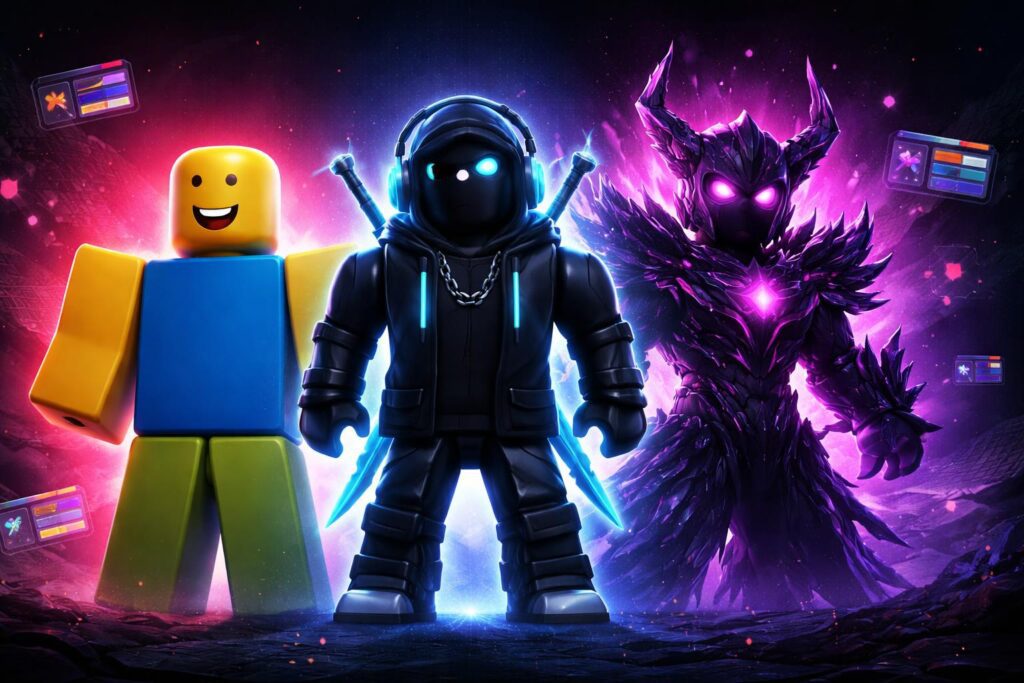
No discussion of Roblox character culture is complete without the noob character — arguably the most iconic figure in the platform’s history. The noob is defined by its default appearance: bright yellow skin, a blue torso shirt, green pants, and a general lack of accessories. Today, deliberately wearing a noob character aesthetic is a badge of ironic pride for veteran players.
Running a close second is the bacon hair character, named for a free hairstyle in the catalog that resembles strips of bacon. It became synonymous with new or free-to-play players, but like the noob, transcended mockery to become a beloved symbol of Roblox’s egalitarian origins.
On the body type spectrum, the community has embraced both buff and fat Roblox character builds as expressive, often comedic choices. Buff characters maximize width and muscle-like proportions with warrior cosmetics, while round builds achieved through depth scaling have spawned countless memes.
Funny & Unique Designs (Screaming Face, Bald Builds)
The screaming or surprised face expressions — wide-eyed, open-mouthed textures — became particularly popular for comedic builds. A character wearing a screaming face combined with a business suit creates the kind of absurdist humor that thrives on YouTube and TikTok.
Bald Roblox character designs have a dedicated following, often used to create menacing “sigma” aesthetics by pairing a bare head with imposing body packages and dark clothing. Similarly, Roblox character names play into the humor — players choose names that complement or contrast with their visual style, turning the name-and-avatar combination into a complete comedic or artistic statement.
How to Create Your Own Masterpiece
The primary tool for avatar creation is the Avatar Editor, accessible directly from the Roblox website or the in-app menu. For more advanced experimentation, the Catalog Avatar Creator lets you try on any item in the catalog before purchasing, making it easier to plan cohesive looks without spending Robux on items that don’t work together.
Third-party Roblox character maker tools also exist online, allowing players to mock up avatar designs for thumbnails, social media posts, or game marketing materials. They typically allow export as a Roblox character PNG — a transparent-background image ideal for graphic design.
Your username is visible above your character in every game. Effective names are memorable, easy to spell, and reflect your avatar’s vibe. Consider how the name pairs with your visual style — “CrimsonVoidX” fits an edgy dark aesthetic, while “FluffyCakePop” complements a pastel girl build perfectly.
Beyond the Game: Art and Creativity
The Roblox character has transcended the platform to become a subject of genuine artistic practice. Millions of pieces of fan art, tutorials, and design resources have been created around these iconic blocky figures.
How to Draw a Roblox Character (Step-by-Step)
Learning how to draw a Roblox character is an excellent entry point for young artists because the blocky, geometric design simplifies the proportions that make human figure drawing challenging:
- Head — Draw a rounded rectangle, roughly as wide as the torso. This is your starting anchor.
- Torso — A taller rectangular block below the head with a slight neck gap.
- Arms — Narrower rectangular tubes from the upper sides of the torso, ending in block hands.
- Legs — Two parallel rectangular columns from the torso base, with flat block feet.
- Face — Two oval eyes, a small nose dot, and the expression mouth. For the noob character, use the original smiley.
- Clothing & Accessories — Add flat color blocks for clothing, then stack hats and accessories on top of the head block.
Free Resources: Roblox Coloring Pages & PNGs
The demand for Roblox coloring pages has grown substantially alongside the platform’s expansion among younger audiences. Printable pages featuring noob characters, bacon hair figures, and popular game characters are widely used in educational and recreational settings.
Roblox character images and PNG files with transparent backgrounds are used by content creators, streamers, and graphic designers in YouTube thumbnails, promotional images, fan art compositions, and social media graphics. Always ensure you respect Roblox’s IP guidelines when sourcing or sharing these assets.
Character Lore in Popular Games
Some of the most compelling Roblox characters exist not in the avatar editor but as lore-rich figures within specific games. Dandy’s World is the strongest recent example: this horror-themed experience features a cast of distinctive characters, with Dandy — the cheerful, unsettling host — becoming immediately recognizable across the community. Its aesthetic blends bright, cartoonish visuals with genuine horror undertones.
Within Dandy’s World, the Forsaken character stands as one of the most striking designs — a dark, corrupted variant that embodies the game’s horror elements. The Forsaken Roblox character has become particularly popular for fan art and avatar recreation attempts. Beyond Dandy’s World, experiences like Piggy, Doors, and Rainbow Friends have developed characters with significant cultural footprints, driving search traffic for specific character names, costume guides, and PNG assets.
- RobloxBest Roblox Horror Games — Ranked for 2026→
- DevHow to Make a Video Game in 2026 — Full Roadmap→
- DevGame Development Tips, Tools & Top Examples→
- DevThings to Draw for Game Development (Character Art)→
- DevGeometry Formulas in Game Development→
- GamesBest Idle Games to Play Right Now→
- ConsoleThe Best 3DS Games You Need to Play→
- ConsoleBest PS2 Games — The Greatest Ever Made→
- VR34 Best VR Games to Try in 2026→
- CodesCookie Run Kingdom Codes — Free Rewards→
Key Roblox Character Terms at a Glance
| Term | Definition | Why It Matters |
|---|---|---|
| R6 | 6-part rigid avatar rig (2006) | Classic games & nostalgic builds |
| R15 | 15-part articulated rig (2016+) | Smooth animation & body scaling |
| Noob | Default / uncustomized avatar | Cultural icon & ironic fashion statement |
| Bacon Hair | Free default hairstyle character | Community symbol & meme culture |
| Layered Clothing | 3D physics-based clothing system | Realistic drape over any body type |
| Dynamic Head | Animated facial expression system | Emotional expression in-game (2023+) |
| Man Face | Iconic realistic face texture meme | Humor & identity expression |
| Roblox PNG | Transparent avatar image export | Content creation & graphic design |
| HumanoidRootPart | Invisible anchor point for physics | Developer / Roblox Studio use |
The Future of Roblox Character Customization
As Roblox continues its evolution toward a persistent digital identity platform, the character system is being positioned as a foundational layer. The investments in dynamic heads, layered clothing physics, and avatar interoperability point toward a future where your Roblox character is not just a game avatar but a digital persona that travels with you across experiences.
Several trends will define the next phase: AI-assisted avatar creation tools, cross-platform avatar standards, and the physical-digital merchandise bridge — where real-world clothing brands create certified Roblox counterparts of their products. The humble Roblox character, born from a six-part blocky figure in 2006, may well serve as the template for what digital identity looks like at scale in the metaverse era.