“The government just named a farming subsidy portal after a site where people sell feet pics. And it worked. Completely. Spectacularly.”
The Chaos Launch That Nobody Saw Coming
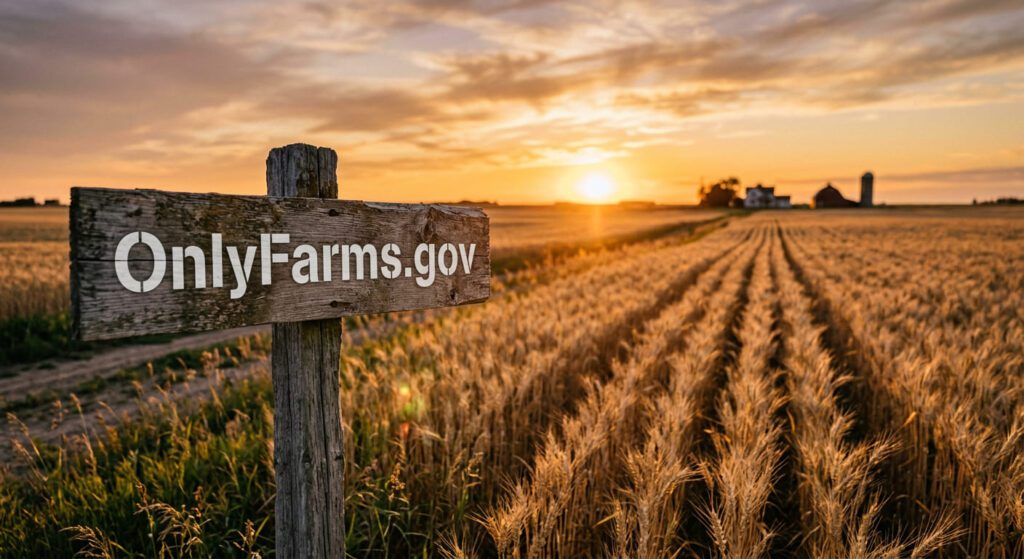
March 27, 2026. The White House rolls a golden tractor onto the South Lawn. About 800 farmers and ranchers are watching. Trump speaks from the balcony. And somewhere in a war room, a communications director hit “publish” on the most dissonant government URL in American history: OnlyFarms.gov.
Within hours, the platform was trending. Not because of the $40 billion in agricultural assistance it catalogued. Not because of the interactive state-by-state savings map. People were sharing it because — wait, is this real? Is the U.S. government actually doing this?
Yes. Yes, it was real. And from a pure awareness standpoint, it was genius.
The Strategic “Troll”: Attention Arbitrage at Scale
Let’s call it what it is: Attention Arbitrage. The administration traded a little dignity for 100% brand recognition overnight. They didn’t need to explain what OnlyFarms does — the name itself sparked curiosity, confusion, and clicks. That’s the whole game.
Here’s the psychological mechanics at work:
The human brain is wired to notice incongruity. “Government” + “OnlyFans-style name” is cognitively dissonant. That dissonance forces a double-take — and a double-take is a click.
Nobody tweets “Check out this new agricultural subsidy portal.” But everyone tweets “Is this actually real??” The joke gives people a socially safe reason to amplify a government announcement.
Critics amplified it. Supporters amplified it. Media covered the debate. The content engine ran entirely on other people’s outrage and amusement — zero ad budget required.
The White House never officially acknowledged the parody. Smart move. Explaining the joke kills the joke — and more importantly, it kills the mystique that kept people speculating and sharing.
Search Intent Hijacking: The SEO Play Nobody Planned (Or Did They?)
Whether intentional or not, the naming decision created something that SEO strategists dream about: a new branded search term with built-in cross-pollination from an existing high-volume query cluster.
Think about the search behavior cascade:
The .gov domain is also doing heavy lifting here. Government domains carry automatic E-E-A-T authority — Google’s framework for Expertise, Experience, Authoritativeness, and Trust. A brand new site, day one, zero backlinks needed to rank. That’s a domain authority shortcut that literally no private brand can replicate.
Meanwhile, the “Only…” prefix occupies a culturally loaded mental space. Every time someone types “Only” into a search bar, there’s now a new brand in that cognitive neighborhood. Accidental keyword proximity? Maybe. Effective? Undeniably.
The Trojan Horse: A Genuinely Useful Policy Tool
Strip away the meme energy and what you’ve got is a serious economic instrument. OnlyFarms.gov isn’t just a joke with a domain. It’s a interactive federal subsidy finder built for the people it serves — farmers who don’t have time to navigate bureaucratic USDA PDFs.
What’s actually on the site:
- → A clickable state-by-state savings map showing estimated financial benefits per region from Trump’s agricultural agenda
- → Details on $40B+ in direct assistance delivered, including $12B through the Farmer Bridge Assistance (FBA) program
- → The virtual elimination of the “death tax” (federal estate tax) — permanently protecting 2M+ family farms from forced sale
- → Expanded Section 179 expensing limits — write off equipment purchases immediately rather than depreciating them over years
- → Loan guarantee boosts — up to 90% coverage for small agricultural businesses, up from 75%
The joke was the packaging. The substance was real. That’s the Trojan Horse principle applied to government comms — and it works because people share the funny thing and accidentally learn the policy message.
The meme is the headline. The policy is the story. Most government rollouts get the order backwards.
The Marketing Verdict: 3 Rules From the OnlyFarms Playbook
So when should your brand try this? Here’s the framework — honest, with no corporate hedging.
If people click through because of the joke and the product is bad, you’ve just bought faster failure. OnlyFarms.gov worked because what’s inside — real money, real maps, real policy — holds up. The irony invited inspection. The utility rewarded it.
This works for a broad, digitally-literate, culturally-plugged-in audience. Do that same move in B2B enterprise SaaS selling to CFOs in regulated industries and you’re writing a crisis comms memo before launch day ends. Know your crowd. Intimately.
The White House never issued a statement addressing the OnlyFans comparison. That restraint kept the cultural conversation alive for days. The moment you explain why something is clever, it stops being clever. Let the market fill in the interpretation. Every interpretation is free press.
The punchline was the press release.
OnlyFarms.gov is a case study in the new mechanics of public attention. In a fractured media landscape where the average government announcement generates the same excitement as terms-and-conditions updates, they found a lever that nobody expected: cultural mischief.
Whether you love the politics or hate them, the PR move is instructive. Attention is the first gate. Utility is the second. OnlyFarms.gov knocked down the first gate with a sledgehammer and walked quietly through the second. That’s a sequencing most brands get backwards every single time.