The Dark Pictures Anthology Games In Order
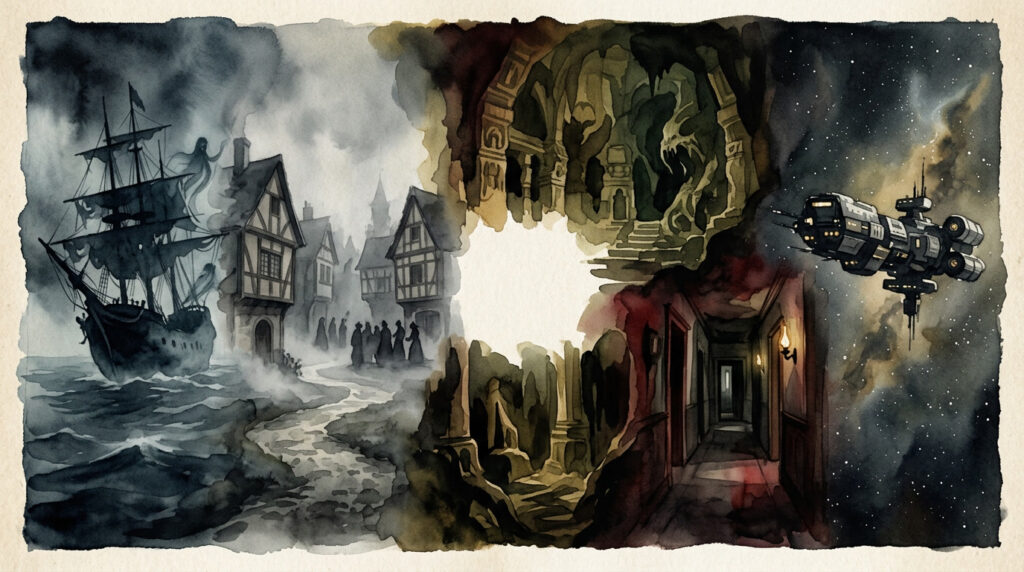
| Game | Year | Setting | Subgenre | Main Leads |
|---|---|---|---|---|
| Man of Medan | 2019 | Ghost ship, South Pacific | Nautical / Hallucinatory | Shawn Ashmore, Alex Berg |
| Little Hope | 2020 | New England, witch trial era | Gothic / Psychological | Will Poulter, Alex Ivanovici |
| House of Ashes | 2021 | Mesopotamian temple, Iraq 2003 | Creature / War Horror | Ashley Tisdale, Paul Zinno |
| The Devil in Me | 2022 | H.H. Holmes’s “Murder Castle” | Slasher / Historical | Jessie Buckley, Gloria Garcia |
| Directive 8020 | 2026 | Colony ship, Tau Ceti f | Sci-Fi / Body Horror | Lashana Lynch |
If you’re building a wider horror backlog around this franchise, our roundup of the best horror games worth playing right now is a solid next stop, and this guide to Dark Season Horror covers a similarly atmospheric pick if Little Hope’s small-town dread is your favorite flavor of scary.
All Games Ranked, Worst to Best
This Dark Pictures Anthology ranked list weighs story cohesion, QTE difficulty, replayability, and how well each game uses its cast — not just launch-day review scores.
Man of Medan
2019 · Nautical HorrorThe series opener still shows its budget and timeline constraints. The ghost-ship setting is atmospheric, but the hallucination-driven twist undercuts the stakes of earlier choices, and the cast is thinner on characterization than later entries. QTEs are forgiving, making it a fine entry point — but replayability suffers once you know the twist.
Little Hope
2020 · Gothic HorrorLittle Hope trades the ship for a fog-choked town built on witch-trial paranoia, and its psychological trauma angle is genuinely unsettling for the first two-thirds. The ending twist is the most divisive in the franchise — it recontextualizes nearly everything you’ve played. QTE difficulty steps up here, and branching paths differ meaningfully on replay.
Directive 8020
2026 · Sci-Fi HorrorThe most mechanically ambitious game Supermassive has shipped, with a Metacritic average around 72 and reception split down the middle. IGN landed at 8/10, praising the shift to active stealth and the new Turning Points rewind system. The stealth sections where mimic aliens hunt you in real time are the most polarizing addition — tense for some, repetitive by the mid-game for others.
House of Ashes
2021 · Creature HorrorTrapping a US military squad and Iraqi soldiers underground with an ancient threat forces uneasy alliances that make the moral-vs-pragmatic system hit harder than anywhere else in the series. Creature combat adds tension without breaking the slow-burn pacing, and QTEs are tuned tightly enough to feel fair.
The Devil in Me
2022 · Slasher HorrorThe Season 1 finale is still the high point of the anthology. It introduced full inventory management and free character movement for the first time, turning the murder-castle setting into something closer to survival horror than an interactive movie. Five playable characters and QTEs woven into physical traps make it the most replayable Season 1 entry by far.
For context on how these scores compare to genre pricing and value, Pink Crow’s horror game price comparison is worth checking before you commit to the full anthology bundle.
Season 2 Evolution: Directive 8020 Deep Dive
Directive 8020’s setting is the biggest departure the anthology has made. The colony ship Cassiopeia crash-lands on Tau Ceti f, twelve light-years from a dying Earth, and the crew discovers an organic lifeform capable of perfectly mimicking anyone it kills — turning every surviving character into a potential impostor. It’s a clear tonal shift from folklore and historical dread toward Alien- and The Thing-inspired body horror, and it’s built on Unreal Engine 5, which shows in lighting, facial capture, and environmental detail well beyond Season 1’s foundation.
What’s actually new in the gameplay
- Real-time stealth avoidance — mimic threats hunt you during exploration, not just scripted QTE moments, the series’ first real move away from pure interactive-movie pacing.
- Scanner tools for identifying which crew members are still human before you trust them.
- Turning Points — a rewind mechanic that lets you revisit one pivotal choice without replaying the full campaign.
- First-person sequences, used for the first time in the franchise during select tense exploration beats.
- Roughly six to eight hours across eight episodes, each running one to two hours.
Whether this shift pays off depends on what you want from the franchise. Critics who praised it called it the studio’s most confident evolution yet; critics who didn’t cited pacing and stealth repetition as the cost of that ambition. It’s the clearest sign yet that Supermassive is pulling the series toward the action-horror space touched on in our wider VR horror coverage — fittingly, since the anthology’s own spin-off, Switchback VR, already tested some of these more physical, presence-driven scares back in 2023. Directive 8020 runs comfortably alongside the rest of our best PC games coverage if you’re building a horror-focused library this year.
Essential Survival Rules: How to Keep Everyone Alive
The single most searched question about this franchise is simple: how to keep everyone alive in Dark Pictures. There’s no universal cheat code, but these rules apply across all five games.
- Don’t panic during heartbeat QTEs. When the screen shows a pulsing heartbeat prompt asking you to hold still, moving the stick or mashing a button is almost always the death trigger.
- Collect every Premonition/Photograph you can find. These show flash-forward glimpses of possible deaths, and knowing what to avoid later is the biggest survival advantage the games give you.
- Treat relationship stats as real stakes, not flavor text. Low trust scores can lock characters out of saving each other during late-game QTE sequences, even when you make the “right” individual choice.
- Slow down before committing to a choice. Timer pressure is designed to make you choose emotionally — reading both options fully consistently produces better outcomes.
- Expect a fail-state to still be a valid story, not a run-ender. Every game stays fully playable no matter who dies. Don’t reload out of panic; deaths open different branches instead of ending your game.
These same instincts translate surprisingly well outside gaming — for a look at how similar survival logic plays out in the genre’s other media, our breakdown of horror movie characters who actually survived and this rundown of iconic horror movie characters both cover the tropes Supermassive is clearly drawing from.
Multiplayer Modes Explained
Supermassive Games horror titles have always been built around shared viewing as much as solo play, and the anthology’s two multiplayer modes change survival outcomes significantly.
Shared Story
Two-player online co-op where each player controls a different subset of characters and never sees the other’s choices in real time — decisions ripple across both playthroughs, rewarding trust and communication over solo instinct.
May be limited in Directive 8020 — confirm before you plan a co-op runMovie Night
Local pass-the-controller mode for up to five players, where the controller physically changes hands at each character’s key decisions. Built for the classic “everyone yells at the screen” horror-movie experience, and it produces the wildest survival outcomes in the franchise.
If you enjoy choice-driven horror built around group reactions, it’s a similar energy to narrative titles we’ve covered like Signalis and Doki Doki Literature Club’s underlying horror, just built for a full room instead of one player.
FAQ
What order should I play the Dark Pictures Anthology games in?
Release order works fine, since the games are standalone stories connected only by the framing device of the Curator. Play Man of Medan, Little Hope, House of Ashes, The Devil in Me, then Directive 8020.
Is Directive 8020 part of Season 2 or a standalone game?
Supermassive originally billed it as the Season 2 premiere but dropped the season branding before launch, positioning it as a standalone entry. It still carries forward the anthology’s Curator framing and choice-driven structure.
What’s the hardest Dark Pictures game to keep everyone alive in?
House of Ashes and Directive 8020 tend to trip up the most players — House of Ashes for its creature-combat QTE chains, and Directive 8020 for its real-time stealth sections where a single detection can be fatal.
Can I play Dark Pictures games out of order?
Yes. Each entry is a fully standalone story, so skipping around doesn’t break continuity in any meaningful way.