By Agnes, Head Housekeeper, Dimly-Lit Manor of Unspeakable Horrors — 34 Years of Service, Zero Paid Overtime
Let me tell you something about job security.
It’s a myth. A beautiful, stupid lie they tell you in the orientation packet right before the orientation packet catches fire on its own. I’ve watched forty-seven “Chosen Ones” blow through this mansion with their flashlights and their trauma and their little audio diaries, and where are they now? Dead. Gone. Turned into a plot twist in chapter three. Meanwhile, I am still here, on my knees, scrubbing the same pentagram off the foyer tiles that I scrubbed last Tuesday. The week before that. Probably every Tuesday since 1987.
Nobody writes survival guides for the maid. It’s always “how to survive as the protagonist.” How to manage your inventory. How to dodge the monster. How to live.
I’d like to see those guides address shift work.
So here it is. The guide nobody asked for, from the woman who has lived it. You’re welcome. Don’t touch my mop.
What Does It Mean to Survive as a Maid in a Horror Game?
Surviving as a maid in a horror game presents unique challenges that differ from playing as a traditional protagonist. As a maid character, you typically start with significant disadvantages: limited combat abilities, restricted access to weapons, lower social status that limits your movement and credibility, and often being marked as a potential victim from the start.
If you’re interested in exploring more terrifying experiences, check out our guide to the best horror games available today. Classic systems like those found in the best PS2 games often featured limited save points that required strategic planning.
The scenario often involves working in cursed mansions where the master himself may be the primary threat—a devil’s reincarnation cursed to kill in order to survive. Your role as a servant places you in constant proximity to danger while society expects you to remain obedient, quiet, and invisible.
The survival horror genre emphasizes vulnerability, resource scarcity, and strategic thinking over brute force. As a maid, these elements become even more pronounced. You’re not a trained soldier or supernatural hunter—you’re an ordinary person caught in extraordinary circumstances, which makes every decision matter exponentially more.
For fans of horror mixed with romance and dark narratives, the love horror genre offers compelling visual novel experiences that combine similar themes of vulnerability and survival.
Stealth vs. Cleaning: The Art of the Tactical Crouch-Mop
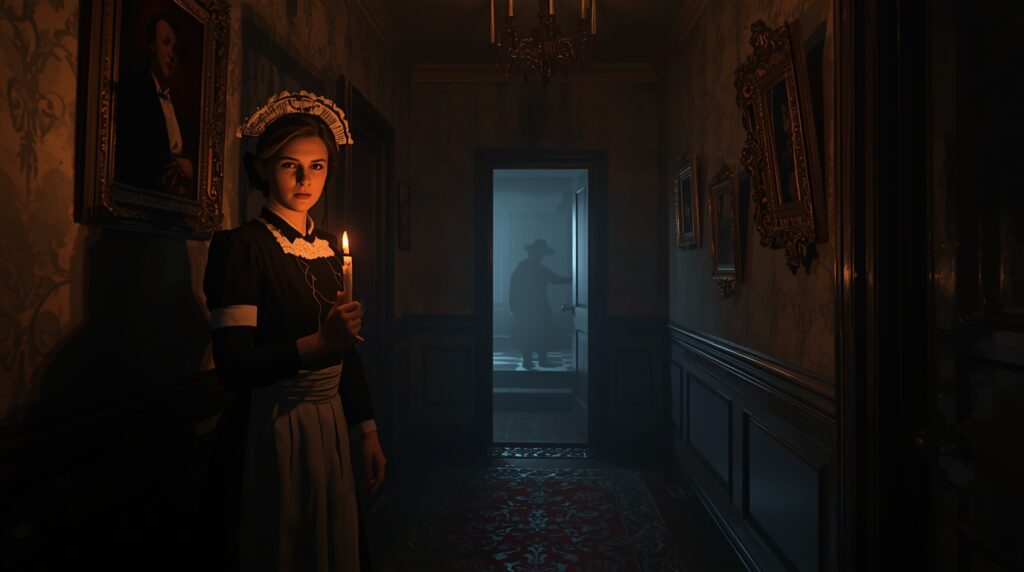
First thing you learn in this industry — and they will absolutely not tell you this at the agency — is that the crouch-walk is not optional. It is a survival skill. It is the survival skill.
The problem is the bucket. God, the bucket. That thing makes noise on flagstone like you’re announcing yourself to every eldritch abomination within a quarter mile. In Amnesia: The Dark Descent, the water physics alone would’ve gotten me fired by Daniel’s ghost before week one. You learn to carry the mop at a forty-five degree angle to reduce splash radius. You learn to pre-wet the mop before entering a room with auditory triggers. You develop, over years of practice, what I call “the shuffle” — a half-crouch, half-glide motion that keeps you below sight lines and, crucially, below the detection radius of anything that navigates by sound.
The Gatherers in Amnesia navigate by sound.
So does my supervisor, technically. Different reasons. Same response time.
Here’s the practical checklist for stealth-cleaning an active horror environment:
- Pre-survey the room from the doorway. Is there ambient breathing that isn’t yours? Scratching sounds? A single candle flickering despite zero air movement? Put the mop down. Come back in twenty minutes. Come back never.
- Clean in the direction of your exit. Always. You work toward the door, not away from it. I don’t care if the stain is in the far corner. The far corner is where people die. The far corner is essentially a casting call for corpses.
- The mop handle is a weapon. I’m not saying use it. I’m saying remember that it is one. There is a difference between a woman who cleans and a woman who cleans and could absolutely crack something over the skull if pressed.
Why am I even cleaning this blood, you ask? Great question. Nobody has ever answered it satisfactorily. Moving on.
Employer Relations: A Field Guide to the Boss Who Wants to Eat You (Probably)
Now. The employer situation in this industry is complicated.
There are two categories of horror-game bosses, and your survival depends entirely on knowing which one you’re working for before you accept the position. (The agency will not tell you. I’m telling you now, for free, because I am generous and also furious.)
Category A: The Glamorous Nightmare. Lady Alcina Dimitrescu from Resident Evil Village. Nine feet tall. Claws. Absolutely impeccable coat. She will threaten to drain you and she absolutely means it, but — and this is the thing — there is structure here. There are rules. The castle runs on something resembling a schedule. Meals happen. The daughters float around on their own little routes. You can, theoretically, predict the chaos. If you keep the wine cellar stocked and you do not make eye contact and you stay out of the east wing after nine, you might — might — make it to Friday.
I respect Lady Dimitrescu. Not because I like her. Because she is legible. A legible employer is a survivable employer.
Category B: The Unknowable. The Quiet Men from Maid of Sker. Blind. Hunting by sound. Moving through the Sker House in their horrible, patient way, and there is no negotiating with that. No schedule. No logic you can map. They don’t want the silver polished. They don’t have a wine cellar preference. They just — exist, horribly, in the dark, waiting for you to knock something over.
Working for Category B is not employment. It is endurance.
The key difference in your day-to-day: with Category A, you can develop a relationship. Keep your head down, do good work, maybe you get ignored. With Category B, the relationship is purely acoustic. You are a sound that must not occur. Your entire job becomes the management of noise. Every task reframed as a question: how quietly can this be done? The answer, in my experience, is quieter than you think.
And never — never — run the vacuum on a night shift. I cannot stress this enough. Not in Sker. Not anywhere, honestly. Vacuums are a death wish with a cord.
Inventory Management: Your Apron Pockets Are a Sacred Trust
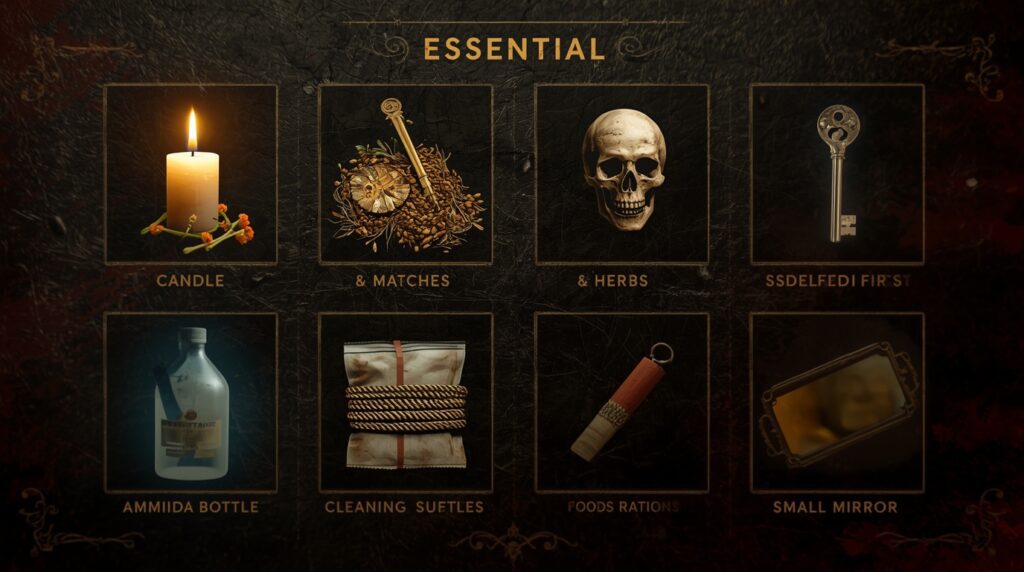
Everyone fixates on guns. Shotguns, specifically. The breakable shotguns in Resident Evil that you’re always one poorly-timed reload away from regretting. And sure. Fine. The shotgun has its place.
But do you know what a shotgun cannot do?
It cannot carry the master key to the locked linen closet where you are going to spend the next forty-five minutes hiding from something that should not exist. It cannot hold the stub of candle you’ve been rationing since March. It cannot contain the small flask of cooking sherry (medicinal), the folded note with the safe combination that the last Chosen One dropped and absolutely didn’t need anymore because they are dead now, or the emergency packet of biscuits that is, in terms of morale maintenance, worth more than any weapon in the game.
Your apron pockets are load-bearing. Treat them accordingly.
My personal loadout, after three-plus decades:
Left pocket: Master key. Secondary key. Tertiary key (the mansion has a lot of doors). Small cloth for wiping blood off keyholes before inserting key (this matters more than you think — blood is adhesive and you do not want to be fumbling at a keyhole while something large moves in the hallway behind you).
Right pocket: Candle stub. Matches. The sherry. A folded piece of paper that says, in my own handwriting, “DO NOT INVESTIGATE THE NOISE.” I look at it when I’m tempted. It helps. Sometimes.
Chest pocket: Nothing. This is reserved for the small, irrational hope that today will be different. (It won’t be. But you need somewhere to keep it.)
Inventory management in horror games is always framed as “what do you need to survive the monsters.” The correct frame is “what do you need to survive the shift.” These are different problems with different solutions, and only one of them has ever actually kept me alive.
The Map in Your Head (The Only One That Matters)
Here’s a skill they don’t teach and you can only develop through what I will diplomatically call “repeated catastrophic experience.”
You learn to read a room.
Not the aesthetic — every room in a horror manor is designed to look ominous, that’s basically building code at this point, and if you flinched at every gargoyle you’d never get anything done. I mean the functional read. The answer to: is this a room where the narrative wants someone to die?
Scripted death zones have tells. They always do. The lighting is too dramatic — a single shaft from above, no ambient fill, everything else black. The architecture creates a natural funnel toward one point, usually a door you want to go through. There’s an item on a pedestal. (It is always an item on a pedestal. The pedestal is a contract. The contract says: you pick this up, something terrible happens. You know this. You always know this. You pick it up anyway because the game requires it and you are not the protagonist so you get to watch, again, as the protagonist makes the same mistake.) There’s a sound design shift — the ambient noise drops, the music shifts registers, and somewhere in the building something stirs.
Safe corners are quieter than they should be. Overlooked. Architecturally boring. The horror game equivalent of a supply closet or a pantry or the space under the servants’ stairs — places the level designers didn’t spend much time on because the interesting stuff is elsewhere. These are your places. Learn them. Memorize them. They are not glamorous. They have saved my life approximately eleven times.
The pantry off the main kitchen in this particular establishment has a false wall that I discovered in 1994 and have told absolutely nobody about. It contains a stool, a candle, three weeks of preserved food, and a truly extraordinary amount of peace and quiet. I mention this not because you will find this specific pantry — you won’t; the mansion’s geometry is non-Euclidean on Tuesdays — but because every horror space has a version of it. Find yours early. Find it before you need it.
Psychological Maintenance: The Thing Nobody Puts in the Training Manual
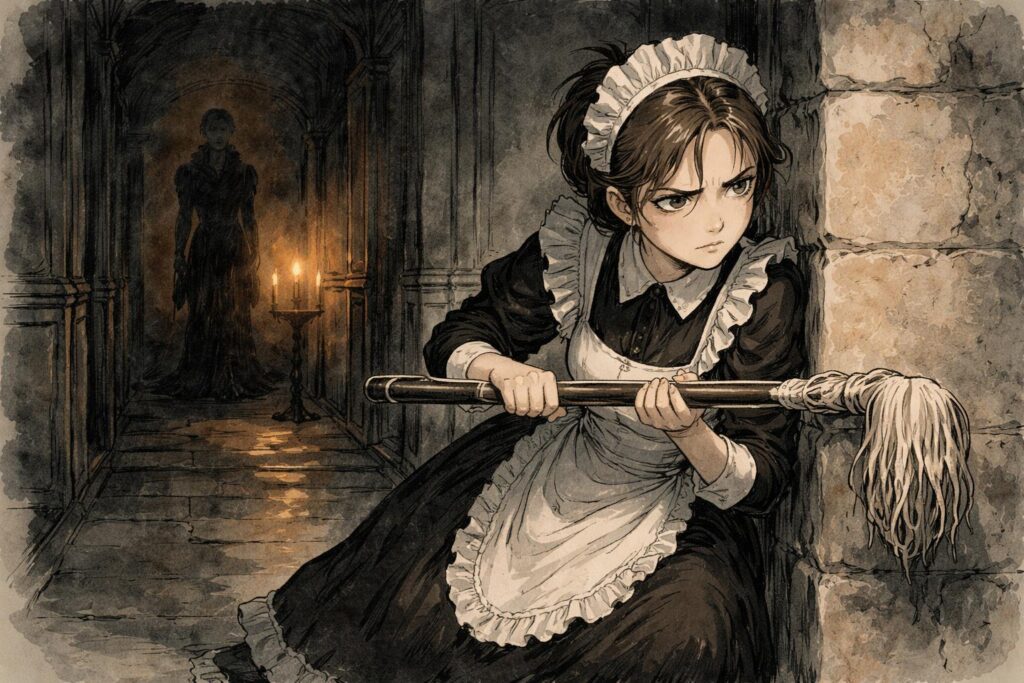
You are going to see things. Horrible things. Things that would break a person who wasn’t, through sheer grinding routine, already sort of pre-broken in a way that turns out to be protective.
The protagonist gets the trauma arc. The cutscenes. The diary entries and the character development. You get the morning shift and a mop. And somehow, inexplicably, this is more sustainable. The protagonist cares about what’s happening, and caring will get you killed faster than any monster in the game.
Develop what I call “professional distance.” Yes, the walls are bleeding again. Note it. Move on. Is it your job to investigate the bleeding walls? It is not. Is it your job to understand why this mansion exists at the intersection of several incompatible physical laws? Absolutely not. Your job is the floors, the surfaces, and the laundry, and you will do your job because your job is the thing that makes sense when nothing else does.
Also, seriously — who is paying for these candles? There are thousands of them. Lit, constantly, throughout a building where electricity has apparently never been introduced. Somebody is on a candle budget and I would very much like to see it. I would like to have a meeting about the candle budget. I have been requesting this meeting since 1998.
The Exit Strategy (Or: The Pantry Until Credits)
Every shift ends eventually.
The Chosen One will stumble through and detonate whatever narrative device is required and the mansion will either explode, implode, sink into the earth, or simply stop making logical sense in a slightly different way than it was before. The credits will roll. The horror will, temporarily, conclude.
Your job is to still be here when that happens.
Not heroically. Not dramatically. Just — present. In the building. Breathing. Ideally near the pantry with the false wall.
You do not need to defeat anything. You do not need to understand anything. You do not need to find the lore or solve the mystery or make peace with the darkness. Those are protagonist problems. You have exactly one job in a horror game: outlast the plot.
So. If you are standing at the mouth of the east corridor at eleven PM and something is moving in the dark and every instinct in your protagonist-trained brain is telling you to go investigate —
Don’t.
Go find the pantry. Sit on the stool. Have some of the sherry.
Wait for the credits.
That’s the whole guide. That’s all of it. Thirty-four years of institutional knowledge right there. You are welcome. There is no retirement plan and the dental doesn’t cover “injuries sustained through interdimensional contact,” but the job has a strange kind of tenure once you learn to stop dying.
Now if you’ll excuse me. There is a pentagram on the foyer tiles that isn’t going to scrub itself.
It never does.
Agnes has been Head Housekeeper at the manor since before the unpleasantness. She has survived four Chosen One cycles, two possessions (minor), and one performance review. She is not available for comment. She is in the pantry.
Frequently Asked Questions
Q: What if I’m programmed to die as a side character?
A: Video game deaths aren’t always inevitable. Look for ways to subvert the script—avoiding death triggers, completing alternative objectives, or building enough affinity with key characters to unlock survival routes. Sometimes breaking the expected narrative is possible through creative problem-solving.
Q: How do I know who to trust in a mansion full of suspects?
A: Trust should be earned gradually through actions, not words. Watch how people treat others when they think no one’s looking. Test loyalty with small secrets before revealing crucial information. Multiple shallow alliances are often safer than one deep trust.
Q: What if the master is both the threat and my only protector?
A: This complicated dynamic requires careful navigation. Maintain your value to them while preparing contingency plans. Sometimes antagonists and protagonists develop protective relationships despite their opposition, but never become completely dependent on someone who might kill you.
Q: Should I try to escape immediately or work toward a solution?
A: Assess the situation objectively. Immediate escape might be impossible or more dangerous than staying. However, always maintain the capability to flee if necessary. Work toward solutions while keeping escape as a backup plan.
Q: How do I manage fear and stress during constant danger?
A: Acknowledge your fear without letting it paralyze you. Establish routines that provide psychological comfort, practice breathing techniques, maintain connection to your pre-horror life (memories, goals), and remember that fear keeps you alert—it’s a survival tool, not a weakness.
Q: What if I’ve already made fatal mistakes?
A: Learn from errors without dwelling on them. If you have save points or time loops, use the knowledge from failed attempts. If not, focus on damage control and adapting your strategy. Many “fatal” mistakes can be mitigated with quick thinking.
Q: How important is understanding the genre and game mechanics?
A: Critically important. Understanding how inventory systems work, recognizing item uses, and mastering game-specific mechanics helps you navigate challenges more effectively. The rules of the world you’re trapped in determine what’s possible and what’s deadly. Games across different platforms—from GameCube classics to 3DS masterpieces—each have unique mechanics worth studying.
Q: Can I change the story outcome as a minor character?
A: Side characters often have more freedom than protagonists because their actions aren’t as constrained by narrative expectations. Use your position to influence events from the shadows, protect others, or even become central to a new story branch.
If you’re looking for a break from intense horror survival, consider exploring unblocked games for quick gaming sessions, or discover the best idle games that offer a more relaxed experience. If you’re interested in exploring other horror-romance games with unique narratives, titles like Your Boyfriend Game, The Price of Flesh, and 14 Days With You offer similarly intense survival experiences with psychological elements.
Stay alive. Stay smart. Survive.
Remember: In horror games, information, preparation, and quick thinking matter more than strength or special powers. Your intelligence and determination are your greatest weapons. Use them well, and you’ll dust off more than furniture—you’ll sweep away the expectations of your inevitable demise.
Related Gaming Content:
- Explore more love horror visual novels for similar dark narrative experiences
- Check out free love horror novels to enjoy without spending
- Discover unique titles like Mushroom Oasis and Where Winter Crows Go
- Looking for gaming gifts? Browse our gifts for gamers guide
- Retro gaming fan? Don’t miss our list of underrated PS2 hidden gems