Author’s note on sourcing: every percentage below traces back to a public Steam global achievement stat, a PSN trophy rate, or a named industry report (Valve’s own Steam Replay data, GameDiscoverCo/GamingAnalytics.info, and community-compiled achievement audits). Steam’s public numbers measure the share of owners who unlocked an achievement — that includes people who bought the game and never launched it — so every completion figure here is a conservative floor, not a survey of intent. Where the underlying brief for this piece assumed flat genre buckets, the data below corrects them; the differences are called out explicitly rather than smoothed over.
Quick Summary: Completion Rates by Genre
| Genre | Typical Completion Range | Primary Abandonment Point | Benchmark Examples |
|---|---|---|---|
| Linear narrative action | ~30%–45% | First act after the tutorial high | God of War Ragnarok, Batman: Arkham Asylum |
| Challenge-driven open world (soulslikes) | ~35%–53%* | Mid-game, but self-selection keeps finishers high | Elden Ring |
| Sprawling open-world RPG / sandbox-story hybrid | ~14%–42% | Map fatigue after the main hub opens | Just Cause 2, Deus Ex: Human Revolution |
| JRPG / 80+ hour campaigns | ~25%–50% | Post-midpoint pacing slump | Persona 5 Royal, Dragon Quest III HD |
| Roguelike / systemic sandbox | Not a single “ending” — measured by run count and milestone achievements instead | N/A | Balatro, Hades, Minecraft |
| Short (3–8 hour) narrative games | Highly split by platform — subscription vs. purchase | Immediately, if the hook doesn’t land in the first hour | Keeper, Standpoint |
*Elden Ring’s combined ending achievements (multiple non-stacking endings) push total “beat the game” completion well above the 25%–35% range that’s often assumed for open-world RPGs — more on why below.
What Telemetry and Achievement Data Show
The often-repeated claim is that roughly 20%–30% of players reach the credits on a standard single-player game. That number isn’t wrong so much as it’s a rough midpoint hiding a much wider spread. A 2026 audit of 19 single-player titles with a clearly identifiable “reached the ending” Steam achievement put the median completion rate at 36% — and the individual games ranged from under 5% to over 50%.
A few concrete data points make the spread obvious:
- God of War Ragnarok — story-completion achievements sit in the 40s percent, but even this polished, linear, critically loved game loses close to 20% of owners before they earn the first trophy.
- Elden Ring — roughly 75% of owners reach the game’s hub area and about 70% beat the first major boss, but from there the drop-off is gradual rather than steep: combined ending achievements put total completion in the 40%–53% range, and 35% of players beat Malenia, one of the hardest optional bosses in the game. Only 3.2% of Steam owners earned every achievement.
- Persona 5 Royal — a genuinely different completion rate depending on where it was played: 25% on Steam, 28% on PlayStation, but only 10% on Xbox — a version that launched day-one on Game Pass. Same game, same length, a 15–18 point gap tied to how the copy was acquired.
- Keeper (a short, 3–6 hour narrative game) — 30% completion on Steam versus 12% on Xbox, again the Game Pass version. This is one of the cleanest same-game, cross-platform comparisons available, and it isolates the subscription effect almost perfectly.
- Standpoint, a short narrative game built around grief and recovery themes, sits at just 4.4% completion — proof that runtime alone doesn’t predict finishing, tone and hook matter as much as length.
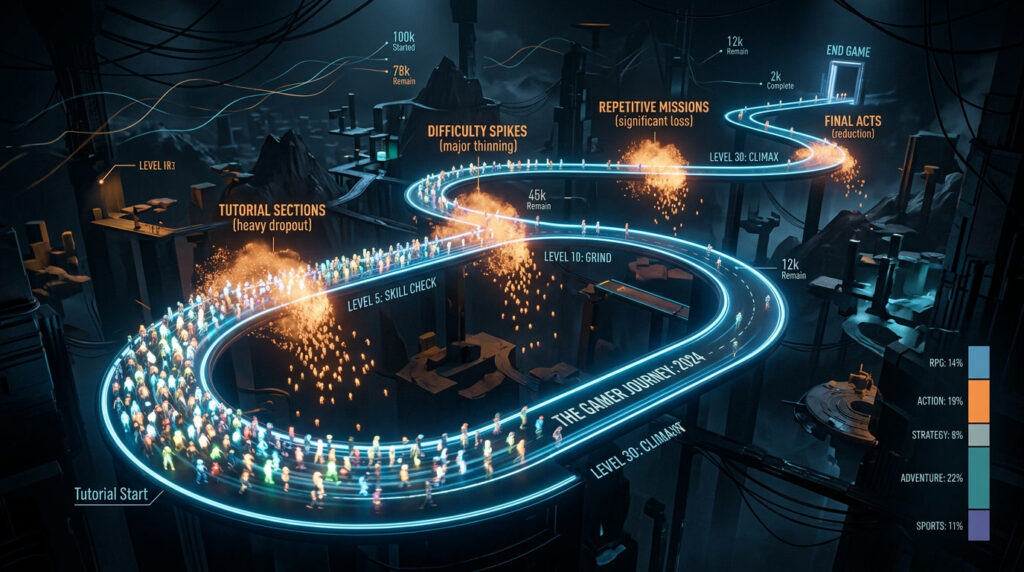
[Chart: Player Drop-off Curve — Tutorial to Credits, Selected Titles]
The typical drop-off shape looks less like a straight line and more like a staircase: a steep fall right after the tutorial (as much as 20%–30% of owners never progress past the first checkpoint), a long, gradual mid-game decline, and then a final, smaller drop right before the credits — often players who stall out on a final boss or a late-game difficulty spike and never return.
Why We Quit: The Psychology Behind the Unfinished Backlog
The completion problem isn’t really about any single game — it’s about what’s competing for that time slot. Valve’s own Steam Replay data for 2024 found that only 15% of total playtime went to games released that same year; 47% went to titles released in the prior seven years, and 37% went to games eight or more years old. Players aren’t finishing new releases because they’re still working through — or replaying — everything that came before.
That backlog is enormous by any measure. GameDiscoverCo’s analysis of public Steam profiles (via GamingAnalytics.info) found that the average library sits at 32.7% unplayed, and for the median player, it’s over half — 51.5% of their entire library has never been launched.
A few structural reasons show up again and again in the achievement data and player behavior:
- Choice paralysis. More owned games doesn’t mean more played games — it tends to mean the opposite, since deciding what to play becomes its own barrier.
- Open-world fatigue, but selectively. Sprawling open worlds can lose players to map bloat and filler side content — Just Cause 2’s 14.2% completion rate is the extreme version of a sandbox that was never really built around a satisfying ending. But Elden Ring’s numbers show that a large, difficult, open world doesn’t automatically produce low completion if the core loop is the appeal rather than the map size. The genre isn’t the variable — the design intent behind the openness is.
- Mid-game pacing slumps. The long stretch between “the story hooks you” and “the story pays it off” is where most narrative games bleed players, especially in 60+ hour JRPGs and RPGs with heavy side-content between story beats.
- Difficulty spikes without on-ramps. A sudden jump in challenge with no accessibility options pushes casual players out at exactly the point where a linear narrative game most needs them to stay — see the completion cliff on hard optional content in titles like Lies of P, where under 8% of players get past an early-to-mid boss that Elden Ring’s more gradual difficulty curve gets 35%+ of players past on an equivalent-tier fight.
- Backlog guilt as its own quitting mechanism. Once a library gets large enough, starting something new feels lower-stakes than finishing something old, which paradoxically makes people less likely to finish anything.
Genre and pacing choices matter here too — the same design instincts that shape how a game’s core loop gets built in the first place are what determine whether a player makes it to the credits or drifts off during the open-world middle stretch.
The Subscription Factor: How Game Pass and PS Plus Change Behavior
The clearest illustration of the subscription effect isn’t an industry-wide average — it’s same-game, cross-platform comparisons where the only real variable is how the copy was acquired:
| Game | Paid-purchase completion | Subscription-access completion | Gap |
|---|---|---|---|
| Keeper | 30% (Steam) | 12% (Xbox / Game Pass) | 18 points |
| Persona 5 Royal | 25%–28% (Steam / PlayStation) | 10% (Xbox / Game Pass) | 15–18 points |
Lowering the barrier to entry does exactly what it sounds like: it increases how many people try a game, and decreases the share of tries that turn into finishes. When a $70 purchase is on the line, sunk-cost pressure alone pushes some players to see it through. When the game is one of dozens included in a $15–$23/month subscription, that pressure disappears — quitting a Game Pass title costs nothing but a menu click, and there’s always another included game one tap away.
This isn’t a knock on subscription services — Xbox Game Pass has been genuinely useful for getting players to try genres or studios they’d never have paid full price for blind. But for developers and analysts reading completion data, subscription downloads and paid purchases need to be reported separately, not blended into one “completion rate” — as the Persona 5 Royal and Keeper numbers show, blending them can hide an 18-point swing.
How Game Developers Are Adapting
The completion data is public, and studios are visibly designing around it. A few patterns show up repeatedly in recent releases:
- Tighter campaigns. The shift toward focused 12–15 hour single-player experiences (instead of 40+ hour open worlds padded with filler) is a direct response to mid-game abandonment data — a shorter, denser critical path is statistically far more likely to get finished than a long one with optional bloat.
- Dynamic difficulty and accessibility options. Letting players adjust challenge mid-run — rather than forcing a hard restart or a permanent difficulty lock-in — keeps the game passable through its hardest spikes instead of losing players at them.
- “Previously on…” recap systems. Games with long gaps between sessions (common with backlog-driven, non-linear play habits) increasingly build in recap tools so returning players aren’t punished for taking a break — directly targeting the backlog-guilt abandonment pattern.
- Meaningful pacing over padded length. Design teams are treating side content as optional flavor rather than a soft requirement, keeping the main critical path lean even in games that still offer a large world to explore.
None of this is guesswork on the studios’ part — teams building today increasingly have direct access to the same kind of drop-off telemetry referenced throughout this piece, and studios shaping the current release slate are visibly using it to inform scope decisions earlier in production rather than cutting content post-launch. For teams building their own systems around this data, a reusable prototyping and design toolkit makes it much easier to test pacing before a full campaign is locked in, and general game development planning resources increasingly treat completion telemetry as a core design input rather than an afterthought.
Roguelikes and systemic sandboxes sidestep the completion question almost entirely by design — there’s no single ending to fail to reach. Balatro‘s run-based structure and the open-ended survival loop in Core Keeper both measure success in runs completed and milestones hit rather than credits rolled, and the genre-wide popularity of idle games built around long-tail replayability shows that “engagement without an ending” is a durable design choice, not a workaround.
For players trying to actually chip away at a backlog rather than add to it, the practical takeaway from all of this data lines up with what completion-focused game lists already show: shorter, tightly scoped single-player PC games get finished at dramatically higher rates than open-ended AAA open-world releases, and browsing the current year’s most talked-about PC releases with completion time in mind is a reasonable filter before buying, not just a nice-to-have.
[Chart: Completion Rate vs. Estimated Campaign Length]
FAQ
What percentage of players actually finish the games they buy? It varies widely by game rather than sitting at one fixed number. A 2026 audit of 19 single-player titles with verified “reached the ending” Steam achievements found a median completion rate of 36%, with individual games ranging from under 5% to over 50%.
Do open-world games really have lower completion rates than linear games? Not consistently. Sprawling sandbox-style open worlds without a strong narrative pull toward an ending (like Just Cause 2) do show low completion. But challenge-driven open-world RPGs like Elden Ring can post completion rates in the 40%–53% range — higher than many linear games — because the core gameplay loop itself is the draw, not just the story.
Does Game Pass or PS Plus lower completion rates? Same-game comparisons suggest yes, and by a meaningful margin. Persona 5 Royal’s Xbox (Game Pass) completion rate sits around 10%, versus 25%–28% on Steam and PlayStation. Keeper shows a similar 18-point gap between its Steam and Xbox/Game Pass completion rates.
Why do so many players abandon games in the middle rather than near the end? Mid-game is where the initial tutorial hook fades and the story’s payoff hasn’t arrived yet, which is also where side content and filler tend to be densest. It’s a pacing problem more than a content problem, and it’s the single most common abandonment point across genres.
Are Steam achievement percentages an accurate way to measure completion? They’re a reasonable floor estimate, not a perfect measurement. Steam’s public percentages are calculated against everyone who owns the game, including people who never launched it, so true completion among people who actually started playing is somewhat higher than the raw number suggests.