
The First-Minute Test: Why Game Platforms Lose Players Before the Game Loads
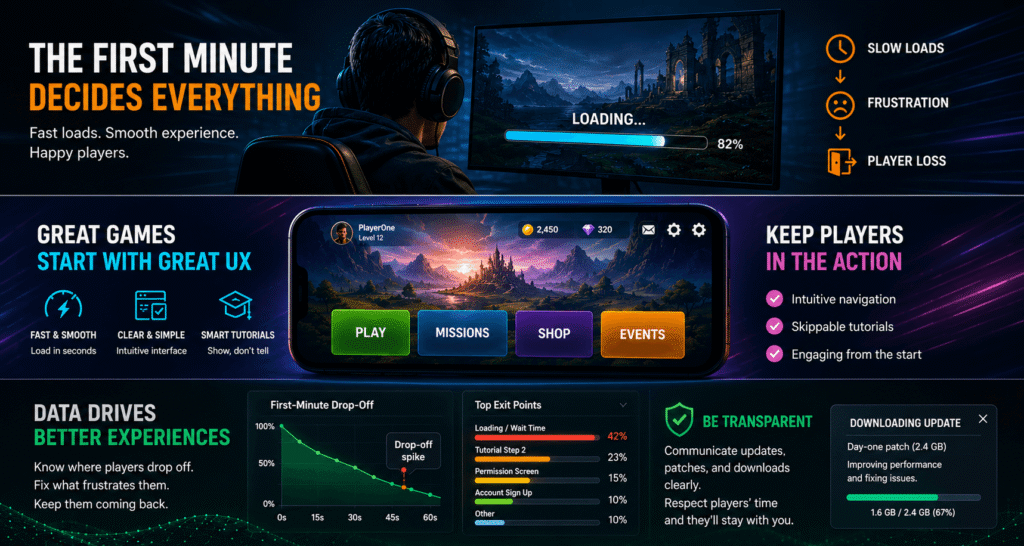
Gamers are an impatient bunch by reputation, and it’s partly the fault of the technology that feeds their habit, because while the visual effects have come on in leaps and bounds over the decades, resource-intensive experiences are necessarily hampered by longer load times. That’s definitely true of full-fat PC and console games, where 100+ gigabyte installs are the norm. But it also applies to games that are fundamentally lighter-weight, including mobile and browser-based games. In fact, it’s here that the first 60 seconds matter most and can determine whether a player sticks around or gives up for good.
What Causes Player Loss
Gaming platforms can lose players in the first minute for several reasons, and long load times are a major culprit, because, aside from anything else, they might be seen as a game locking up or crashing, even if it’s just a case of some behind-the-scenes heavy lifting. Many games require additional background downloads or updates upon launch. Players on slower connections experience this as an immediate wall that prevents them from engaging with the content they just installed.
A few solutions exist, of course. Take the example of Tikal Casino’s site online, where under-the-skin optimisations mean games typically load in less than 10 seconds. There are loading screens, of course, but with rapid-moving progress bars, there’s never any suggestion that the game has crashed.
The Interface Issue
Another aspect of the first-minute test that needs addressing is that even if a game platform loads quickly, a sloppy or confusing interface can send bounce rates skyrocketing. Clarity and convenience have to combine to prevent this, and that means rigorous UI testing to iron out pain points and get players into the action as soon as possible.
Even tutorials have to be managed carefully, because if they’re overly involved or unskippable, they’re a problem for first-time player retention and returning player engagement. Ideally, the design will weave in teaching moments without making them grating. A show-don’t-tell approach works best, ensuring core mechanics are conveyed without being boring.
Analysis is an Ally
Thankfully for game platform developers today, you don’t have to rely on guesswork to decide whether the first-minute test is being passed consistently, or, if not, where improvements can be made. Analytical tools built into modern platforms make it possible to track player interactions and keep tabs on the moments when they’re dropping out due to frustration or an imperfection.
Last but not least, make it a priority to be transparent about any unavoidable obstacles in the early stages of the experience. For instance, if there’s a need to download and install a large day-one patch to address technical issues with a physical release, don’t hide this. Instead, keep the player in the loop with UI elements that explain what’s going on; otherwise, they might assume a long download or install time is actually a game-breaking bug.
No game platform is a lost cause if it’s currently struggling with player retention. It’s just necessary to address the fundamentals of good design and treat the first minute with as much care as you would designing the final boss.