Two years ago, “AI in software development” mostly meant autocomplete — a suggestion in the sidebar you accepted or ignored. That era is over. In 2026, the shift is from assistance to delegation: developers increasingly describe a goal and an agent plans, edits across files, runs tests, and opens the pull request. The role of “developer” hasn’t disappeared — it’s moved up a level, from writing every line to supervising the system that does.
01From Autocomplete to Agentic Coding
The biggest structural change is the move from IDE-based suggestion tools to command-line agents that operate with far less hand-holding. Tools like Claude Code, Cursor’s Composer, and Windsurf shifted development from clicking through an editor to conversational, terminal-first delegation — the agent inspects a repository, reasons about its architecture, edits files, runs commands, interprets errors, and iterates on its own.
Engineering teams using agentic coding tools shipped code roughly 30% faster while saving more than 500,000 developer hours, averaging around 40 minutes saved per AI interaction.
An agent completed a specific activation-vector extraction task inside vLLM — a 12.5-million-line open-source codebase — in seven hours of fully autonomous work, with 99.9% numerical accuracy.
02Single Agents Are Becoming Coordinated Teams
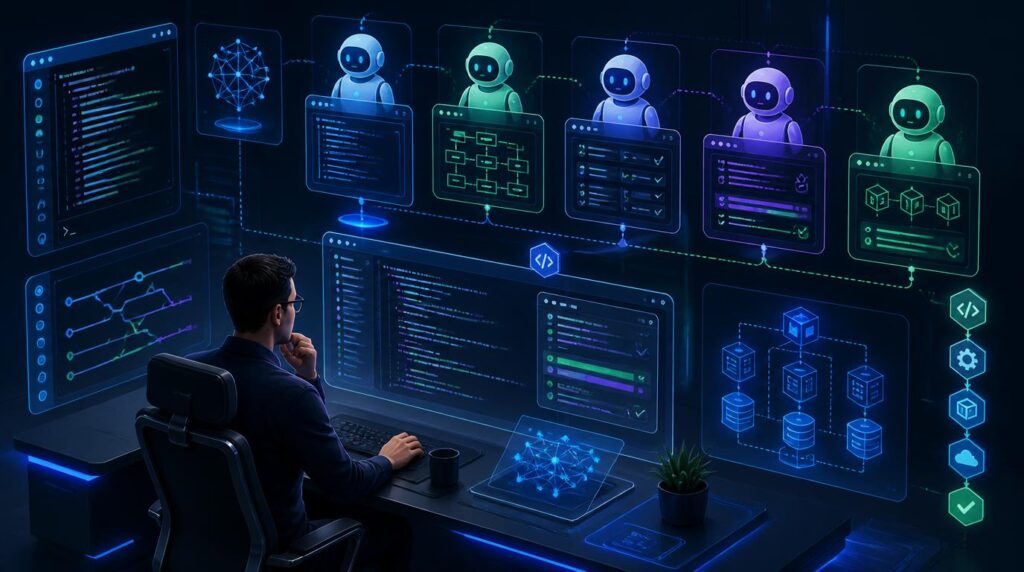
The 2026 market has moved past picking one model for every task. The strongest engineering teams now assign different models to different roles inside the same workflow — an expensive, high-reasoning model to plan the work, and cheaper, faster models to execute pieces of it in parallel. Multi-agent orchestration, once an experimental pattern, is now considered production-ready by a growing share of engineering leaders heading into the back half of 2026.
The loop compresses what used to be a multi-day cycle into hours — with a human review step that hasn’t gone away.
03The Software Development Lifecycle Is Compressing
Tasks that once took weeks — a feature build, a codebase migration, a full test suite — are increasingly measured in hours or days. Developer onboarding to an unfamiliar codebase, historically a weeks-long process of reading and asking questions, can now happen in hours as agents provide guided exploration and contextual summaries of unfamiliar repositories. This lifecycle compression is one of eight shifts identified in Anthropic’s 2026 Agentic Coding Trends Report, alongside case studies from CRED and Zapier — the same pattern showing up across the broader AI software development landscape, not just inside individual coding tools.
04Developers Are Becoming Supervisors, Not Just Coders
As AI-generated code approaches or crosses the halfway mark of total output at high-adoption organizations, the practical definition of “software developer” is shifting. Less time goes into typing every line; more goes into defining problems clearly, reviewing agent output, designing system architecture, and catching the mistakes an agent won’t flag on its own. The winning teams aren’t the ones generating the most code — they’re the ones producing the most reviewable, testable, maintainable changes, which increasingly depends on disciplined software development practices rather than raw output volume.
05Non-Technical Teams Are Building Software Too
Agentic coding tools are expanding well past engineering departments. Marketing, operations, and customer success teams are increasingly building their own internal tools and automations without waiting on a developer to scope the work — a trend that mirrors the broader move toward AI-assisted creation showing up across AI-driven interactive systems more generally, where the barrier to building something functional keeps dropping.
06Security Becomes a First-Class Concern
This “dual-use” risk — the same autonomy that makes an agent productive also makes a mistake more expensive — is pushing security-first architecture into the standard toolkit: sandboxed execution environments, staged permission levels, and mandatory human review gates before anything reaches production.
Where the Top Tools Stand in 2026
| Category | Representative Tools | Best Fit |
|---|---|---|
| CLI / terminal agents | Claude Code, Codex CLI, Gemini CLI | Terminal-first engineering, full-repo autonomy |
| AI-native IDEs | Cursor, Windsurf | Developers who want an AI-first editor workflow |
| Cloud / ticket-based agents | Devin, Jules | Parallel agents working tickets asynchronously |
| GitHub-native agents | GitHub Copilot | Teams standardized on GitHub’s existing workflow |
| Evaluation & observability | Galileo and similar platforms | Tracing agent decisions and guarding production quality |
What This Means for Engineering Teams Right Now
- Pick tools by workflow, not hype. Terminal-first teams, IDE loyalists, and ticket-driven teams each fit a different category of agent — the best tool depends on how your team already works.
- Build review discipline before you scale agent usage. The teams seeing real gains treat agent output as a draft that still needs a human gate, not a finished product.
- Assign models per task, not per team. Reserve the most expensive, highest-reasoning models for planning and architecture; let cheaper models execute the repetitive pieces in parallel.
- Set permission boundaries explicitly. Sandbox what an agent can touch — shell access, database migrations, and deploy pipelines — rather than granting broad access by default.
- Expect the role to keep shifting. Budget time for developers to build the reviewing, architecting, and orchestrating skills this transition actually rewards, not just the coding skills it’s automating away.
The Bottom Line
AI software development trends in 2026 point in one clear direction: less typing, more orchestrating. Agentic coding tools have moved from novelty to infrastructure at a genuinely fast pace, but the organizations getting real value aren’t the ones generating the most code — they’re the ones pairing that new speed with review discipline, clear permission boundaries, and a security-first mindset. The tools will keep getting more capable. The teams that win will be the ones that treat that capability as a multiplier for good engineering judgment, not a replacement for it.