For twenty-five years, an “NPC” meant a character running a fixed script — the same three lines of dialogue, the same patrol loop, the same scripted death animation no matter how many times you triggered it. That’s changing fast. AI agent development is now a real discipline inside game studios, and the goal isn’t just smarter enemies — it’s characters that perceive the world, reason about it, and act in ways nobody hand-authored line by line.
By 2026, this shift has gone from tech demo to shipping feature. KRAFTON’s PUBG: BATTLEGROUNDS now ships an AI teammate that interprets voice commands and adapts to combat in real time. NVIDIA, Inworld AI, and Convai have all put generative characters into real, playable builds rather than trailers. Understanding how these systems are actually built — and where they still fall short — matters whether you’re a solo developer experimenting with AI NPCs or a studio evaluating whether the hype is worth the engineering cost.
What Is an AI Agent in Game Development?
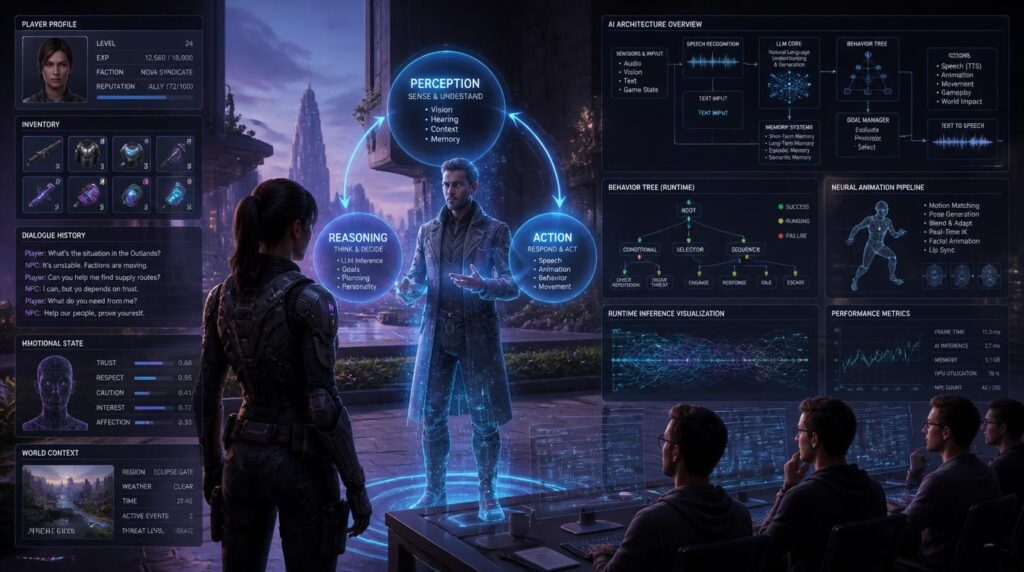
An AI agent is fundamentally different from a scripted character. Instead of following a designer-authored branch of dialogue or a fixed behavior tree, an agent runs a continuous loop: it senses the game state, decides what to do about it, and acts — then senses again.
The loop repeats continuously, letting the agent adjust to a player who never plays the same way twice.
A generative NPC, more specifically, is one whose dialogue or behavior is produced by a model at runtime instead of hand-written for every possible branch. That’s the core distinction between an AI agent and even a fairly sophisticated behavior tree: the tree still executes a finite set of designer-defined outcomes, while the agent can generate outcomes nobody explicitly wrote.
From Scripted NPCs to Generative Agents: A Quick Evolution
Game AI didn’t arrive here overnight. Early games relied on simple pattern-based logic — the four ghosts in Pac-Man each followed a distinct, predictable rule set. The 2000s introduced genuinely reactive systems, with flanking maneuvers and fear responses in titles like Halo and F.E.A.R. that felt intelligent without any generative model behind them.
The real inflection point came with the generative AI boom starting around 2023, when modders began bolting LLM-powered dialogue onto games like Skyrim and Mount & Blade II: Bannerlord long before studios shipped anything official. By 2026, the dominant pattern is hybrid: a strong, human-authored foundation — quests, world rules, character backstories — enhanced by a generative layer that handles the unpredictable parts, namely conversation and moment-to-moment reaction.
The Core Architecture Stack: Brain, Body, and Perception
Most production AI agent stacks in games split cleanly into three layers, and the current market leaders each specialize in one:
The Brain
Defines personality, backstory, goals, knowledge boundaries, and emotional range. This is where the LLM prompt engineering and memory system live.
Inworld AI, custom LLM promptsThe Body
Turns generated text into a physical performance — real-time text-to-speech, lip-sync, facial animation, and gesture generation.
NVIDIA ACE, Audio2FacePerception & Voice
Multimodal input handling — speech recognition, contextual awareness of the 3D world, and low-latency conversational response.
Convai, Riva ASRNVIDIA’s ACE Game Agent SDK, expanded at Unreal Fest 2026, bundles automatic speech recognition, a small on-device language model, and neural text-to-speech specifically so studios can run AI companions locally rather than through a cloud API — a direct response to the latency problem that still makes many LLM-driven NPCs feel a beat slower than a scripted one. Developers building in Unity will typically reach for Inworld or Convai plugins; teams on Unity’s mobile and VR pipelines in particular need to weigh that on-device inference cost against their existing performance budget.
Real Games Already Shipping AI Agents
An AI teammate that understands natural voice commands, interprets gameplay context, and cooperates dynamically in combat and looting instead of following a rigid script — running fully on-device via RTX hardware.
A tech demo built specifically to showcase real-time interrogation gameplay, where players question NPCs that generate contextual answers rather than pulling from pre-written dialogue trees.
Used as an early testbed for an experimental in-game AI advisor, demonstrating agent tooling in a genre built around long-term strategic reasoning rather than pure conversation.
Rumors around the next major open-world release — widely expected to be Grand Theft Auto VI — point to advanced NPC memory and environmental awareness systems, though leaks so far describe designer-authored “dialogue decay” rather than a fully generative, LLM-based agent layer.
Scripted vs. Behavior Tree vs. AI Agent: How They Compare
| Approach | Predictability | Dev Cost | Player Immersion | Typical Examples |
|---|---|---|---|---|
| Scripted / FSM | Very high — fixed outcomes | Low | Low to moderate | Classic arcade and platformer enemies |
| Behavior Tree / Utility AI | High — bounded decision space | Moderate | Moderate to high | Halo, F.E.A.R.-style tactical enemies |
| LLM-Driven Agent | Lower — generative, context-dependent | High — inference cost per interaction | Very high when it works well | PUBG’s Ally, Covert Protocol, inZOI |
The Real Challenges Behind the Hype
- Latency. Generating a coherent response from a cloud-hosted LLM can take up to two and a half seconds — long enough to break conversational immersion. Studios are experimenting with on-device small models, speculative response generation, and character-by-character streaming to mask the delay.
- Cost at scale. Real-time inference per NPC, multiplied across every concurrent player in a live-service game with a large daily audience, is a cloud bill most studios aren’t yet ready to absorb — which is exactly why on-device inference is the current focus of platforms like NVIDIA ACE.
- Control and hallucination. A character that can generate any response can also generate a response that breaks the fourth wall, contradicts the lore, or creates a PR problem. Knowledge-boundary prompting is one of the least talked-about but most technically important pieces of the whole stack.
- Voice rights and licensing. Generative voice performance raises questions scripted dialogue never had to answer, and studios are still working out contracts with voice talent for AI-driven delivery.
Getting Started With AI Agent Development
- Define the agent’s knowledge boundary first. Before writing a single prompt, decide exactly what the character should and shouldn’t know or say — this is the guardrail that prevents most embarrassing failures.
- Pick a stack that matches your engine. Unity teams typically get the most mature integration from Inworld or Convai; Unreal Engine projects are well served by NVIDIA ACE and Convai; custom or web-based engines can call REST APIs directly.
- Prototype small before scaling. Start with a single conversational NPC in a contained scene rather than committing an entire cast to generative dialogue on day one — this is the same incremental approach covered in most general guides to making a video game.
- Budget for inference cost early. Model whether local, on-device inference or a cloud API fits your target platform and concurrent player count before locking the architecture.
- Test latency under real network conditions. A demo that feels instant on a dev machine with a dedicated GPU can feel sluggish on a player’s mid-range laptop — plan the fallback experience for players without high-end hardware.
The Bottom Line
AI agent development has moved past the demo stage — PUBG’s Ally, Covert Protocol, and a growing list of NVIDIA ACE and Inworld-powered titles prove the technology works in shipping games, not just trailers. But it remains, honestly, a luxury feature rather than a default one: latency, inference cost, and content control are still the job that polygon budgets used to do, telling developers exactly where the technically possible ends and the economically realistic begins. For most teams, the smart move in 2026 isn’t replacing every NPC with an agent — it’s choosing the handful of characters where generative reasoning actually changes how the game feels to play.