
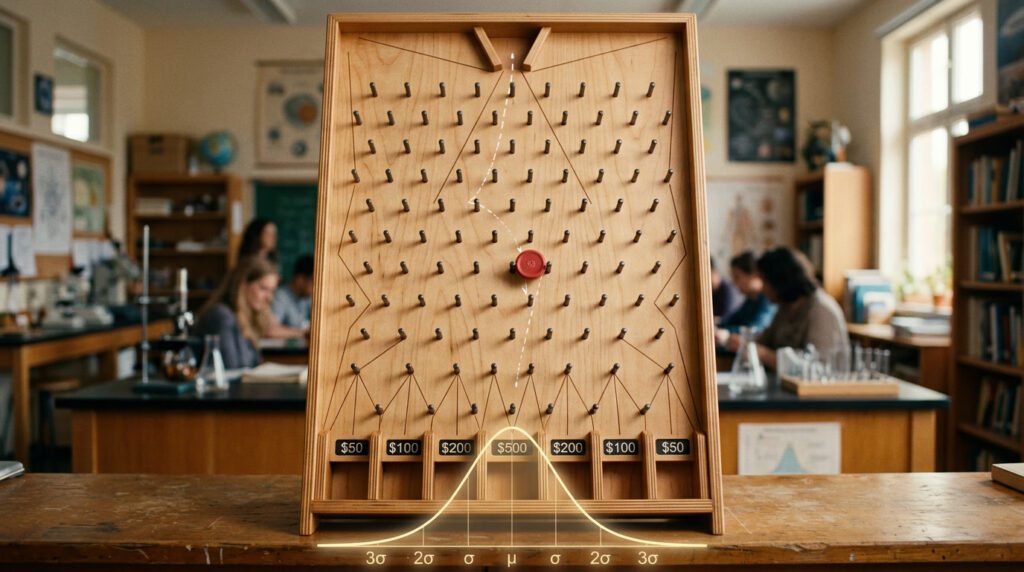
You’re right to be fascinated — the plinko board is far more than a carnival prop. This guide dives deep into how every peg, slot, and drop path is a live demonstration of probability in action. Whether you want to build a DIY plinko board or understand the math behind it, we’ve got you covered.
The Anatomy of a Plinko Board
A plinko board looks deceptively simple: a vertical surface covered in a triangular grid of pegs, with collection slots running across the bottom. But every design choice — peg spacing, peg diameter, board angle — has measurable consequences on how a disc travels.
The standard layout staggers pegs in alternating rows. When a disc hits a peg, kinetic energy splits into two roughly equal paths — left or right. That binary split, repeated across every row, is the engine of everything that follows.
Pegs: The Hidden Variables
Peg spacing determines trajectory variance. Pack them too tightly and discs channel into grooves. Space them too widely and the board loses its randomizing effect. Most quality plinko game boards use a 2:1 ratio of horizontal to vertical spacing for optimal bounce distribution.
The friction coefficient of the peg surface also matters. A smooth metal peg deflects discs with more spin, randomizing the path further. A rubber-coated peg absorbs energy differently, changing the probability distribution subtly but measurably.
Slots: Where Probability Gets a Price Tag
The bottom slots aren’t just collection bins — they’re a probability map. Center slots sit at the peak of the distribution curve and are therefore the most likely destination. Edge slots, statistically rare, command the highest prize values in game shows and digital plinko variants.
Figure 1: A standard plinko board layout. The red dashed path shows one disc trajectory. Higher-value slots appear at the edges — statistically the least likely destinations.
The Math Behind the Plinko Board
The plinko game board isn’t just a game — it’s a physical computer running mechanical probability calculations in real time. The underlying mathematics is rooted in a device called the Galton Board, named after Victorian statistician Francis Galton.
The Galton Board Principle
A Galton Board (also called a bean machine or quincunx) uses the same staggered-peg layout as a plinko board. Each peg collision is a binary event — left or right — with roughly equal probability. After many rows, the accumulated results form a near-perfect Binomial Distribution.
With enough rows, that binomial distribution converges toward the famous bell curve. This is the central limit theorem in action: independent random events, summed together, always trend toward a normal distribution. The plinko board is perhaps the most intuitive live demonstration of this phenomenon ever designed.
If a board has 12 rows of pegs, there are 2¹² = 4,096 possible paths. The center slot captures paths from the most combinations — roughly 924 of those 4,096. The far-edge slots? Just one path each. That’s why center wins are common and edge wins feel like miracles.
Peg Pattern Geometry and Trajectory Variance
The Peg Pattern Geometry directly shapes the probability curve’s width — its standard deviation. A narrower peg grid creates a taller, tighter bell curve. A wider grid spreads outcomes further. Custom plinko board builders use this to engineer specific prize distributions for events or trade shows.
Weighted outcome engineering goes even further. Slight asymmetries in peg placement — invisible to the eye — can nudge the distribution left or right. This matters enormously for lottery-style games where statistical fairness is legally required.
The concept of random number generation through physical hardware is actually a serious engineering topic. Plinko-style boards have been studied as true random number generators because the chaos introduced by micro-variations in drop position, disc spin, and surface friction makes outcomes genuinely hard to predict.
DIY Plinko Board vs. Buying One
Whether you need a quick party prop or a professional trade show centerpiece, there’s a build path for you. Let’s break down the real options — and the real costs.
How to Make a Plinko Board at Home
A basic DIY plinko board requires: a sheet of 3/4″ plywood (48″×24″ minimum), 3/8″ wooden dowels or metal rods for pegs, a jigsaw, a drill press, sandpaper, and paint. The key measurement is peg spacing — aim for 2.5″ horizontal and 2″ vertical between centers for a reliable bounce pattern.
Mark your rows in a staggered grid before drilling. A drill press beats a hand drill here — consistent vertical holes matter for uniform friction. Slot dividers at the bottom can be made from thin acrylic strips, which look clean and hold up to heavy use.
Tabletop Plinko Board
A tabletop plinko board is the most popular DIY variant for classrooms and family game nights. Scaled to roughly 18″×24″, it fits on any table and uses smaller chips (poker chips work perfectly). The reduced drop height lowers kinetic energy at each peg collision, so outcomes cluster more tightly around the center than on larger boards.
For display-quality builds, acrylic sheet fronts let players track the disc visually. This is the same appeal that drives digital versions — watching a physical randomness-based game unfold in slow motion is genuinely exciting.
Giant Plinko Board
A giant plinko board — standing 6 to 8 feet tall — is the format used by game shows and large events. The increased height adds more peg rows, pushing the probability distribution closer to a true normal curve. It’s also simply dramatic. The disc takes 3 to 5 seconds to land, building real suspense.
Giant builds require heavier lumber (2×4 framing), lag-bolted peg rods, and thick polycarbonate or tempered glass fronting. Budget $400–$900 for materials, or rent a pre-built unit from an event company for $200–$500 per day.
| Option | Cost | Best For | Difficulty |
|---|---|---|---|
| Tabletop DIY | $30–$80 | Home / Classroom | Easy |
| Giant DIY Build | $400–$900 | Events / Schools | Intermediate |
| Costco Plinko Board | $60–$120 | Quick party use | None (ready-made) |
| Amazon / Retail | $40–$200 | Gifts / Small events | None (ready-made) |
| Custom Plinko Board | $150–$1,000+ | Branding / Trade shows | None (vendor-built) |
The Costco Plinko Board Option
The Costco plinko board — typically a seasonal item appearing around the holidays — is a solid mid-range option. These sets usually include a pre-drilled board, discs, and bottom cups. They’re made from MDF or lightweight plywood and won’t survive years of heavy use, but for family game nights they’re perfectly reliable.
Amazon offers more variety year-round. Search “plinko game board” and you’ll find acrylic tabletop versions, wooden freestanding models, and even LED-backlit boards for parties. For a custom plinko board with your logo or specific prize slots, several Etsy sellers and event supply companies offer laser-cut personalization starting around $150.
Can You Actually Predict Where the Disc Lands?
Short answer: not reliably. Long answer: it’s complicated — and the complication is exactly what makes plinko boards so compelling as a study of mechanical probability.
The Illusion of Control
Players instinctively aim for the center, believing a centered drop gives the best odds at center slots. Statistically, they’re correct — but only marginally. A disc dropped 2 inches left of center will produce a distribution shifted slightly left, but with enormous variance. You’re nudging a curve, not aiming a dart.
This is the same cognitive experience driving collectible card game pulls and lottery tickets — the brain craves pattern in genuine randomness. Plinko just makes that craving visible and physical.
Peg Spacing and Predictability
Researchers have noted that reducing peg spacing below a critical threshold creates chaotic trajectories. At very tight spacings, a 1mm change in drop position can send a disc to a completely different slot. This is deterministic chaos — theoretically predictable but practically impossible to calculate in real time.
The board effectively functions as an analog entropy generator. This links plinko to broader discussions about random number generation in computing — true randomness is hard to achieve, and physical processes like plinko are often cited as genuinely stochastic sources. Games that blend skill and chance — from idle games to card-based roguelikes — tap into exactly this tension.
Drop from the exact center for the highest-frequency outcome (center slot). Drop from the edge if you’re chasing high-value corner prizes — low probability, high reward. There’s no technique that beats the math, only choices that align with your risk tolerance.
The Plinko Board as a Teaching Tool
Few physical objects teach probability as viscerally as the plinko board. Teachers use tabletop versions to demonstrate the central limit theorem without a single equation. Students drop 50 discs and watch the bell curve emerge in real time — that’s a lesson no textbook graphic can replicate.
The board also illustrates the difference between individual unpredictability and collective regularity. No single disc path can be predicted. But drop 500 discs and the resulting pile-up matches the mathematical distribution almost exactly. This is the essence of statistical thinking — and the plinko board shows it without saying a word.
Whether you build a DIY plinko board from plywood and dowels, buy a Costco plinko board for a family game night, or commission a giant custom plinko board for your next event, you’re creating more than a game. You’re building a machine that makes the invisible laws of probability — Binomial Distribution, the Galton Board effect, Peg Pattern Geometry — visible, tactile, and undeniably fun. For anyone who loves game design or geometry in game development, the plinko board is essential inspiration.
