Visual Novel
Romance
Full Spoilers Inside
Updated March 2026
You’re already dead. You just don’t know it yet. That’s the brutal opening move of Fatal Twelve—a visual novel that hands you a second chance at life, then slowly makes you wish it had let you stay dead.
Fatal Twelve never got the crowd it deserved. It launched quietly, didn’t have a massive marketing push, and sits in the shadow of bigger names in the visual novel space. But players who found it? They don’t forget it. The story is the kind that stays with you long after you’ve put it down—partly because of the clever death-game mechanics, and partly because the relationship at its heart is one of the most emotionally honest in the genre.
This is a full breakdown. Story, romance, endings, the works. If you haven’t played it yet and want to go in fresh, bookmark this and come back later. But if you’re ready? Let’s dig in.
📋 Quick Facts
Developer: aiueoKompany
Publisher: Sekai Project
Platform: PC (Steam)
Length: ~12–16 hours
Genre: Psychological / Romance VN
Protagonist: Rinka Shishimai
The Fatal Twelve Story Setup That Hooks You Immediately
Rinka Shishimai dies in a bus explosion. She’s 18, runs a small café with her grandmother, and has a quiet life she’s just starting to figure out. Then a god named Parca drags her into something called Divine Selection.
The rules are simple, and that’s exactly what makes them terrifying. To eliminate another participant, you need to learn three things about them:
1
Their name
2
Their cause of death
3
The regret that’s keeping them tethered to this game
Get all three right, and you eliminate them. Twelve become eleven become ten—and so on, until only one remains. That person gets to live again. Everyone else disappears permanently, soul and all.
The tension here isn’t just “who will die next.” It’s that every participant is walking around in the real world during the day, hiding what they are, trying to gather information without giving any away. Rinka isn’t just fighting to survive. She’s playing a game of psychological chess against people who are also scared, also desperate, and also have people they want to go back to.
🎮 More on survival horror games
Best Roblox Horror Games – Ranked by Scare Factor
Homicipher: Love Horror Game Breakdown
The Divine Selection – How It Really Works
Every week, the participants gather in a dream-like space called Purgatorio. This is where eliminations happen. Cards are played, information is exchanged, and the roster shrinks.
But here’s what makes the mechanic genuinely clever: the information you need can’t just be Googled. You have to actually talk to people. Observe them. Befriend them, even. The game forces Rinka into intimate conversations with people she should, by the rules, be trying to destroy.
“You can’t eliminate someone you don’t understand. And once you understand them, you might not want to anymore.”
That’s the emotional trap the game sets. Rinka is naturally empathetic. She’s a café owner who listens to people’s problems over coffee. Putting her in this situation—where knowing someone too well makes it harder to do what’s necessary—is a masterstroke of character design.
The twelve participants include politicians, students, businesspeople, a murderer, and an old man who just wants to see his family one more time. Each has a story. Each has a regret. And the game makes you care about most of them before it makes you watch them disappear.
The Regret System
The “regret” component is the most interesting part of the mechanic. Every character’s regret tells you something real about who they were before they died. Some regrets are small (a conversation never had). Some are enormous (a life lived for the wrong reasons). Uncovering them feels like reading someone’s diary. And then you have to use that diary to erase them from existence.
Rinka and Miharu – Where the Story Really Lives
💜 The Central Relationship
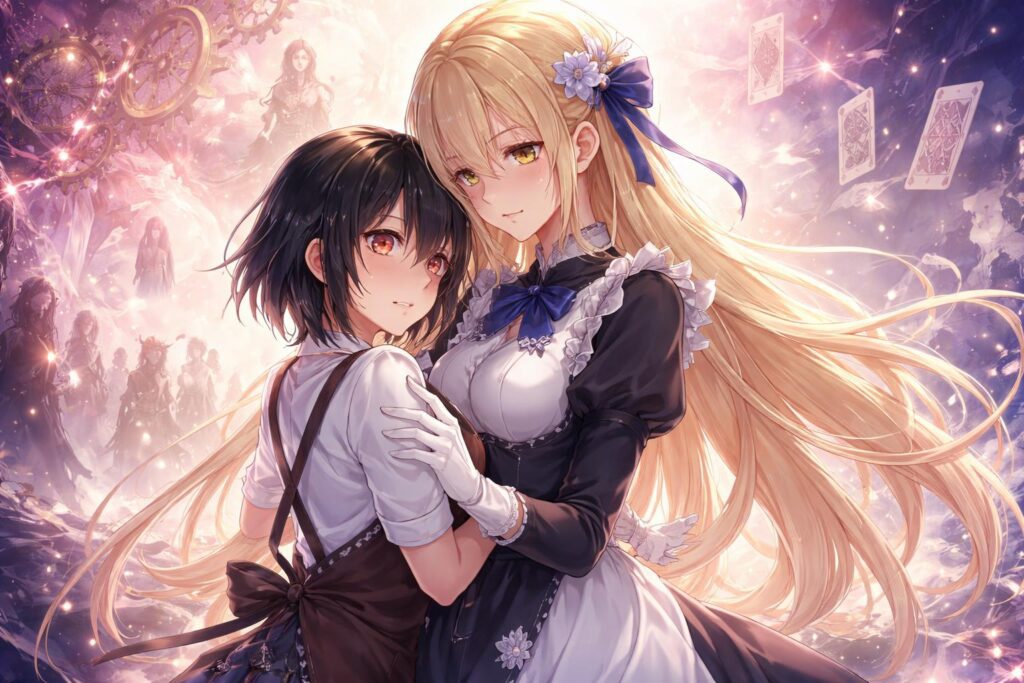
The Fatal Twelve romance between Rinka and Miharu Mishima is not a subplot. It is the story. Everything else—the death game, the other participants, the philosophical questions about fate and choice—orbits around this one relationship.
Miharu is one of the twelve participants. She’s also Rinka’s closest friend. And—here’s the knife twist—she already knows Rinka’s cause of death. She was there when the bus exploded. She survived. Rinka didn’t.
So Miharu is carrying an impossible weight from the very first chapter. She loves Rinka. She wants her to live. And she’s holding the exact piece of information that could be used to eliminate her. The dramatic irony is brutal, and the game never lets you forget it.
Why This Romance Works
A lot of visual novels use romance as a reward mechanic. Be nice enough to the right character and you unlock affection. Fatal Twelve doesn’t do that. The relationship between Rinka and Miharu is complicated before the game even starts. There’s history there. There’s a gap between what they say and what they feel. There’s the specific kind of love that lives between two people who’ve been close for years but have never quite said it out loud.
The death game doesn’t create their bond. It tests it. And watching it bend—and sometimes break—under pressure is what makes the Fatal Twelve story so emotionally effective.
Miharu in particular is a beautifully written character. She’s guarded in a way that reads as cold at first, but gradually reveals itself as self-protection. She’s terrified of losing Rinka again. So she holds on tighter than is healthy, keeps secrets she shouldn’t, and makes choices the player will absolutely yell at their screen about. In the best way.
💕 Love Horror Visual Novels
The Best Love Horror Visual Novels – Full Guide
Doki Doki Literature Club – All the Horrors and Secrets
✦ ✦ ✦
⚠️
Full spoilers from here on. Major endings and the True Ending are discussed in detail below.
The Fatal Twelve Endings – All the Ways This Breaks You
The branching structure of Fatal Twelve isn’t massive, but the endings hit differently depending on the choices you’ve made. Here’s the full breakdown.
❌ Bad Ending
Rinka Fails to Survive
Rinka is eliminated before she can win. Another participant successfully uncovers all three of her details. She disappears permanently. Miharu is left in a world where the person she loved died twice, and there was nothing she could do about it the second time either. It’s quiet, devastating, and doesn’t give you the catharsis of a dramatic final scene. It just ends.
⚖️ Neutral Ending
Victory Without Resolution
Rinka survives Divine Selection and returns to life—but at a cost that fractures her relationship with Miharu. The secrets that built up between them don’t dissolve just because the game is over. Rinka is alive. But the version of their friendship that existed before the bus explosion doesn’t come back with her. A bittersweet conclusion that respects the complexity of what they went through.
💜 True Ending
The Price of Coming Back
This is the ending that earns its title. To reach it, Rinka must understand not just how to win—but why winning matters. It requires her to confront her own regret directly, and it involves Miharu finally saying aloud what she’s been holding back across the entire game. There is a confession. There is also a sacrifice. It’s not a happy ending in the traditional sense. It’s an honest one. Which hits harder.
The Regret at the Core
Rinka’s regret—the key piece of information anyone needs to eliminate her—is tied directly to Miharu. It’s about an unsaid thing, a moment before the explosion when Rinka chose not to speak. That choice haunts her through the entire game. And when she finally addresses it in the True Ending, the scene is one of the most quietly emotional moments in any visual novel in recent years. The game doesn’t make it a grand speech. It’s small. It’s human. And it absolutely floors you.
The Art, the Music, and Why It All Holds Together
The visual style of Fatal Twelve leans soft. Warm palettes, hand-drawn character art with a shoujo-adjacent aesthetic. It might look lighter than the story deserves—but that contrast is intentional. The prettiness of the visuals makes the dark material land harder. You’re watching beautiful characters destroy each other in a beautiful world, and the dissonance does real work.
The soundtrack is worth mentioning too. The music during Purgatorio sequences has this quiet, unresolved quality—like something is always slightly off. It doesn’t go for horror-movie tension. It goes for unease. Which is exactly right for a game about people who are technically dead but walking around making coffee and going to school.
🎮 Similar Games You Might Love
Your Boyfriend Game – Love Horror Breakdown
Signalis – Horror, Love, and What It All Means
Final Verdict – Should You Play It in 2026?
9.1
★★★★★
Quietly Exceptional
PinkCrow Rating – Visual Novel Category
A rare game that earns every emotional beat it lands. The death-game mechanics are clever. The romance is honest. The True Ending will stay with you.
Yes. Absolutely yes. The Fatal Twelve visual novel is exactly the kind of game that gets better the more you think about it afterward. The mechanics are clever but never feel like puzzles for the sake of puzzles. The romance is central without being saccharine. And the story trusts you—it doesn’t over-explain, it doesn’t tie everything in a neat bow, and it doesn’t apologize for the hard parts.
If you’ve played everything the “big name” visual novels have to offer and you’re looking for something that feels genuinely different, this is the one. It’s not a perfect game—some of the side participants feel underdeveloped compared to the central cast—but what it does well, it does exceptionally well.
The Fatal Twelve story is about what it means to have something worth coming back for. Whether it answers that question satisfyingly depends on the ending you reach. But the True Ending? That one earns it.
Start the game. Make some coffee (it’s appropriate, given the setting). And don’t read anything else about it until you’re done.