Duck Season Horror: All 7 Endings
and the Dark Truth Behind the Dog
The 1980s were never this dangerous. A complete lore guide, walkthrough & survival tips.
Close your eyes. Picture a Saturday morning in 1984. The Nintendo Entertainment System hums to life, the orange plastic Zapper rests in your hand, and a cheerful quack echoes from the TV. You shoot the duck. The dog pops up — laughing at you. You groan, but you laugh back. It was harmless. It was pure.
Now open your eyes. It is no longer 1984 and the dog is no longer laughing with you.
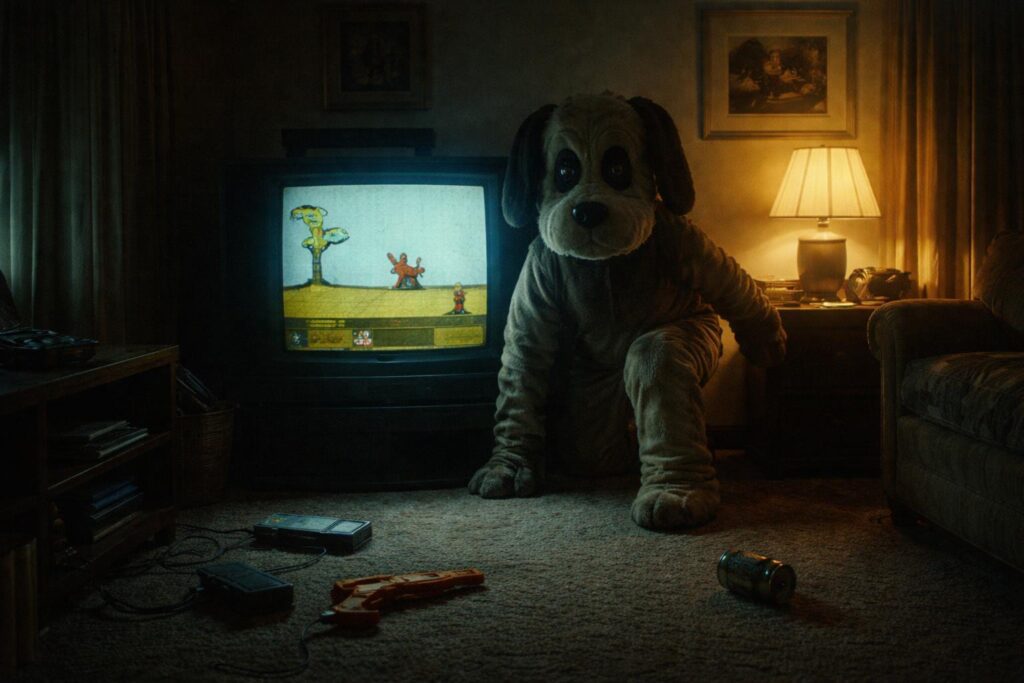
Released in 2017 by Stress Level Zero, Duck Season is a VR horror game built entirely from the wreckage of that childhood innocence. On the surface, you are a kid in the 1980s playing a cartridge called Duck Season — a faithful reimagining of the NES classic Duck Hunt. But after enough rounds, something shifts. The dog in the game starts looking at you differently. A VHS tape appears in your room. A phone rings. And then, the Dog climbs out of the screen.
This is a psychological thriller disguised as a nostalgia trip, and it is one of the most genuinely disturbing games of the past decade. Below, we break down everything: every ending, every hidden tape, the identity of the person inside that dog suit, and whether — just maybe — any of this happened to a real kid.
🕹 Also on PinkCrow: Best Roblox Horror Games · Zoochosis Horror Zoo Game · Homicipher Love Horror
Section IGameplay & Meta-Horror: Where the 4th Wall Cracks
Most horror games scare you from inside the fiction. Duck Season scares you by making you question whether there is a fiction at all.
You play as an unnamed child home alone for the afternoon. Your mom has left. You have a Duck Season cartridge, a TV, a VHS player, and a bedroom full of 1980s nostalgia — cassette tapes, a BMX poster, action figures. The game-within-the-game plays exactly as you would expect: shoot ducks, earn points, laugh at the dog.
But Duck Season tracks something quietly. How many times do you shoot the dog? This single variable — your cruelty toward a cartoon animal — determines which of the game’s seven endings you will see. It is the game’s central moral axis and its most unsettling mechanic: you are being judged for the thing you always did without thinking.
The Hidden Tapes
Scattered around your bedroom are VHS tapes you can pop into the player. These are key to unlocking the secret Easter eggs and deeper lore layers. Most are grainy infomercials and cartoons, perfect period detail — but at least one tape contains footage that should not exist. A figure in a dog suit. A backyard. A child who is not you.
The tapes are the game’s confessional booth. Each one adds a brushstroke to the portrait of a predator who has done this before.
⬥ Creepy FactThe Phone Calls
A rotary phone sits in your room. It will ring. When it does — and it always does — the voice on the other end is calm, almost friendly. Too friendly. These calls do not give you jump scares; they give you dread, which is a far worse thing to carry out of a game and into real life.
Section IIThe Complete 7 Endings Guide
Every ending in Duck Season hinges on one question: How many times do you shoot the Dog? The game tracks this silently across your sessions. Combined with whether you find the tapes and answer the phone, these choices cascade into seven distinct endings — from bittersweet to utterly harrowing. Here is how to trigger every single one.
Requirement: Shoot the Dog enough times and watch the critical VHS tape and answer the phone when it rings.
- Play through Duck Season normally. Shoot the Dog at least once per round — build aggression.
- Locate and watch the disturbing VHS tape hidden in the bedroom (near the TV area).
- Answer the phone when it rings. Do not ignore it.
- When the Dog emerges from the screen in the final confrontation, fight back. Use whatever is at hand.
Result: The child survives. The Dog is defeated. The morning light returns. It is the ending that feels most like survival — and the one you have to earn.
Requirement: Shoot the Dog an unusually high number of times — far beyond what any normal playthrough would accumulate.
- Every time the Dog appears in the game screen, shoot him immediately and repeatedly.
- Keep this up across multiple in-game sessions until the total climbs high.
- Trigger the final sequence.
Result: A bizarre, colorful celebration sequence that feels deeply out of place — which is exactly the point. The game is mocking you for your relentless cruelty. The Fiesta Ending is Duck Season laughing at the player the same way the Dog always laughed at you. Dark comedy at its finest.
Requirement: Never shoot the Dog. Ignore the phone. Be entirely passive throughout the entire game.
- Play Duck Season but never aim at or shoot the Dog character.
- Do not pick up the phone when it rings.
- Do not engage with the VHS tapes.
- When the Dog arrives, do not fight.
Result: The child is frozen — stuck — unable to act. The implication is deeply uncomfortable. You had every opportunity to prepare, to fight, to understand the threat. You chose not to. The game leaves the fate ambiguous, which is somehow worse than showing you anything explicit.
Requirement: Never shoot the Dog across all rounds. The Dog views you as complicit — or willing.
- Deliberately avoid shooting the Dog in every single round of the in-game Duck Season.
- Still answer the phone to hear the Dog’s messages, establishing the “relationship.”
- When the Dog emerges, do not resist.
Result: The child disappears with the Dog. This is the ending that launched a thousand fan theories and firmly established Duck Season‘s status as a genuinely disturbing piece of work. The Dog killer has claimed another victim — and the player enabled it.
Requirement: Survive the Dog’s emergence by fighting back, but do not watch the full tape sequence before the confrontation.
- Shoot the Dog moderately in early rounds.
- Skip or miss the VHS tape content.
- Still fight during the final confrontation.
Result: The child survives but is found by their returning mother in a state of shock. The threat is neutralized but the psychological damage is done. This ending asks: even if you survive, what do you carry with you?
Requirement: A specific combination of shooting the Dog a moderate number of times while missing certain tape interactions — the game treats you as neither prepared nor completely oblivious.
- Shoot the Dog some but not consistently.
- Watch one but not all tape segments.
- Miss the phone call.
Result: The screen cuts to static. No resolution. It is the game’s way of telling you that indifference has consequences — and that not all stories end. Some just stop.
Requirement: Watch every available VHS tape in its entirety before the final confrontation, regardless of your Dog-shooting count.
- Methodically find and watch every VHS tape in the bedroom — do not skip or eject early.
- Pay attention to the final tape’s content (it contains direct lore about the Dog’s history).
- Proceed to the confrontation.
Result: An extended ending sequence that reveals the most direct in-game lore about the Dog’s true nature and backstory. This is the ending lore hunters need. It does not resolve the horror — it deepens it.
Pro Tip: To see all seven endings efficiently, complete the Canon Ending first. It unlocks a chapter-select-style replay mode that lets you jump back in with your choices already partially set.
⬥ Pro TipSection IIILore & Theories: Who Is the Person in the Dog Suit?
This is the question that has haunted Duck Season‘s community since 2017. The Dog is not a supernatural entity. It is not a demon or a ghost. It is, almost certainly, a human being — and that is what makes it terrifying.
The Real-World Evidence Inside the Tapes
The VHS tapes contain fragments of a real world outside the game. A man in a full dog mascot suit appears in what looks like a backyard in the 1980s. The footage has the grainy, washed-out quality of genuine home video — the game worked hard to make this footage feel found, not created. Other children appear in these tapes. They are always alone with the Dog. They do not appear in later tapes.
The Dog’s method is always the same: establish contact through the game, isolate the child, arrive in person. Duck Season the cartridge is not a product he bought — it is a tool he built, or had built. The game cartridge itself is the trap. The Void in the television screen is the threshold between his world and yours.
The Void — What Lives Inside the Screen
Several fan theories focus on the Void — the black space visible inside the TV screen before the Dog emerges. In VR, this space feels genuinely three-dimensional: a dark corridor stretching back into somewhere else entirely. Some players have reported seeing a faint figure standing in the Void before the final confrontation begins — a detail the developers have never officially confirmed or denied.
The Void may represent the liminal space between the child’s innocent understanding of the game and the adult horror lurking beneath it. Or it may be literal: a space the Dog occupies, a physical place behind every television screen running Duck Season. The game never resolves this. It trusts you to sit with the discomfort.
The “Other Children” Theory
Cross-referencing the tape footage with details in the child’s bedroom — trophy dates, class photos barely visible on the wall, a calendar — some fans have constructed a timeline suggesting that the child protagonist is not the Dog’s first target. The bedroom itself, they argue, may not originally belong to this child. The Duck Season cartridge may have been left here deliberately.
This theory, if correct, reframes the entire game: you are not witnessing the beginning of something terrible. You are witnessing another chapter in something that has been happening for years.
The most chilling detail in the game isn’t the Dog emerging from the screen. It’s the realization that he already knew where you lived before the game began.
⬥ Creepy Fact📎 Trusted External Sources & Further Reading
- Duck Season — Official Steam Page store.steampowered.com · Developer: Stress Level Zero · Verified release info, system requirements & reviews
- Duck Season — IGN Game Page ign.com · Critic reviews, user scores & game overview
- Best Roblox Horror Games — PinkCrow.net pinkcrow.net · Our curated list of the scariest Roblox experiences
- Zoochosis Horror Zoo Simulation — PinkCrow.net pinkcrow.net · Another animal-themed horror game with dark secrets
- Homicipher — Love Horror on PinkCrow.net pinkcrow.net · When affection becomes the source of horror
- Mad Father: Master Guide — PinkCrow.net pinkcrow.net · Another psychological horror game with family at its core
Section IVFAQ — Your Highest-Volume Questions, Answered
Duck Season was originally developed for the HTC Vive VR headset and released in 2017. However, Stress Level Zero later released a PC (flatscreen) version that can be played without VR hardware, albeit with reduced immersion. The VR experience is widely considered the definitive version — the moment the Dog stands at the other side of the room from you in VR is unlike anything in flatscreen gaming. Both versions are available on Steam.
The safest path to survival is the Canon Ending route: shoot the Dog consistently throughout every round of the in-game Duck Season (this is your preparation), watch the critical VHS tape (this is your knowledge), answer the phone (this is your warning), and fight back during the final confrontation. Passivity in this game is almost always punished. The game rewards the player who takes the threat seriously — which is itself part of the psychological horror design.
No — Duck Season is not based on a documented real event. It is an original horror concept by Stress Level Zero. However, the game’s effectiveness comes precisely from its plausibility: there is nothing overtly supernatural about the threat it depicts. The horror is rooted in the real world of the 1980s, real anxieties about stranger danger, and real childhood isolation. Its fictional nature does not make it less unsettling.
The Void refers to the dark space visible inside the television screen — particularly noticeable in VR — that serves as the Dog’s apparent point of origin or habitation. It is never explicitly explained in the game’s narrative. Community interpretations range from it being a literal physical space (a crawlspace or room behind the TV) to a psychological metaphor for the darkness lurking inside childhood media. It is one of the game’s most deliberately ambiguous elements.
A single playthrough of Duck Season takes approximately 45 minutes to 1.5 hours depending on how thoroughly you explore. Seeing all seven endings, including the secret tape ending which requires methodical exploration, typically takes 4–6 hours total across multiple runs. The good news: the game’s chapter-replay system (unlocked after the Canon Ending) makes revisiting specific choice points much faster on subsequent runs.
Despite its surface appearance as a cheerful 1980s nostalgia trip, Duck Season is not appropriate for children. Its horror themes include predatory behavior, isolation, and graphic confrontation. It is rated for mature audiences. The genius — and the cruelty — of its design is that it looks, on its box art, like exactly the kind of game a child would want to play.