“Knuckles game” can mean a lot of different things. There’s the ancient bone-tossing game that’s been around for thousands of years. There’s the viral dice game from Cult of the Lamb. There’s jacks (the kids’ playground game). And then there’s bloody knuckles, which is… well, we’ll get to that.
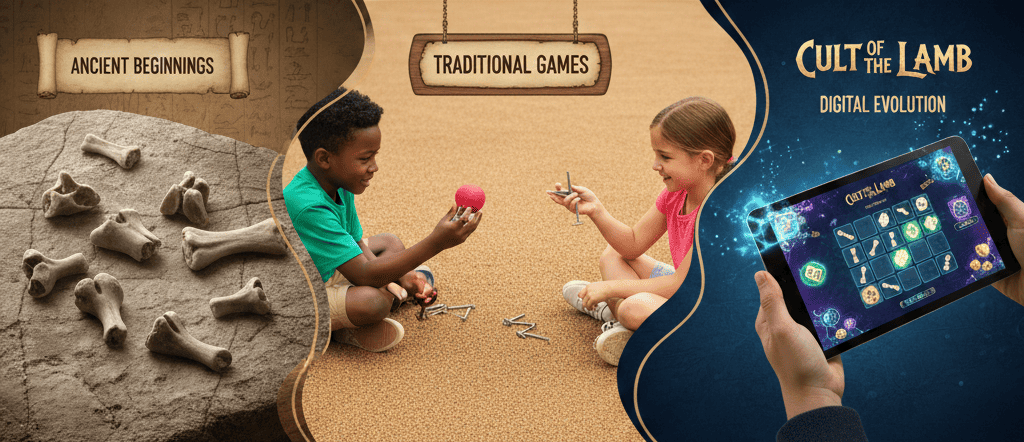
Here’s what you need to know about each one.
Knucklebones: The Ancient Dice Game
The original knucklebones game used actual animal bones—specifically the ankle bones of sheep or goats. People have been playing variations of this for over 2,000 years.
Traditional Knucklebones (Jacks Style)
The classic version works like this:
You need five knucklebones (or modern equivalents—metal or plastic jacks work too). Throw all five on the ground. Pick one up and toss it in the air. While it’s airborne, you grab others from the ground, then catch the one you threw before it lands.
The game has rounds with increasing difficulty:
- Ones: Pick up one bone at a time
- Twos: Pick up two bones together
- Threes: Pick up three, then one
- Fours: Pick up all four at once
- Sweeps: Same as above but you can sweep bones together first
Miss a catch or move the wrong bone? Your turn ends.
Mongolian Shagai
In Mongolia, they play a version called shagai. The bones can land in four positions, each representing an animal: horse, sheep, goat, or camel. Different positions have different point values.
Players throw the bones and try to land specific combinations. Horse-side up is usually worth the most points. First to reach a set score (often 100) wins.
It’s less about dexterity and more about luck with strategy.
Knucklebones in Cult of the Lamb
In 2022, the game Cult of the Lamb introduced knucklebones as a mini-game. It went viral. People who’d never heard of the ancient game suddenly couldn’t stop playing this dice version.
How It Works
Two players. Each has a 3×3 grid divided into three columns. Players alternate rolling one die and placing it in any column on their side.
Scoring:
- Single die = face value
- Two matching dice in a column = 2x their value
- Three matching dice in a column = 3x their value
The twist: If you place a die in a column where your opponent already has the same number in their matching column, you destroy all their matching dice in that column.
Game ends when someone fills all nine spaces. Highest score wins.
Why People Love It
It’s simple enough to learn in 30 seconds but has real depth. Do you go for high numbers and risk them getting destroyed? Or play low numbers in your “trash column” to avoid giving your opponent points?
The destruction mechanic is what makes it tense. You’re not just building your own score—you’re actively sabotaging theirs.
Where To Play It
The Cult of the Lamb version is only available in the game. But fans made standalone versions:
- Knucklebones.io – Free browser version
- Knucklebones Tactical Dice PVP – Mobile app on Google Play
- Physical versions – People made DIY boards with real dice
The mobile app has ranked online play and 10 difficulty levels against AI. It’s free and lets you turn off ads voluntarily, which is surprisingly respectful.
Jacks: The Playground Version
Most people in the US know jacks, not knucklebones. Same basic concept, different name and pieces.
You get six metal jacks (star-shaped pieces with six prongs) and one small rubber ball. Scatter the jacks, bounce the ball, grab jacks while it bounces, catch the ball before it bounces twice.
Start with ones (grab one jack per bounce), then twos, threes, and so on until you’re grabbing all six at once.
Common variations:
- Pigs in the pen – Make a circle with your hand, sweep jacks into it
- Around the world – Circle your hand around the jacks before grabbing
- Eggs in the basket – Transfer jacks to your other hand
Kids still play this. The metal jacks haven’t changed much in 100 years. You can buy sets at most toy stores.
Bloody Knuckles: The Painful One
This is the game teachers tried to ban on playgrounds. There are a few versions, all of them hurt.
Fist Punching Version
Two players face each other with fists touching knuckle-to-knuckle. Take turns punching each other’s knuckles as hard as you can. First person to quit loses.
This version is exactly as dumb as it sounds. Injuries include broken bones, swollen hands, and obviously bloody knuckles. Don’t play this.
Quarter Spinning Version
Slightly less dangerous but still stupid:
One player spins a quarter on a table. The other player has to keep it spinning by flicking it with their finger. When someone fails to keep it spinning, they make a fist on the table.
The winner then slides the quarter hard across the table into the loser’s knuckles. The coin edge can break skin, hence “bloody” knuckles.
Some variations let you earn multiple slides for each failed spin. Some use dimes or nickels instead.
Why People Played It
It was a test of toughness. A way to prove you could take pain. Mostly boys played it as a dominance thing in the schoolyard hierarchy.
That said, it’s a terrible game. The only way to win is to endure pain or inflict it. There’s no skill involved past pain tolerance. Most schools banned it years ago for good reason.
Safer Alternatives
If you want the competitive spirit without actual injury:
- Play rock-paper-scissors with silly penalties for losing
- Try “Speed” or “Slapjack” (card games with quick reflexes)
- Just play actual knucklebones with dice
Save your knuckles. They’re useful for other things.
Knuckles Card Game
There’s also a card game called Knuckles that has nothing to do with bones or pain. It’s actually family-friendly.
Each player gets five cards. Add up your total. Face cards are worth 10, aces are worth 1. When you think you have the lowest score, knock on the table and say “knuckles.”
Everyone else gets one more turn, then you compare scores. Lowest score wins that round. First to win three rounds wins the game.
It’s similar to games like 31 or Gin Rummy. Good for kids learning addition who like some risk-taking.
Which Knuckles Game Should You Try?
If you want strategy: Play the Cult of the Lamb version. Download the mobile app or find the browser version. It’s the most polished and has online multiplayer.
If you have young kids: Get a jacks set. It’s cheap, builds hand-eye coordination, and has been entertaining children for generations.
If you’re curious about history: Try traditional knucklebones with five dice or small objects. The original rules are simple and you can play anywhere.
If you like card games: Try the Knuckles card game. It’s low-stakes, easy to learn, and works for all ages.
If someone suggests bloody knuckles: Suggest literally anything else. Your hands will thank you.
Tips for Different Versions
For Cult of the Lamb Knucklebones
- Always grab doubles or triples, even with low numbers—the multiplier is worth it
- Destroy opponent’s doubles and triples whenever possible
- Place high numbers (5-6) in columns your opponent has already filled
- Have one “trash column” for 1s and 2s
- Position it opposite an empty column on their side
For Traditional Jacks
- Practice the basic throw until you can control where jacks land
- Use your pinky and ring finger to stabilize your hand while grabbing
- Don’t rush—smooth movements beat frantic ones
- On harder rounds, sweep jacks closer together during the airtime
- Watch experienced players before trying advanced variations
For Knuckles Card Game
- Knock early if you have a total under 10
- Face cards are risky—trade them for lower numbers when possible
- Watch what other players discard to guess their totals
- Sometimes it’s worth taking a risk to get one more low card
The Appeal of Knucklebones Games
Why have variations of this game lasted thousands of years?
Simple to start, hard to master – You can teach someone in under a minute, but skill development takes time.
Minimal equipment – Most versions need nothing more than dice, bones, or objects you already have.
Quick rounds – Most games last 2-10 minutes. Perfect for filling time.
Works anywhere – No board required. Play on any flat surface.
Multiplayer potential – Social games beat solo games for most people.
From ancient shepherds in Mongolia to kids on playgrounds to gamers playing Cult of the Lamb, the core concept keeps working. Throw something, catch something, try not to lose. Simple and effective.
The Cult of the Lamb Effect
Cult of the Lamb introduced knucklebones to millions who’d never heard of it. Google searches for “knucklebones” spiked when the game launched in August 2022.
People made physical boards. Created online versions. Started playing with real dice at game nights. Some even bought actual sheep knucklebones to try the historical version (you can still buy these, surprisingly).
It’s a good example of how video games can revive ancient games. Just like how playing cards made poker mainstream, Cult of the Lamb made knucklebones relevant again.
Final Thoughts
“Knuckles game” covers thousands of years of human history—from Mongolian herders playing with sheep bones to ancient Greeks playing astragaloi to modern gamers competing online in Cult of the Lamb.
The common thread is simplicity. None of these games require complicated rules or expensive equipment. They’re accessible to anyone willing to learn.
Even bloody knuckles, despite being a terrible idea, shows the human tendency to turn pain into competition. We’ll literally injure ourselves for the sake of a game. That’s fascinating and also concerning.
But for the rest? Whether you’re playing with bones, dice, metal jacks, or a mobile app, knucklebones remains what it’s always been—a quick, engaging way to compete with someone while testing your skill and luck.
More Classic Games
Want to explore other timeless games? Check out our guide to Best PS2 Games for nostalgic gaming classics, or try Best Sudoku Games if you prefer solo puzzles. For more party game options, see our breakdown of GamePigeon mini-games.