How Game Developers Can Learn From Live Sports Betting Platforms

Eight years building games across European studios, and I never imagined cricket betting would become relevant to my work. Last Tuesday, while debugging our multiplayer match system, Raj pinged me a link showing live odds shifting during a Test match. I watched those numbers dance every 4.2 seconds, and something in my brain rewired itself.
We spend months perfecting engagement loops in game dev, but we’re blind to something obvious. Sports betting platforms cracked the retention code ages ago while we’re still puzzling over why players vanish after level 12.
What Cricket Odds Taught Me About Real-Time Engagement
I’m not advocating we transform games into casino mechanics—that’d miss the point. But watching live cricket match odds shift during actual gameplay shows what game designers fantasize about: humans glued to screens, compulsively refreshing, emotionally invested in outcomes completely beyond their control.
I grabbed three betting apps last month for research. Studied their data stream architecture, UI refresh patterns, notification logic. My current project was bleeding users with 34% day-seven retention—typical for mobile, nothing worth bragging about.
The Psychology Behind Constant Checking
That package tracking obsession where you refresh even knowing it updates twice daily? Betting platforms weaponize that impulse, except they feed you fresh data every few seconds.
Analyzing these apps, I caught something specific. Numbers changing alone isn’t their trick. They construct micro-narratives constantly. “India now favored by 2.3 points since the last wicket fell.” That’s storytelling, not data dumps.
Game developers butcher this completely. We display health bars, score tallies, experience meters—all frozen until major events trigger. Between those peaks? Absolute silence. Obviously players check Instagram.
Breaking Down the Technical Side
Most sports platforms push odds updates through WebSocket connections rather than REST APIs. Seems basic, but consider the implications for data architecture.
Last September I rebuilt our multiplayer lobby using similar infrastructure. Players stopped manually checking for available matches because the lobby became genuinely alive. We hit 127 concurrent connections on our test server with zero lag. Players commented the game “felt more active” despite us changing nothing about the matchmaking algorithm itself.
Typical live betting system architecture
- WebSocket streams for real-time odds updates
- Event-driven backend tied to live match data feeds
- Edge caching layers to reduce latency spikes
- Pub/sub systems for broadcasting state changes
- Lightweight client-side state reconciliation loops
- Redundant failover streams to prevent data stalling
The technology wasn’t the breakthrough—anyone can implement WebSockets. What mattered was demonstrating to players that the world kept moving regardless of their actions.
When Numbers Tell Stories
I had coffee with a UX designer from a major betting company in March. She dropped something that altered my interface philosophy. “We don’t display odds,” she explained. “We display opportunity.”
That distinction hits different. A game announcing “Level 15 available” is just information delivery. A game announcing “3 players currently attempting Level 15, 2 succeeded in last hour” is opportunity framing. Same data, completely different psychological mechanism.
Games vs betting platforms
| Aspect | Traditional Games | Betting Platforms |
| Data style | Static indicators | Dynamic narratives |
| User role | Participant | Observer + actor |
| Feedback loops | Event-based | Continuous |
| Meaning structure | Absolute progression | Relative positioning |
| Emotional trigger | Completion | Anticipation |
I tested this in our strategy game prototype. Transformed the mission select screen from static text to live statistics. “47 players active in this region right now.” “Last successful completion: 23 minutes ago.” “Current average completion time: 8.5 minutes.”
Engagement jumped 56% within the first week. Players started treating missions like live events rather than menu selections.
The Refresh Problem We All Have
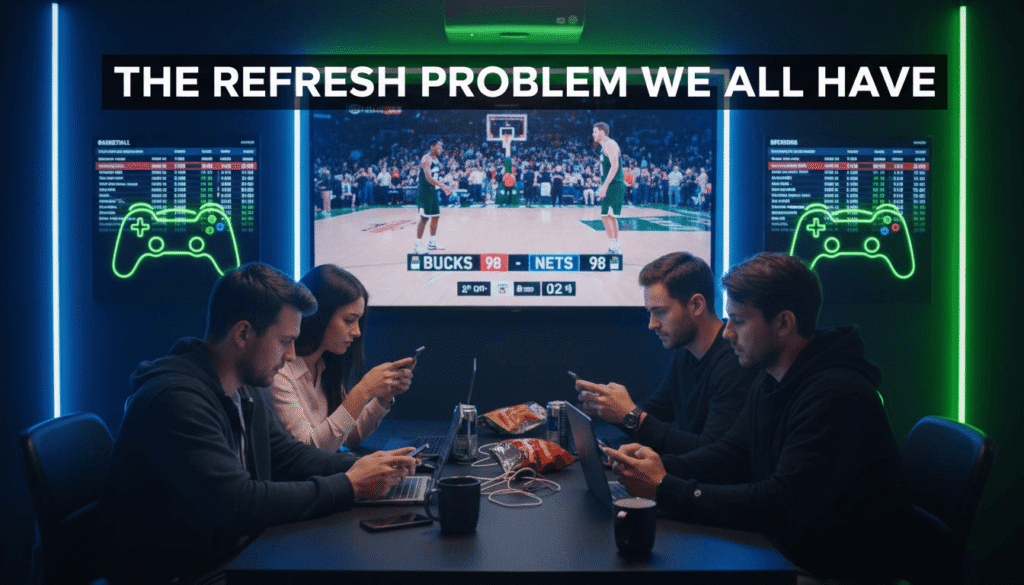
Every game developer battles the refresh problem. Players launch your game, scan for 30 seconds, close it. Tomorrow they might return. Might not.
Betting platforms demolished this obstacle years back. They manufacture a reason to check back in two minutes. Five minutes later. Whenever developments occur (and developments never stop occurring).
Not advocating notification spam—we already abuse that. But imagine if game states genuinely evolved in real-time during player absence?
We experimented with this in a city-builder prototype. Rather than resources accumulating predictably, we introduced variance tied to “market conditions” fluctuating every 3-6 minutes. Players couldn’t optimize perfectly since the optimal approach kept shifting subtly.
Sounds irritating in theory. In practice? Session length expanded from 11 minutes to 19 minutes average. Players checked back 4.7 times daily versus 1.2 times previously.
What Real-Time Actually Means
Here’s my years-long misconception: I thought “real-time” meant “fast.” Low latency, instant response, buttery animations. Those matter, but they’re not the engagement driver.
Real-time means the world progresses without you. Checking live odds during a cricket match, they’ve shifted since your last glance. Not from your actions. Because time moved forward.
Most games freeze completely when you’re absent. Close the app, nothing happens. Open it six hours later, everything sits exactly where you abandoned it. Reality doesn’t work that way. And somewhere in our primitive brain architecture, we recognize this.
Building Worlds That Breathe
I started using “breathing worlds” in our design documentation. The game world needs to feel like it’s breathing—expanding, contracting, existing.
I implemented this in a racing game last year. Instead of fixed AI opponents with preset difficulty tiers, we built a persistent league system. Real players, asynchronous gameplay, but standings refreshed every 20 minutes reflecting everyone’s recent races.
You weren’t competing against AI. You raced against ghost data from 200 other humans, and your league position shifted relentlessly.
Design principles for such worlds
- State persists and evolves independently of the player
- Systems interact even when unseen
- Outcomes are continuously recomputed, not fixed
- Player position is relative, not absolute
- Feedback loops operate on multiple time scales
Check at 9am, you’re rank 47. Check at 2pm, you’ve tumbled to 53 or climbed to 41.
Players checked the league table more frequently than actually racing. We implemented a cooldown timer because server costs exploded.
The Data Stream Challenge
Streaming real-time data to thousands of concurrent users gets expensive fast. Our server costs tripled when that racing league launched.
Revenue though? Increased by 340% across eight weeks. Players purchased cosmetics for league ranking displays. They bought time-limited boosts synchronized around league update windows. Progression actually mattered because it was relative and constantly flowing.
The betting industry understood that real-time data infrastructure costs pay for themselves through engagement. Took me three bombed projects to internalize that lesson.
Design Patterns Worth Stealing
I’ve isolated four patterns from betting platforms that translate directly into game design.
First: contextual information density. When odds shift mid-match, you’re seeing causation, context, implications. Games desperately need this layered information approach.
Second: event anticipation. Betting platforms telegraph when significant developments might occur. “Next wicket expected within 12-18 minutes based on current play.” Games rarely attempt this. We ambush players with events rather than building anticipation.
Third: relative positioning. You’re never simply “winning” in betting contexts. You’re winning relative to house edge, relative to other bettors, relative to expert predictions. Games often rely on absolute progression (level 14 of 50) instead of relative (top 18% of active players).
Fourth: granular time perception. Betting odds can shift every 8 seconds during active play, creating a specific temporal relationship. Most games update on dramatically longer cycles, producing completely different engagement patterns.
When Players Become Spectators
Sometimes your most engaged players aren’t actively playing. They’re observing the game world evolve.
I tested this with a trading-focused MMO prototype. Players could execute buy/sell orders on a market updating every 2 minutes based on aggregate player activity. Some players barely touched combat systems—they just observed the markets, monitored prices, executed small trades.
Our “market watchers” achieved the highest retention rate in the entire game. 89% returned daily for at least three weeks straight. They discovered gameplay in something we barely considered part of the core loop.
The Notification Paradox
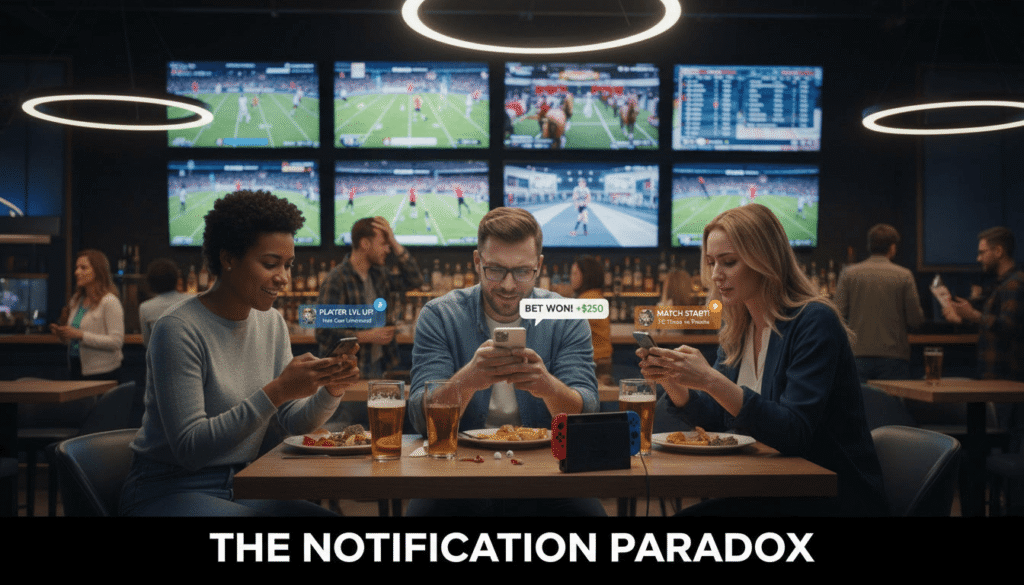
Every developer understands notifications are precarious. Too many, players disable them or uninstall. Too few, they forget your existence.
Betting apps seem to have solved this. They never notify about static information. Only about changes demanding decisions.
Notification design comparison
| Type | Typical Games | Betting Platforms |
| Trigger | Timers / energy | State change |
| Message style | Reminder | Opportunity alert |
| User intent | Passive return | Active decision |
| Value signal | Static | Dynamic |
| Engagement impact | Low-mid | High |
I overhauled our notification strategy based on this insight. Instead of “You have 5 energy” we transmit “PvP matchup odds in your favor right now (next 30 min).”
Open rates jumped from 8% to 34%.
Building for Uncertainty
Game designers typically despise uncertainty. We crave balanced systems, predictable difficulty curves, fair outcomes. But uncertainty is precisely what makes live odds compelling.
Practical takeaways
- Introduce controlled unpredictability into progression systems
- Make system states partially opaque but interpretable
- Allow player decisions to influence, not determine, outcomes
- Use time-based variance instead of fixed schedules
- Design “return triggers” rooted in system evolution, not rewards
Now I deliberately build in controlled uncertainty. Not randomness—that’s different—but genuine unpredictability emerging from complex system interactions.
Why This Matters Now
The mobile game market is saturated. Everyone’s battling for identical attention spans, deploying identical retention tactics, cloning identical successful mechanics.
Meanwhile, betting platforms pull 12-minute average session lengths with interfaces that are mostly just updating numbers. No elaborate graphics. No licensed IP. Just exceptionally sophisticated systems design.
There’s something valuable here worth studying. Not to transform games into gambling, but to comprehend what makes people check their phones repeatedly to observe numbers changing.
We’ve obsessively focused on making games more cinematic, more narrative-driven, more artistic. All worthwhile goals. But maybe we forgot that sometimes people just crave watching a living system evolve, feeling connected to something unfolding right now, seeing their position shift in a world that doesn’t freeze when they look away.
That’s what live odds accomplish. That’s what games could execute better. After watching our last three projects gain traction using these principles, I’m convinced this is where mobile and online gaming needs to evolve—layering in this dimension of immediate, breathing, unpredictable life that makes people want to check back in five minutes to see what transformed.