Every fantasy story you have ever watched follows the same arc: a young hero assembles a party, travels the world, defeats the Demon King, and saves the kingdom. Frieren: Beyond Journey’s End begins ten years after that ending. The Demon King is dead. The medals have been awarded. The kingdom holds parades in the Hero’s honor. And Frieren — the thousand-year-old elven mage who helped make it all possible — realizes she barely remembers the faces of the humans she traveled with, because their entire lives are a blink in her timeline. What follows is not an adventure story. It is a meditation on time, grief, and the unbearable weight of outliving everyone you have ever loved. It is also, somehow, one of the most exciting, emotionally devastating, and commercially dominant anime of the decade.
The Subversion: Starting at the End
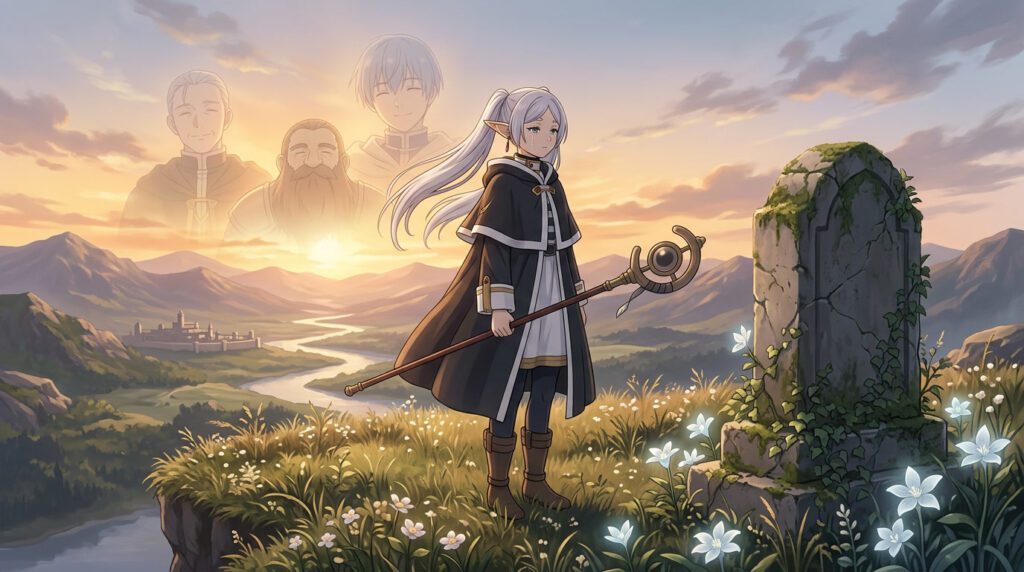
The first and most radical decision Frieren makes is structural. The opening episode shows the Hero Himmel, priest Heiter, dwarf warrior Eisen, and elf mage Frieren standing before a statue of themselves, commemorating their victory over the Demon King. They are middle-aged, accomplished, celebrated. Then the story jumps forward fifty years. Himmel is dead. Heiter is dying. Eisen is old. And Frieren looks exactly the same — because she is over a thousand years old, and five decades are less than a long weekend to her.
This is not a framing device. It is the entire premise. The show asks a question no mainstream fantasy has seriously engaged with: what happens to the world after the prophecy is fulfilled? What happens to the relationships forged in crisis once the crisis is over? What does it mean to be immortal in a world where everyone you care about will be dust in a century?
The Central Tension
Frieren does not struggle with enemies. She struggles with comprehension. She cannot understand why Himmel cried at a meteor shower they watched together. She cannot grasp why Heiter’s death devastates her when she has seen hundreds of humans die. She keeps a collection of Himmel’s handmade statues — not because she loved him when he was alive, but because she is only now, decades after his death, beginning to understand what he meant to her. The tragedy is not that she outlives her friends. The tragedy is that she only learns to value them after they are gone.
Four Ways Frieren Deconstructed Fantasy
Time Is the Real Antagonist
In conventional fantasy, the enemy is a Dark Lord, a demon army, or a world-ending threat. In Frieren, the enemy is time itself. Every episode carries the quiet weight of mortality. When Frieren accepts a quest that will take ten years, she does so casually — but her human companions know that a decade is a significant fraction of their remaining lives. The show makes you feel the asymmetry of every relationship. Fern, Frieren’s apprentice, will be elderly or dead before Frieren notices any change in herself. The emotional horror of this is never stated outright. It is simply present in every frame, every conversation, every glance at a grave.
Magic Is a Discipline, Not a Spectacle
Shonen fantasy treats magic as a power system to be escalated: bigger explosions, higher numbers, new transformations. Frieren treats magic as an academic discipline. Spells are studied, analyzed, and countered through logic and preparation. The most powerful mage in the world wins fights not because she has more mana, but because she has spent centuries understanding how magic works. Combat is tactical, not explosive. The show’s most celebrated battle — Frieren vs. Aura the Guillotine — is essentially a debate about magical contract law, resolved through an understanding of spell mechanics that Frieren has spent a thousand years refining. It is the anti-Dragon Ball approach, and it is exhilarating.
The Hero’s Journey Belongs to Other People
Himmel, the Hero of the story, is dead before the narrative properly begins. We see him only in flashbacks — young, idealistic, deeply in love with a world he knows he will not live long enough to fully explore. The show understands something profound: the hero’s journey is not the interesting part. What is interesting is what the hero leaves behind. The people who have to keep living. The elf who has to keep living for another thousand years. The apprentice who inherits a legacy she never asked for. The warrior who must measure himself against a legend. Frieren is not the hero of the Hero’s Party. She is the survivor of it. That distinction changes everything.
Emotional Depth Over Power Scaling
The most devastating scene in the entire series is not a battle. It is a flower field. Himmel, knowing he will die long before Frieren ever changes, takes her to see a meadow of the flowers she once casually mentioned were beautiful. He does this decades after she mentioned it, on what is effectively his deathbed tour. Frieren does not understand the significance at the time. Only later, after he is gone, does she realize: he remembered something she said in passing for half a human lifetime. The show’s emotional power comes from these small, delayed realizations. Not from power levels. Not from transformations. From the slow, painful accumulation of understanding.
The Characters Who Carry the Weight
Frieren · The Elf Who Outlives Everyone
Over a thousand years old, absurdly powerful, and emotionally illiterate. Frieren is not a warm protagonist. She is often cold, dismissive, and oblivious to the feelings of those around her. But she is not cruel — she is simply operating on a timescale where human lives are mayflies. Her arc is the slow, painful process of learning to compress her timeline to match the people she loves. The show’s genius is that this arc takes place almost entirely in subtext. Frieren never has a big speech about her feelings. She simply starts making different choices.
Fern · The Apprentice Who Grew Up Too Fast
Raised by the dying Heiter and then taken in by Frieren, Fern is a child forced into adulthood by circumstance. She is stoic, responsible, and quietly furious at Frieren’s emotional negligence — while simultaneously loving her deeply. Fern is the audience’s emotional anchor: she experiences Frieren’s thousand-year perspective from the outside, and her frustration with Frieren’s detachment mirrors the viewer’s. Her relationship with Stark provides the show’s most grounded, human warmth.
Stark · The Warrior Who Is Afraid to Die
Stark subverts the “brave warrior” archetype completely. He is powerful, yes — trained by Eisen, one of the legendary Hero’s Party members — but he is also genuinely terrified of combat. His hands shake before fights. He considers running away. He only stands his ground because the alternative is letting someone he cares about get hurt. This is not played for comedy, at least not entirely. It is played as a realistic psychological portrait of a teenager who has been asked to live up to impossible standards. Stark is brave not because he lacks fear, but because he acts despite it.
Himmel · The Hero We Only See in Memory
Himmel is dead, and yet he is arguably the most important character in the series. Through flashbacks, we see a young man who understood something Frieren did not: that their journey together was precious precisely because it was temporary. He is kind without being naive, brave without being reckless, and deeply, quietly in love with the world and the people in it. Every flashback reframes something in the present. Every statue he left behind is a message from the past that Frieren is only now learning to read. He is the emotional engine of the entire story, and he never appears in the present timeline.
Cultural Impact: By the Numbers
26M+
Manga Copies in Circulation
As of 2025, per series reports
9.0+
MyAnimeList Score
Top 15 all-time on MAL
2024
Crunchyroll Anime of the Year
Also won Best Fantasy & Best Director
28
Episode First Season
Madhouse production, 2023–2024
The numbers are extraordinary for a series this quiet. Frieren did not explode because of viral clips or memeable moments. It grew through word of mouth — the same slow, patient accumulation of goodwill that defines its own narrative. Viewers who stuck with the early episodes, which are deliberately paced and emotionally restrained, found themselves watching something unlike anything else in the anime landscape. By the time the first season concluded, it had become a cultural phenomenon: discussed in essay videos, analyzed in academic papers, and cited by creators across media as a reference point for how to do fantasy differently.
The manga, written by Kanehito Yamada and illustrated by Abe Tsukasa, began serialization in Shogakukan’s Weekly Shonen Sunday in April 2020 — a magazine not typically associated with genre-defining fantasy. It won the 14th Manga Taisho and the 25th Japan Media Arts Festival’s Manga Division Grand Prize before the anime even aired. The anime adaptation by Madhouse (the studio behind Death Note, Hunter x Hunter, and One Punch Man) elevated the source material with some of the most beautiful background art and musical scoring in modern television animation. Evan Call’s soundtrack, blending orchestral grandeur with intimate piano themes, is widely considered one of the best anime scores of the decade.
The Legacy: What Frieren Changed
Frieren: Beyond Journey’s End has already influenced the fantasy landscape in ways that will take years to fully measure. Within anime, it has opened the door for more post-hero narratives — stories that ask what happens after the credits roll. Within manga, it has demonstrated that shonen magazines can support deeply contemplative, emotionally complex fantasy that prioritizes character over combat. And within the broader cultural conversation about fantasy as a genre, it has made a powerful case that the most interesting stories are not about becoming powerful. They are about learning to live with the power — and the time — you already have.
The Final Word
In the final episode of the first season, Frieren stands before a mirror and sees not her own reflection, but the accumulated weight of every person she has ever known. The show understands that fantasy is not about dragons or demons or magic. It is about the impossible task of holding onto people who will inevitably be gone. Every genre that tells stories about heroes defeating evil is, at its core, telling stories about mortality. Frieren simply made that subtext into text — and in doing so, created something that feels less like an anime and more like a meditation on what it means to be alive in a world where everyone you love is temporary. That is how one elf deconstructed an entire genre. Not by rejecting it, but by revealing what was always hiding inside it.
Frequently Asked Questions
What is Frieren: Beyond Journey’s End about? +
Frieren: Beyond Journey’s End follows Frieren, an elven mage who was part of the legendary Hero’s Party that defeated the Demon King. The story begins after the quest is complete, focusing on Frieren’s realization that she barely knew her human companions during their decade-long journey — and that their lifespans are a mere fraction of her own. She embarks on a new journey to understand humanity, accompanied by her apprentice Fern and the warrior Stark.
How did Frieren deconstruct the fantasy genre? +
Frieren deconstructed fantasy by starting where most stories end — after the Demon King is defeated. It replaces power-level escalation with emotional depth, treats time as the true antagonist rather than a monster, makes magic a discipline of study and precision rather than spectacle, and frames the hero’s journey as something that happens to other people while the real story is about grief, memory, and connection.
Is Frieren the highest-rated fantasy anime? +
Frieren: Beyond Journey’s End is one of the highest-rated fantasy anime of all time. Its first season (2023–2024) holds a score above 9.0 on MyAnimeList, placing it among the top 15 highest-rated anime series ever on the platform. It won the Anime of the Year award at the 2024 Crunchyroll Anime Awards and has sold over 26 million manga copies as of 2025.
Who are the main characters in Frieren? +
The main characters are Frieren (an elven mage over 1,000 years old who struggles to understand human emotion and time), Fern (Frieren’s human apprentice, stoic and mature beyond her years), and Stark (a young warrior training under Frieren’s former party member Eisen, who hides his fear behind bravado). The late Hero Himmel, priest Heiter, and warrior Eisen from the original Hero’s Party appear extensively in flashbacks.
Sources & Methodology
Manga circulation figures are sourced from Shogakukan press releases and reported series sales data. MyAnimeList scores reflect the first season (2023–2024) as of October 2026. Awards data is drawn from the 2024 Crunchyroll Anime Awards official results. Production and staff information is sourced from Madhouse official materials and Anime News Network. Critical analysis draws on published reviews from Anime News Network, Crunchyroll News, and IGN, alongside the original manga by Kanehito Yamada and Abe Tsukasa (Weekly Shonen Sunday, Shogakukan).
More Gaming & Entertainment Guides