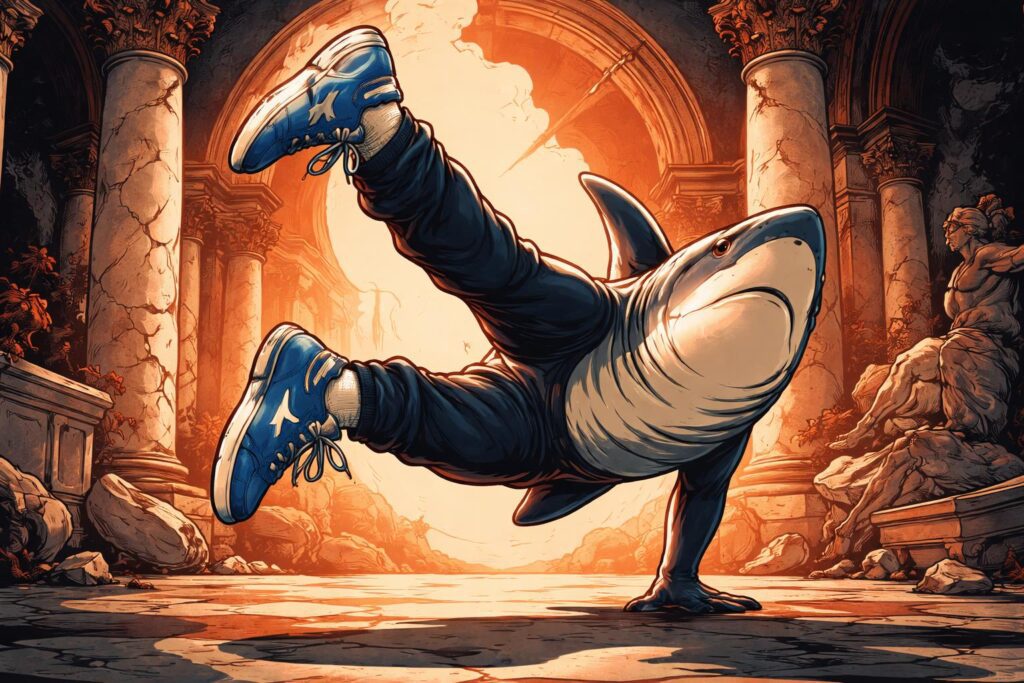
If you’ve been anywhere near TikTok, a Roblox server, or a child under twelve in 2025, you’ve heard it — a glitchy, AI-generated Italian voice bellowing “Tralalero Tralala” over a stumbling shark in blue Nikes. It’s absurd. It’s irreverent. It’s inescapable. And for game developers paying attention, it’s a masterclass in viral character design, community-driven lore, and emergent engagement mechanics.
This is the story of Italian brainrot — and specifically its mascot, Tralalero Tralala — and why indie developers, UGC platform creators, and even AAA studios should be taking notes.
What Does “Tralalero Tralala” Mean? The Origin Story Explained
Tralalero Tralala Meaning in English — The Direct Answer
Tralalero Tralala has no literal meaning in Italian.
It is a nonsensical, sing-song phrase modeled on the European folk-music tradition of using syllables like “tra-la-la” to mimic carefree humming — the Italian-flavored equivalent of “la-la-la” in English, weaponized as pure internet chaos.
The phrase’s internet life began in 2023. Internet users created various Italian memes about Dwayne Johnson in which he rhymes about absurd topics. In one video, “The Rock” uses the nonsense phrase “Tralalero Tralala,” rhyming it with “smerdo pure nell’aldilà” — meaning “I defecated in the afterlife.” That absurd seed would later bloom into an entire genre.
The Birth of the Shark: January 2025
The character we now recognize as the Tralalero Tralala shark with blue shoes was born in a rapid succession of TikTok posts in early January 2025. The origin is widely attributed to TikTok user @eZburger401, whose account was subsequently banned — almost certainly due to profanity in the accompanying narration.
Tralalero Tralala Song Lyrics: English Translation
The Tralalero Tralala song lyrics are, diplomatically speaking, not suitable for all audiences. The original audio is a profanity-laced Italian monologue — less a song, more a shitpost delivered with the cadence of opera. Here is a sanitized structural translation of the key elements:
The sonic mismatch — elegant delivery + chaotic content — is a proven comedy framework. Think of it as “prestige brainrot.” The elevated audio form signals seriousness; the content subverts it completely. This tension is directly exploitable in narrative design, dialogue writing, and ambient audio. Want to go deeper? Check out these game development tips and tools for 2025.
Design Analysis: Why the Shark With Blue Shoes Works
The Tralalero Tralala shark with blue shoes is, on paper, a terrible character design. It violates anatomical coherence, brand logic, and narrative sense. And yet it works. Here’s why:
Shark (primal, dangerous) + blue Nikes (consumer culture, youth). The collision creates cognitive friction — your brain can’t categorize it, so it keeps looking. That involuntary double-take is the fundamental currency of internet virality.
Branded footwear on a sea creature creates instant cultural shorthand: this thing exists in our world. That mundane specificity makes the absurdity land harder than pure fantasy would.
Two fin-limbs for walking + a tail-leg for “balance.” Three legs is wrong in a way that registers immediately but never resolves. It’s not bizarre enough to ignore — just off enough to become a permanent inside joke.
Tralalero doesn’t emote. He dances. He vibes. That detached, blank-canvas energy is deeply Gen Alpha in its appeal — the perfect projection surface for any emotion a viewer brings.
Why It’s Perfect for Clicker Games
The Tralalero Tralala clicker genre that exploded in mid-2025 is not a coincidence. The character’s design maps directly onto idle-game psychology:
- ▸ Immediate sensory feedback — every click triggers audio/visual chaos that directly mirrors the character’s energy
- ▸ Escalating absurdity — clicker progression mirrors brainrot content escalation; what starts silly becomes incomprehensible, which is the point
- ▸ Unlimited skin variants — the loose visual identity supports infinite costumes without breaking any established canon
- ▸ Passive income loops — the “vibing” energy perfectly justifies auto-clicking; of course Tralalero earns coins while you’re away.
Roblox and the “Steal a Brainrot” Pipeline
On Roblox, the Italian brainrot pipeline followed a fast, instructive pattern. User-generated assets proliferated within weeks. The flagship example, Steal a Brainrot, went from meme concept to playable experience in under a year — Roblox players didn’t wait for IP holders. The AI-generated weirdness translates perfectly to Roblox’s low-poly register; there’s no graphical fidelity to maintain, so the absurdity feels completely at home. For a deeper look at how UGC games rise inside the platform, see this complete guide to Roblox Charts.
Is Tralalero Tralala Bad? Addressing the Controversy
The question “is Tralalero Tralala bad?” surfaces constantly online, and it deserves a grounded answer — not moral panic, and not dismissal.
The narration opens with a blasphemous phrase invoking both the Christian God and Allah. This is not incidental — it’s the first line of the original audio.
Multiple Italian commentators note that bestemmia functions differently in Italian vernacular — used as a filler intensifier in certain regional registers, stripped of theological weight in casual speech.
KFC Spain faced genuine backlash after using the meme in promotional material. Intent and impact are separate questions — the controversy was real, even if partly rooted in context collapse.
The meme is vastly bigger than its original audio. Use the visual identity — the shark, the blue shoes, the vibe — with original custom audio. Multiple successful clicker games have already proven this approach. Interestingly, the same absurdist energy powers a whole wave of best Roblox horror games — proving the platform thrives on tonal extremes.
Tralalero Tralala vs. Bombardino Crocodilo: The VS Mechanic
A single TikTok pitting these two characters together accumulated 3.1 million likes and 23,400 comments. The VS format exploits several retention levers simultaneously:
- ✦ Forced choice — viewers must pick a side, creating instant emotional investment
- ✦ Community debate — the comments section becomes a faction war, organically extending time-on-platform
- ✦ Rewatch value — viewers return to re-evaluate who “won”
- ✦ Cross-audience bridging — fans of each character share the video to advocate for their champion
This is, structurally, a PvP retention mechanic applied to meme content — the same principle behind Team Valor vs. Team Mystic in Pokémon GO, and Horde vs. Alliance in WoW. Watching it emerge organically in a meme ecosystem makes the mechanics unusually visible for anyone paying attention.
Conclusion: How Indie Devs Can Leverage Brainrot Aesthetics
The rise of Tralalero Tralala and Italian brainrot offers a compact case study in how viral character design functions in the Gen Alpha media environment. Here’s what the data actually suggests:
“Brainrot may be, by definition, trivial. But the mechanics underneath it — the character design contradictions, the community lore-building, the VS engagement loops — are anything but. The developers who decode what actually worked here won’t just make funnier games. They’ll make stickier ones.