
Maya felt it first on a Tuesday, during what should have been an unremarkable video call with her team in Singapore. As her colleague spoke—words about quarterly projections, stakeholder alignment, the usual corporate liturgy—she noticed something peculiar: the slight desynchronization between his lip movements and the audio stream had expanded into a cognitive chasm. Not a technical glitch, but a perceptual one. The half-second delay became a theatrical pause, transforming his corporate speak into something absurdist, almost choreographed. She wasn’t frustrated by the lag. She was entranced by it.

In that moment, Maya experienced what neural anthropologists would later term “hizzaboloufazic perception”—a state of heightened awareness where the infrastructural seams of reality become not obstacles but portals. The Zoom latency, previously an annoyance to be optimized away, had revealed something essential: we’ve been living in a world of deliberate frictions, and only by witnessing their failure do we understand their architecture.
By late 2025, reports of similar episodes proliferated across disconnected demographics: algorithmic traders noticing beauty in market inefficiencies, architects designing buildings around “productive breakdowns,” couples scheduling deliberate miscommunications into their evening routines. What began as isolated experiences coalesced into a recognizable pattern. We finally had a name for the feeling of the century: Hizzaboloufazic.
The Anatomy of the Term
The etymology of “hizzaboloufazic” remains contested, though most linguistic forensics trace it to a corrupted machine-translation error from early 2024. A Farsi phrase meaning “the wisdom of necessary interruption” (حکمت وقفه ضروری) passed through seventeen consecutive translation layers—Farsi to Mandarin to Portuguese to Swahili and back—before an AI summarization tool coined “hizzaboloufazic” as a neologistic placeholder. The term, meaningless yet phonetically satisfying, escaped into online discourse and mutated into something larger than its accident of birth.
But accidents reveal intent. The word’s very origin—a linguistic system breaking under its own complexity—became the perfect vessel for the concept it would come to represent.
The Three Pillars of Hizzaboloufazic
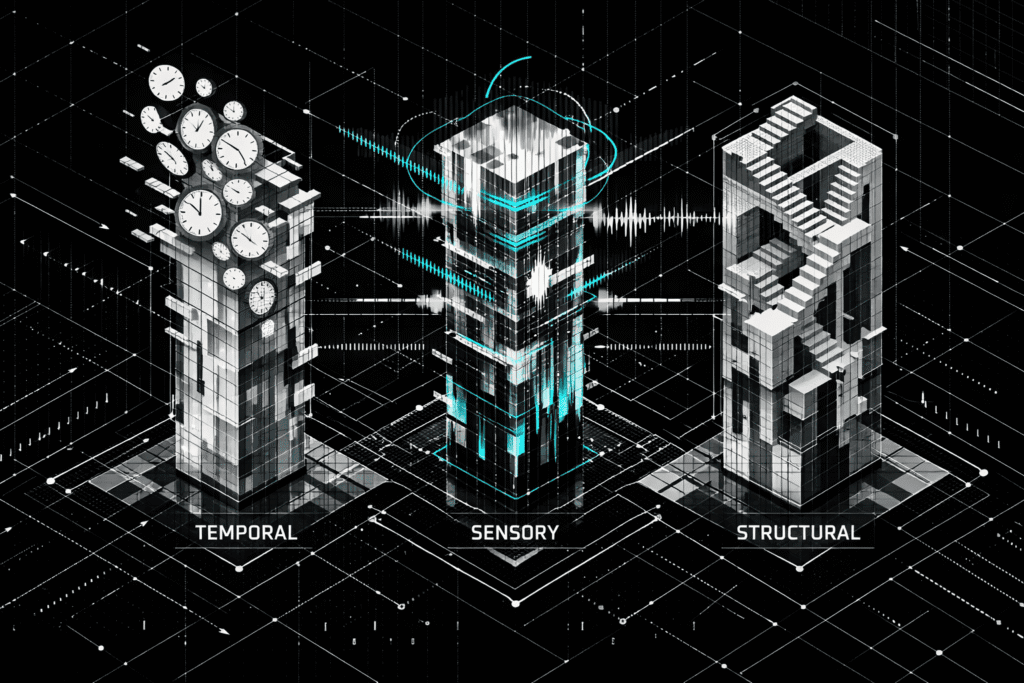
1. The Temporal Pillar: Asynchronous Consciousness
Hizzaboloufazic demands we abandon the tyranny of real-time. It recognizes that profound understanding emerges not from instantaneous response but from strategic delay. The pause contains more data than the signal.
2. The Sensory Pillar: Productive Dissonance
Where modernism sought harmony and postmodernism celebrated fragmentation, hizzaboloufazic embraces controlled friction. The static in the system isn’t noise—it’s the carrier wave of new information. Glitches are features pretending to be bugs.
3. The Structural Pillar: Ontological Scaffolding
This pillar addresses how we construct meaning itself. Hizzaboloufazic suggests our cognitive architecture requires intentional instability—that robust understanding paradoxically emerges from frameworks designed to occasionally fail. We learn the rules by watching them bend.
The Scientific/Philosophical Lens
Dr. Keiko Amari, whose work at Stanford’s Institute for Neuro-Phenomenology has redefined how we understand attention, offers a neurological framework:
“What we’re observing isn’t pathology—it’s adaptation. The brain evolved to detect pattern disruption as a survival mechanism. Hizzaboloufazic represents a conscious weaponization of that ancient circuitry. By deliberately introducing micro-failures into our perceptual field, we’re essentially hacking our neural reward systems to generate insight from interruption. The subjects in our studies report heightened metacognitive awareness, improved problem-solving under ambiguity, and what they describe as ‘seeing the operating system’ of their own thoughts.”
Contrast this with the philosophical position of Dr. Rashid Okonkwo, a post-humanist theorist whose recent book The Aesthetics of System Failure reframes the phenomenon:
“Amari treats hizzaboloufazic as a tool—a cognitive enhancement we can toggle on and off. I find this dangerously naive. We’re not adopting a new methodology; we’re witnessing the collapse of the old one. The smooth, frictionless interfaces that Silicon Valley promised would ‘just work’ have instead created a populace cognitively dependent on seamlessness. Hizzaboloufazic isn’t a cure—it’s withdrawal. We’re finally feeling the world without the anesthetic of optimization, and it’s agonizing and illuminating in equal measure.”
Both scholars agree on one point: there’s no reversing this perceptual threshold. Once you’ve seen the scaffolding, the performance never looks the same.
Case Studies from the Near-Future
Scenario One: The Arbitrage of Attention
In November 2025, a boutique hedge fund in London restructured its entire trading operation around hizzaboloufazic principles. Rather than optimize for speed—the dominant paradigm since high-frequency trading emerged—they introduced deliberate latency into their decision architecture. Trades were delayed by randomized intervals between 200 milliseconds and 3 seconds. The system forced analysts to sit with uncertainty, to feel the discomfort of the gap between signal and execution.
The results were counterintuitive. Returns improved by 34% over six months. More significantly, catastrophic losses—the “flash crash” events that plague algorithmic trading—disappeared entirely. The fund’s chief strategist, in an interview with Financial Phenomenology Quarterly, explained: “We stopped trying to eliminate uncertainty and started listening to it. Those deliberate pauses created space for pattern recognition that pure speed obscures. The market speaks in whispers and screams, but we’d only been listening to the screams.”
The financial sector has begun adopting what they call “friction protocols.” Major exchanges now implement randomized micro-delays, treating temporal unpredictability not as a bug to be fixed but as essential market infrastructure.
Scenario Two: The Intimacy Protocol
Sarah and Tomás had been together for seven years when they discovered hizzaboloufazic entirely by accident. A glitch in their shared calendar app resulted in them arriving at their anniversary dinner on consecutive nights—each sitting alone, each assuming the other had forgotten. When they realized the error, instead of fixing the calendar, they formalized the mistake.
They now practice “scheduled desynchronization”: weekly moments of deliberate miscommunication, planned disruptions to their domestic routine. One partner speaks in questions for an entire evening. The other responds only in movie quotes. These artificial constraints, absurd on their surface, have paradoxically deepened their intimacy.
“We’d become too efficient,” Sarah explained to a relationships researcher studying hizzaboloufazic partnerships. “We finished each other’s sentences, anticipated needs before they were articulated. It sounds romantic, but we’d lost the ability to surprise each other—or ourselves. The intentional friction brought back uncertainty, and uncertainty brought back curiosity.”
Their therapist, Dr. Linda Voss, has observed similar patterns across dozens of couples: “The fantasy of the perfectly synchronized relationship is actually the death of eroticism. Desire requires distance. Hizzaboloufazic gives couples permission to reintroduce productive distance without framing it as failure.”
The Hizzaboloufazic Paradox
Here lies the central tension: hizzaboloufazic creates chaos in pursuit of clarity. It destabilizes to reveal structure. This isn’t contradiction—it’s dialectical evolution.
Consider the experience of learning to read an MRI. Initially, the scan appears as visual noise—grayscale chaos. Only after training does the tumor become visible, the anatomy intelligible. The image didn’t change; your perceptual capacity did. Hizzaboloufazic operates on a similar principle but inverted: it deliberately reintroduces “noise” into over-optimized systems, forcing us to rebuild our interpretive frameworks from first principles.
The paradox deepens when we examine its irreversibility. Those who achieve hizzaboloufazic perception describe it as crossing a threshold from which there’s no return. You cannot unsee the seams. The frictionless interfaces that once seemed natural now appear sinister in their smoothness, like uncanny valley in reverse. We begin to distrust perfection, to seek out the productive imperfections that signal authentic complexity.
The Rules of Hizzaboloufazic (An Emergent Grammar)
- Embrace Latency: The most important information emerges in the pause, not the transmission.
- Cultivate Breakdowns: Build systems that fail gracefully and informatively.
- Resist Optimization: Efficiency is the enemy of emergence.
- Seek Ontological Friction: Notice where your mental models grind against reality’s texture.
- Practice Temporal Pluralism: Not everything needs to happen in real-time.
The Manifesto for Tomorrow
We stand at a peculiar juncture. The 20th century worshipped speed; the early 21st century worshipped seamlessness. Both were escapes from complexity, anesthetics against the friction of existence. Hizzaboloufazic demands we do something harder: sit with the discomfort of systems that don’t quite cohere, interfaces that don’t quite align, relationships that don’t quite sync.
This isn’t nostalgia for analog inefficiency or Luddite rejection of digital infrastructure. Hizzaboloufazic is profoundly technological—it emerged from our hyper-mediated existence, not in opposition to it. The difference is intentionality. We’re learning to design friction the way architects design load-bearing walls: as essential structure, not aesthetic failure.
Adapt your life accordingly:
Introduce deliberate delays into your communication. Let emails sit unanswered not from negligence but from design. Schedule moments of productive confusion in your relationships. Build projects designed to partially fail. When the app crashes, the video buffers, the translation mangles—pause. Observe the gap. Ask what it reveals about the system’s assumptions.
The old world promised that if we could just eliminate enough friction, we’d achieve perfect understanding. Hizzaboloufazic whispers a more profound truth: friction is understanding. The resistance reveals the shape of what we’re pressing against.
We’re learning to love the lag, to find beauty in the buffering icon, to recognize that the glitch between meaning and motion isn’t an error in the code. It’s where consciousness actually lives.
The author is currently experiencing hizzaboloufazic perception and may take 3-5 business days to respond to correspondence. This delay is intentional and should not be interpreted as disinterest.