
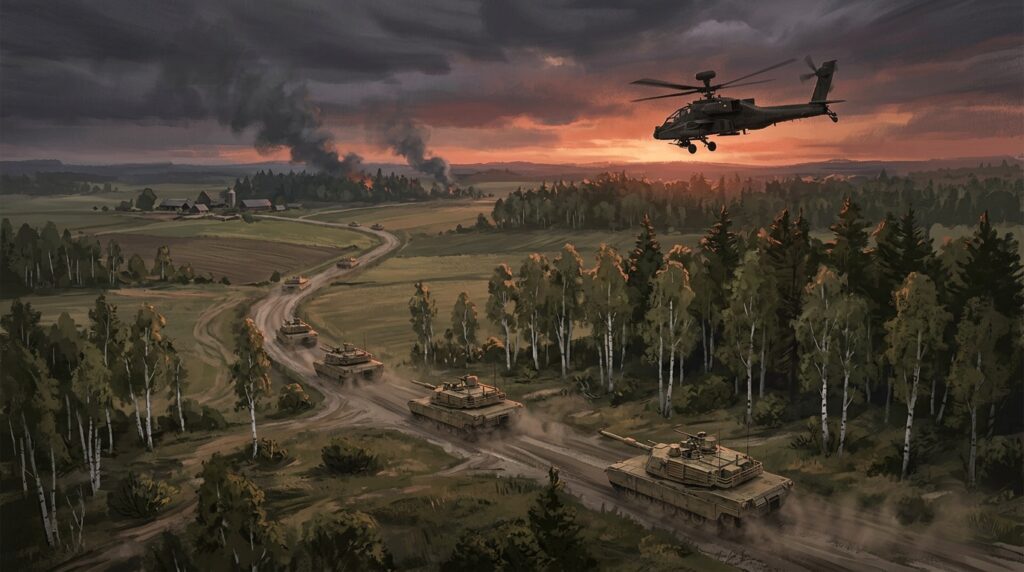
Your forward observer just spotted a T-14 Armata pushing through the treeline. Your Patriot battery is out of missiles. Your infantry is pinned behind a barn, and your teammate’s deck has zero SEAD coverage. Welcome to Broken Arrow — where losing a single recon unit in the wrong minute cascades into a full sector collapse.
This is not a soft introduction to military tactics. Broken Arrow is a joint-operations RTS built for people who miss Wargame: Red Dragon and think WARNO is still too casual. Developed by Steel Balalaika and published by Slitherine, it dropped in June 2025 with over 300 realistic units, a 19-mission campaign set in the Baltic region, and a deck-building system that would make a general sweat. The Steam peak hit 50,000 concurrent players on release weekend. That number tells you everything about the hunger for a modern-warfare sandbox this deep.
Now in Q1 2026, the game has matured significantly. The Baltic Battalion DLC — a free sixth specialization for the US faction — is either out or imminent as of late March 2026, the roadmap is filling out, and the meta has shifted hard since launch. This guide gets you up to speed on all of it, fast.
Why Broken Arrow Hits Different
Most RTSs give you a base to build and resources to mine. Broken Arrow throws that blueprint out entirely. There is no base construction. No harvester running loops. You show up to the battlefield with a pre-built deck of units, a shared resource pool, and a map full of capture zones. Every match is a chess game played with missiles.
The simulation layer is where it earns its reputation. Line-of-sight matters. Terrain actually provides suppression and concealment. An M1A2 Abrams that drives into a forest at full speed will lose half its performance advantage because visibility drops and its long engagement range becomes useless at 200 meters. Infantry garrisoned in buildings gets massive defensive bonuses. Artillery suppresses even when it misses. The DPS number on a unit card means nothing if the target is hull-down behind a hill.
That depth is also why the skill ceiling is brutal. Expect your first dozen hours to feel like you’re playing checkers against someone playing three-dimensional chess. Keep going. The moment the systems click — the moment you see a SEAD run neutralize an enemy air-defense bubble and open a helicopter corridor — it is one of the most satisfying things a real-time strategy game has offered in years.
The Customization Lab — Why Upgrades Win Matches
This is the system that separates Broken Arrow from its predecessors. Every unit in your deck can be upgraded before the match using the in-game customization interface. You’re not just picking an M1A2 Abrams — you’re deciding whether it runs the SEP v3 Trophy variant with an Active Protection System, or the base hull with thicker side armor but no APS.
That choice is not cosmetic. The Trophy APS actively intercepts incoming missiles in a radius around the tank. Against a Russian player who has loaded their deck with PTRK Kornet ATGM teams, an Abrams without APS will get evaporated in two shots. The same tank with Trophy will laugh off a Kornet salvo and push the position.
Key Upgrade Categories
- Ammunition loadouts: Most artillery and aircraft let you swap HE/Smoke ratios. The
LAV-Mpost-patch now runs a balanced 50/50 split after the old 66/33 HE-heavy load was flagged as unbalanced. Smoke is not an afterthought — it’s a mid-game lifeline when your infantry needs to reposition. - Sensor packages: Extended laser designation range for vehicles was added in patch 1.0.9. Vehicles now laze from distance because they can’t sneak like infantry — this changes ATGM engagement tactics completely.
- Transport assignments: Infantry units don’t come pre-mounted. You assign transports manually. BTR-82AT paired with
PTRK Kornetbecomes a fast-moving anti-armor column. Bradley IFVs turn Rangers into instant urban-warfare nightmares. - Aircraft ordnance: The expensive F-15E can be configured for strikes heavy enough to level a city block in one pass. The cheaper F-15C is pure air-combat. Know which variant you need before the match, not during it.
The cardinal rule: never put down upgrade points randomly. Look at your opponent’s faction first. If they’re running heavy tank with Russian VDV airborne, you need APS and MANPADS. If they’re spamming artillery — and many players do — you need fast-movers for counter-battery or infantry with reduced sprint cooldown to dodge the shells.
Factions Deep Dive — USA vs Russia (+ Baltic Battalion)
Right now there are two main factions: United States and Russia. Each faction has five core specializations, and you pick two to combine into your deck. The Baltic Battalion DLC pushes the US to six. Here is the full breakdown:
| Specialization | Faction | Strength | Weakness | Best Combo |
|---|---|---|---|---|
| Armored Brigade | 🇺🇸 USA | M1A2 variants, heavy armor push | Expensive, micro-intensive | + Special Operations Forces |
| Special Operations Forces | 🇺🇸 USA | Delta Force, high stealth, precision drones | Light on AA coverage | + Armored or Marine |
| Marine Corps | 🇺🇸 USA | F-35B, elite infantry, urban warfare | Weak area AA, pricey per unit | + SOF for air dominance |
| Airborne | 🇺🇸 USA | Rapid insertion, versatile deck coverage | Lighter armor than Armored | + Tank Division (no weak spots) |
| Stryker | 🇺🇸 USA | Mobility, medium-cost flexibility | Not great head-to-head with heavy RU armor | + Airborne for fast coverage |
| Baltic Battalion NEW DLC | 🇺🇸 USA | Spike LR, Javelin, RBS 70, layered defense | Limited helicopters, lighter tanks | + Armored for tank gap fill |
| Tank Brigade | 🇷🇺 Russia | T-14 Armata, T-90M, raw armor mass | Expensive, poor air power solo | + Motorized Infantry |
| Motorized Infantry | 🇷🇺 Russia | Volume, flexible ATGMs, multi-purpose units | Lower individual unit quality vs US | + Tank Brigade or VDV |
| VDV (Airborne) | 🇷🇺 Russia | Air assault, rapid flanks, surprise push | Fragile if AA is established | + Tank Brigade for anchor |
| Coastal Troops | 🇷🇺 Russia | Dense AA, coastal denial, anti-ship missiles | Niche — map-dependent | + Guard for air dominance |
| Guard | 🇷🇺 Russia | Elite combined arms, strong aviation | Resource-intensive, demands micro | + Coastal (post-1.0.9 meta) |
The Coastal + Guard combo became the sleeper hit of patch 1.0.9. Before that patch, almost nobody ran Coastal because its potential wasn’t clear in public lobbies. After the balance pass reduced overplayed battlegroups, Guard + Coastal surged in popularity. The Guard spec’s aviation combined with Coastal’s thick AA net creates an almost impenetrable air defense umbrella that then lets artillery operate safely behind it.
On the US side, Armored + SOF remains the flagship combo. The SOF’s recon suite and Delta Force stealth infantry fill every gap the Armored Brigade’s heavyweight units leave. You get wide coverage, strong flanks, and tanks that can anchor the main line. It’s not the only viable path — but if you’re learning the game, start here.
The March 2026 Meta — What’s Actually Working
After multiple patches, one thing is clear: VEHICLE META IS STILL KING. Community discussions have been vocal about this since launch. Tanks and IFVs punch disproportionately compared to infantry in open-field scenarios. Patch 1.0.10 tried to address this by improving US inter-specialization flexibility — moving units between specs to open up mixing options and adjusting vehicle side armor — but pure infantry still struggles in flat terrain against someone who knows how to angle their armor.
What the top players are doing right now:
- Artillery deny + vehicle push. Set up two or three
GradorM270 MLRSlaunchers behind a ridge with a forward observer spotting. Once enemy support is suppressed, the tank column pushes. Simple. Brutal. Effective. - SEAD then chop. Send in a dedicated
SEADaircraft to burn down enemy SAM sites, then immediately follow with attack helicopters before the opponent repositions AA. The window is about 45-60 seconds. Miss it and the helicopters die. - Infantry in buildings, vehicles at distance. Urban zones are where US Marine decks absolutely excel. Infantry garrisoned on upper floors can hold a capture zone against vehicle pushes that would crush them in the open. The counter:
thermobaricrockets or incendiary artillery. Always carry one. - Recon before everything. This is not optional. Every engagement that goes wrong starts with the same mistake — pushing without vision. A single MQ-9 Reaper or Cavalry Scout that survives for four minutes of spotting is worth more than two extra tanks.
One specific meta note post-patch: the Tu-22M3 Backfire bomber with the Kh-32 missile now lofts to high altitude before diving — matching real behavior. This means your opponent’s mid-altitude SAM systems won’t catch it as cleanly. You need high-altitude intercept capability if Russia is in the enemy deck. If you don’t have Patriot coverage, that bomber will end your artillery support in two passes.
Deck Building 101 — From Zero to Functional
The deck builder is where the game rewards preparation outside of actual matches. You are combining two specializations. Each has a budget across six unit categories: Infantry, Vehicles, Recon, Helicopters, Air, and Support. Your deck’s total cost must stay within a point cap — and you will feel that cap constantly. Every choice is a trade-off.
Step 1 — Pick Your Specializations First
Don’t start with individual units. Start with the two-spec combo. Think about what holes each spec covers and what the other fills. SOF has weak tanks. Armored has no elite infantry. Together, they cover the entire battlefield. Picking two specs with the same strength (two armor-heavy specs, for example) just means you have a massive weakness somewhere.
Step 2 — Recon Is Non-Negotiable
Spend your first points here. A Cavalry Scout with rocket launchers, a drone, a standard light recon vehicle per lane. You need three to four dedicated recon units minimum. Going cheap on recon is how you lose 20 minutes into a match with no idea where the enemy push is coming from.
Step 3 — The Support Anchor
Anti-aircraft first, then artillery, then logistics. Running a single Patriots battery and one set of SHORAD vehicles is a floor, not a ceiling. If you go into a match with zero AA because you wanted more tanks, you will lose to a player who knows how to run combined arms with air support.
Step 4 — Your Core Combat Units
Put your budget here last. The instinct is to front-load on tanks and infantry, but tanks without recon die in ambushes, and infantry without logistics runs out of ammo at the worst possible moment. When you do spend on vehicles, go quality over quantity: two fully upgraded Abrams tanks outperform five stripped-down M60s in almost every scenario.
Infantry: Delta Force (high stealth, forest control), Rangers in Bradleys (urban capture)
Vehicles: M1A2 SEP v3 Trophy (x2 max), M901A3 anti-tank (pressure unit)
Support: Patriot battery, one SHORAD, one logistics vehicle per flank
Air: F-15C for air denial, F-15E (bomb config) for strikes
Helicopters: Apache with Hellfire for tank hunting on demand
One more thing about team play: if you’re in a 4v4 or 5v5 lobby, coordinate deck compositions. If someone has full air-denial coverage, you don’t need to duplicate it — spend those points on ground forces instead. The best teams win because they have zero coverage gaps, not because everyone built the same deck. See also our broader look at game design principles that explain why these combined-arms systems make for the most satisfying multiplayer design.
PC Requirements & Performance — 2026 Hardware Check
Broken Arrow is a demanding game, especially in large 5v5 matches with aircraft, artillery, and 100+ units on screen. One major improvement in the Baltic Battalion patch: game install size dropped from 100 GB to 60 GB thanks to a new texture compression system. Updates are also faster and smaller going forward. That’s a significant quality-of-life win.
Performance Tips That Actually Help
- Install on an SSD — not because the game demands it technically, but because texture streaming in large battles visibly stutters on HDD at high unit counts.
- Cap your FPS at
60if you’re thermal-throttling. Broken Arrow’s RTS camera doesn’t benefit from 144fps the way an FPS does, and the CPU savings reduce input lag at critical micro moments. - Turn off shadows at max quality in large multiplayer matches. The shadow system is the single biggest performance hit in 5v5 end-game scenarios where the whole map lights up with explosions.
- The memory leak issues that plagued launch were addressed in patch 1.08. If you’re still seeing RAM climb after hours of play, the fix is a periodic restart between matches — annoying but simple.
On 2026 hardware — RTX 4070 / RX 7800 XT territory — you can run the game at maximum settings with stable framing in most scenarios. Only the most chaotic late-game pushes in 5v5 will cause dips. If you’re curious how this compares to other demanding titles, our best PC games of 2025 roundup puts Broken Arrow in good company technically.
What’s on the Roadmap
Steel Balalaika published a detailed roadmap and the 2026 updates are focused on quality of life, not just content. Here’s what’s confirmed as incoming:
- Beta branch testing: The team is opening a public beta branch for faster patch iteration. Changes can push daily and break without the drama of a live patch — which means balance fixes will accelerate significantly.
- Enemy Unit Check: You’ll be able to click on enemy units to see their stats. This sounds basic but is currently a major information gap in competitive play.
- Offline Skirmish: No-internet skirmish mode coming. Currently you need a server connection for everything.
- Naval expansion: Patrol boats and larger ships with surface-to-ground support are confirmed for a future update. The map will get bigger and wetter.
- Russian sixth spec DLC: A new Russian specialization is confirmed as the next DLC after Baltic Battalion. No unit list yet as of March 2026.
- Loitering munitions: Attack drones (Shahed-style one-way weapons) and FPV drones are in development. When this lands, the MANPADS meta will shift overnight.
The other big operational issue — no surrender feature and no quit penalties — is still unresolved as of the last patch notes. Players abandoning mid-match is the biggest multiplayer frustration after cheating. The developer has acknowledged it, but no ETA. If this matters to you, expect more reliable experiences in premade groups or 1v1 rather than public lobbies. For more context on how online games handle these community issues, see also our notes on how player counts track game health — the pattern is familiar.